
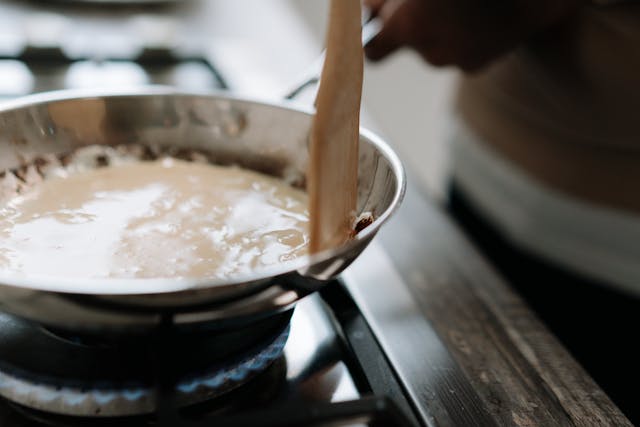
Why does starch thicken sauce? Starch thickens sauces because starch granules swell when they are heated in water. As they swell, they trap water and release long starch molecules that tangle together, turning a thin liquid into a thicker one.
Starch is a complex carbohydrate that is produced by green plants as their main way of storing energy. Plants usually store it in their roots, tubers, seeds, and grains. Starch is a natural polymer, which means it is made from many smaller molecules joined together in a long chain. Plastic is a human-made polymer, and starch is a natural one. A polymer is not stronger than an atom in a simple sense, but it has different properties because all of its smaller parts are linked together.
Starch is made from glucose molecules. There are two main kinds of starch molecule: amylose and amylopectin. Amylose is mostly a long, straight chain of glucose molecules. Amylopectin is also made from glucose, but it is branched, like a tree with many smaller branches coming off the main trunk. Different plants have different amounts of each, but many common starches are roughly 20% amylose and 80% amylopectin.
Plants produce glucose when they photosynthesize, but they don’t use all of that glucose straight away. They store what they don’t use as starch, and they can use it later when they don’t have enough sunlight, or when they are producing new leaves in the spring. Plants move sugar around in their sap, often as sucrose rather than glucose. This is the sugar-rich liquid that people tap from maple trees to make maple syrup. When plants make starch, they add glucose units one at a time to a growing chain.
We eat an enormous amount of natural starch. Rice, potatoes, wheat, corn, beans, pasta, bread, and many root vegetables are full of it. Some fruits and vegetables contain starch as well, although fruit usually contains more simple sugars than starch, especially when it is ripe. Some starch is broken down quickly by our bodies, but some passes farther through the digestive system. This is called resistant starch, and the microbes in our gut can feed on it.
Humans use an enormous amount of starch every year. It is taken out of plants by grinding them, then washing, sieving, and drying them. Corn is one of the most common sources because corn kernels contain a large amount of starch and corn can be grown cheaply in huge quantities. Wheat, potatoes, and tapioca are also important sources. A lot of corn is also turned into sweeteners, such as corn syrup, which is one reason corn appears in so many processed foods.
Cornstarch is made by soaking corn kernels so they become softer. The different parts of the kernel are then separated and ground. The ground material is washed so the starch can be pulled away from the fiber, protein, and oil. After that, machines separate and dry the starch until it becomes the fine white powder used in kitchens and factories. Starch is not only used in food. People have used it for glues, paper, cloth, and many other things for a very long time.
One of the most familiar uses of starch is thickening sauces. To thicken a sauce, the starch is usually mixed with a small amount of cold liquid first to make a slurry. The liquid does not make the starch dissolve. It just spreads the starch granules out evenly so they don’t clump together. If dry starch is poured straight into hot sauce, the outside of each little lump thickens almost instantly, trapping dry starch inside. That is why lumps form and why they are so difficult to remove.
When the starch slurry is added to the hot liquid, nothing much happens at first. The sauce may still look thin. The change begins when the starch granules get hot enough. The exact temperature depends on the kind of starch, but many starches start to thicken somewhere above 60℃, and they thicken more as they get closer to boiling. The granules absorb water and swell. As they swell, some amylose leaks out into the liquid. These long molecules begin to bump into each other and tangle together.
That tangle is what thickens the sauce. The swollen granules and loose starch molecules form a kind of soft mesh through the liquid. The water is still there, but it can no longer move around as freely as before. The sauce becomes thicker, smoother, and glossier. This process is called gelatinization.
However, starch-thickened sauces are not indestructible. If they are boiled too long, stirred too hard, or exposed to too much acid, the starch network can start to break down. When that happens, the sauce can become thin again. That is why starch-thickened sauces usually work best when they are heated until thick, then cooked gently.
Why does starch thicken sauce? It is because tiny starch granules change shape when they are heated in water. They swell, leak long molecules, and build a loose net that holds the water in place. A thin liquid becomes a sauce because the water is trapped inside a starch web. And this is what I learned today.
Sources
https://www.thespruceeats.com/thicken-a-sauce-with-cornstarch-996071
https://en.wikipedia.org/wiki/Corn_starch
https://en.wikipedia.org/wiki/Starch
https://www.bbc.co.uk/bitesize/articles/zxwwsrd#zbxwwnb
https://www.vedantu.com/biology/difference-between-amylose-and-amylopectin
Photo by cottonbro studio: https://www.pexels.com/photo/close-up-of-cooking-7696492/