
What was the first arms race? To be honest, nobody knows, and this is probably not something we can ever know. Arms races are probably older than written history. Most likely, human civilization has been a trail of one arms race after another.
An arms race happens when two or more groups compete to make better weapons, better defenses, or larger military forces because they are afraid of falling behind each other. That means the first arms races were probably between neighboring settlements, long before anyone wrote anything down. Once people moved from hunter-gatherer lives to agriculture and permanent villages, they had things to protect: food stores, animals, water, homes, land, and people. If one group decided it was easier to take what another group had than to make or grow its own, the other group needed to defend itself. The first arms race was probably not between countries. It was probably between weapons and fortifications.
Early weapons would have been simple things: sticks, stones, clubs, bows, arrows, and spears. Flint arrowheads from tens of thousands of years ago have been found. They were probably used mostly for hunting animals, but anything that can kill an animal can also be used against people. To deal with that threat, early settlements built barriers. A fence of logs might have been enough for a small village, but as settlements grew, their defenses grew as well.
The walls of Jericho, built around 8000 BC, are one of the earliest famous examples of large defensive walls. They surrounded a Neolithic settlement and included stone walls and a tower. They are not proof of the very first arms race, but they show that very early communities were already putting enormous effort into protection. Once one settlement had a wall, another group needed a way to get over it, through it, or around it. That is the basic pattern of an arms race. Better walls led to better ways of attacking walls. Those led to higher, thicker, and stronger walls. Later, siege engines and catapults were made to defeat fortifications. That led to stronger castles. Then cannons were invented, and they changed the balance again. Eventually, airplanes made walls and castles almost useless as serious military defenses. That particular arms race was basically won by the attackers.
There was also an arms race between weapons and armor. People did not start with swords. Before metal weapons, they had stone knives, flint blades, spears, arrows, and clubs. Flint can be very sharp, but it is also brittle. A long sword made of flint would break too easily. Metal changed that. Some of the earliest known swords come from Arslantepe in modern Turkey, where archaeologists have found early metal weapons that suggest organized combat had become connected with power and status.
Once metal weapons appeared, armor had to improve as well. Early armor could be made from leather, cloth, wood, or layers of material that were good enough to stop some blows. Then bronze armor appeared, and later iron and steel armor. However, this was not a simple story of one material always being better than the last. Early iron was not automatically superior to bronze. One of iron’s great advantages was that iron ore was easier to find than the tin needed to make bronze. As ironworking improved, and especially as steel became more common, weapons became stronger and armor had to become heavier and better made.
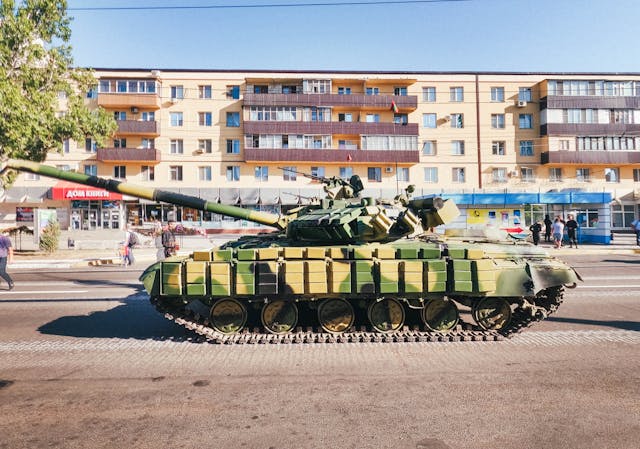
This pattern continued for thousands of years. A better sword led to better armor. A better bow led to stronger shields and helmets. A stronger castle led to better siege weapons. Gunpowder led to guns and cannons, which made thick armor and high stone walls less useful. Then tanks were invented to protect soldiers from machine guns and artillery. Then anti-tank guns, mines, and missiles were invented to destroy tanks. Then tank armor became thicker and more advanced. Then weapons were designed to defeat that armor. And so on and so on.
The first “modern” arms race is often said to be the naval race between Britain and Germany before World War 1. It was not really the first arms race, but it was one of the clearest industrial arms races. Britain had the largest navy in the world, and naval power had helped Britain build and maintain its empire. Germany had unified in 1871 and, by the end of the 19th century, wanted to become a major world power as well. Germany’s Navy Bills of 1898 and 1900 began a massive naval expansion, and Britain saw this as a challenge.
The race became even more intense after Britain launched HMS Dreadnought in 1906. This ship was so powerful and so modern that it made many older battleships seem outdated almost overnight. Britain and Germany then competed to build more and better modern battleships. The race did not directly cause World War 1 by itself, but it increased suspicion and tension between the two countries. It also showed what a modern arms race looked like: industry, technology, money, fear, pride, and politics all pushing each other forward.
Then, at the end of World War 2, the USA used nuclear bombs, and a new arms race began. None of the previous weapons could compete with a nuclear bomb, so the new race was to build nuclear bombs, then bigger bombs, then more bombs, and then missiles that could deliver them across the world. Eventually, the USA and the Soviet Union reached the terrifying logic of mutually assured destruction. If one side launched its nuclear weapons, the other side could launch its own in return, and both sides would be destroyed. At that point, the purpose of the weapons was not really to use them. It was to make sure the other side was too afraid to use theirs.
Today, one of the newest arms races is artificial intelligence. It is not only a race between armies. It is also a race between companies and countries to build more powerful systems, control more advanced chips, develop better drones and autonomous weapons, and use AI before their rivals do. Military researchers are already studying autonomous weapon systems and AI-assisted decision-making in targeting, which shows that AI is becoming part of the future of warfare.
Of course, AI is only a weapon, but once a technology can give one side an advantage, it is very hard to stop it from becoming part of an arms race. Each side worries that if it slows down, the other side will pull ahead. That is the same pattern we saw with walls and siege engines, armor and swords, battleships and battleships, nuclear bombs and nuclear bombs.
So, what was the first arms race? We will never know. It probably happened before writing, before countries, and maybe even before cities. But the basic idea has never gone away. Someone builds a better weapon. Someone else builds a better defense. Then the first person builds something stronger. The tools change, but the fear stays the same. Maybe one day we will leave arms races behind and simply live in peace. Maybe. And this is what I learned today.
Sources
https://en.wikipedia.org/wiki/Arms_race
https://warhistory.org/article/early-fortifications
https://en.wikipedia.org/wiki/Bronze_Age_sword
https://en.wikipedia.org/wiki/Bronze_Age
https://www.salimbeti.com/micenei/armour1.htm
Photo by Anna Dub: https://www.pexels.com/photo/military-tank-on-a-road-5275919/