
How do fish farms work? Fish farms work by raising fish from eggs to full sized fish in a carefully controlled environment.
There are different ways to farm fish, and they all have their benefits and problems, but they are all trying to overcome a situation that we have created ourselves. The situation is that we have overfished the seas and there are not enough fish left. If we continue to fish industrially in the way that we have been, many fish stocks could collapse. Farming fish can help with this problem because fish can be bred specifically for the market, leaving fish in the oceans some breathing room so their stocks can be replenished. It is not necessarily kind to the fish being farmed, and some intensive fish farms have been compared to factory farming, but it is one possible solution.
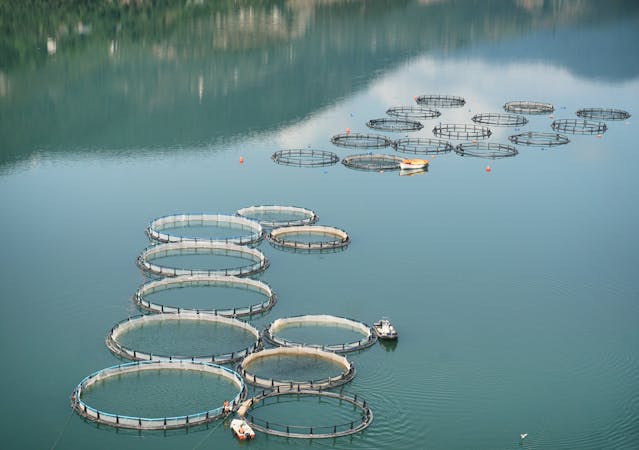
Two common ways of farming fish are in a fish pen or in a cage in the open sea or a lake. In both cases, fish eggs are taken out of female fish and raised in hatchery tanks until they have reached a certain size before they are released into the pens or the cages. Once there, the fish are given food designed to make them grow as quickly as possible, and then they are harvested. Fish pens are enclosed ponds that are cut off from a natural water source. Fish need oxygen, obviously, so fish pens need a large supply of water to replace the oxygen in the pen. Fish cages are large and very deep cages that float in the sea. They are open at the top and descend to different depths depending on the type of fish being raised. The fish have a lot more space to swim around in and the water from the ocean flows through the cage, which means the farm doesn’t need to pump in fresh water. Although, often, so many fish are farmed in the same cage that they don’t really have space to swim.
Fish farms have been around for at least three thousand years and possibly more. People realized that it was easier to raise some fish in captivity than it was to go out and catch them. Archaeological evidence has shown that both the Egyptians and the Romans employed fish farms. However, they were not the most common way of catching fish because they have a lot of problems and they were expensive. It was still far easier for people to make a living as fishermen. That changed once industrial fishing became a thing in the late 19th century when steam powered fishing trawlers were invented. Ships could travel further and catch far more fish than sailing ships ever could. That worsened when modern diesel trawlers were invented and then factory ships were invented in the 1950s and we rapidly overfished the oceans. A factory ship can stay out for long periods of time and process and freeze all the fish it catches.
Fish, shellfish, and crustacean farming has gradually increased year by year. In 2022, for the first time, farmed aquatic animals made up 51% of global aquatic animal production.
Fish farms have obvious advantages. Fish can be raised almost anywhere on the planet, and they are very easy to catch. Fish can be raised in areas where they wouldn’t naturally be found, which means they don’t have to be shipped internationally, which is better for the environment. We can raise as many fish as we need without having to overfish the oceans.
There are also a lot of problems, though, that are proving very difficult to solve. The first is disease. When fish are raised naturally in the ocean, they are spread out so diseases don’t easily jump from fish to fish. In a fish pen or a cage, they are confined and diseases can become a real problem. Pests like sea lice also multiply very easily in the confined conditions. In a sea cage, these can spread to local fish as well. Pollution is a problem as well. In some fish farms, antibiotics may be used to treat or prevent disease, and in some places, they have also been used to promote growth. Pesticides are also heavily used to keep the bugs and pests away. In a pen, the water is constantly changed, but not always fast enough and pollution from the fish can build up. The water from the pen is often just pumped into a river without being treated and that can spread the pollution. In fish cages, the water changes, but the pollution from the fish gets washed into the ocean and can have an effect on the local ecosystems. Escapes are also a problem. Millions of fish escape from fish cages every year. These fish are not always native to the local area and they can become an invasive species, outcompeting native fish. Farmed fish are also expensive because they have to be fed special food and the infrastructure is very expensive to maintain. There are many other problems with fish farms as well, but we cannot continue to overfish the oceans. I wonder what the solution is. And this is what I learned today.
Sources
https://en.wikipedia.org/wiki/Fish_farming
https://www.nationalgeographic.com/foodfeatures/aquaculture
https://en.wikipedia.org/wiki/History_of_fishing
Photo by Ali Düzdemir: https://www.pexels.com/photo/motorboats-and-boat-near-fishing-nets-on-lake-18640095/