
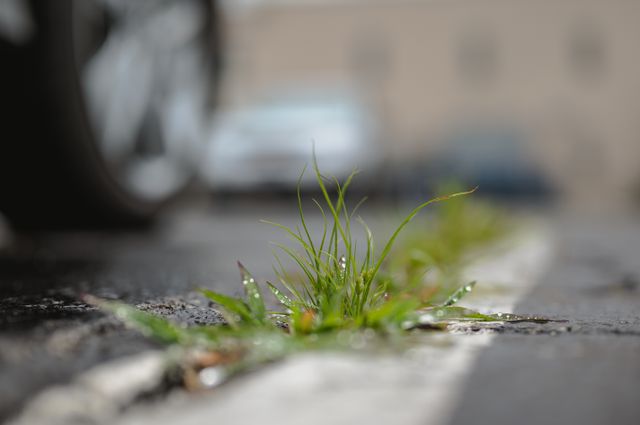
How does grass break concrete? Grass breaks concrete by widening existing cracks until the concrete falls apart.
Grass can’t actually break solid concrete, but it can exploit cracks that are already there. This is due to a property of concrete. Concrete has incredible compressive strength, which means it can support an enormous amount of force from above. This is the main reason why we use it in buildings. It can easily support the weight of the building on top of it. However, concrete has much lower tensile strength, which means it is far easier to crack by pulling or bending. Concrete’s high compressive strength is due to the materials it is made of. The ingredients in concrete are sand, gravel, and cement. All of these materials are very good at resisting being squashed together. When there is a lot of force on top of the concrete, the sand and gravel are forced together, but they are held in place by the frame of hardened cement paste. Obviously, it can be crushed, but it takes a lot of force. On the other hand, as concrete cures and dries, chemical reactions and shrinkage can leave microscopic cracks. When concrete is pulled apart, the stresses collect around the cracks, elongating them until the concrete breaks apart. Concrete is only about 10% as strong when being pulled as when it is being compressed. To overcome this, if the concrete needs to be strong laterally as well, it is reinforced with steel. Steel is very strong when being pulled and helps the concrete resist the force.
If you have seen an old concrete road that is no longer in use, or a concrete building that no one lives in, you’ll notice grass and other greenery growing out of the cracks. It will start with only one or two shoots, but, over time, they will increase. And this is how all of our buildings and roads will be broken down to rubble if humankind suddenly disappears. But how does it happen?
Grass grows from seeds. All types of grass produce flowers and then seeds. These seeds are often very light and they can be carried by the wind. They are aiming for somewhere fertile they can develop in, but the wind can blow them anywhere, including across roads and into cities. The seeds are very small and they easily fall into the tiny cracks in concrete. These cracks might have naturally formed due to stresses, or they might have formed as rainwater gets into microscopic cracks and freezes, expanding and widening the crack.
Once they have settled, as long as there is moisture, the seeds start to germinate. The husk splits open and the plant begins to shoot upwards and the roots begin to shoot down. Evolution has given plants roots that are able to seek out moisture. When they encounter it, the cells on the opposite side of the root with the water rapidly expand, pushing the root in the direction of the water. The roots grow into the crack, following moisture and any soil or organic matter that has collected there. If the crack reaches deeper soil, the roots can keep growing downward.
You might think that the tiny roots of grass plants are not very strong, but they can actually exert a lot of force. As the roots grow, the cells divide and expand as they fill with water. This water pressure puts out a lot of force which can slightly enlarge the crack in the concrete. One grass plant isn’t enough to destroy a block of concrete, but as more and more seeds start to germinate in the crack, each one of them widens the crack slightly until the concrete breaks apart.
Grass is one of the plants that we commonly see growing out of cracks in concrete, asphalt, and other surfaces, but that is because grass is a very common plant. There are other plants that can grow in through concrete and some of them can cause a lot more damage. Grass roots can produce enough force to slightly widen a concrete crack, but large trees can produce far more force than that. You have probably seen road surfaces that are uneven or cracked because of the tree roots that are growing under them. Tree roots are also much thicker and grow much further, so they can cause a lot more damage.
If the concrete is still being used, then it is an ongoing battle between the plants that grow in the cracks and the engineers that are looking after the building. However, if a building is no longer being used, grass and other plants can help start the slow process that eventually reduces it to rubble. And this is what I learned today.
Sources
https://cnysealing.com/blog/how-exactly-do-plants-break-through-concrete
Photo by Chris F: https://www.pexels.com/photo/grass-in-a-crack-in-the-asphalt-8419086/