
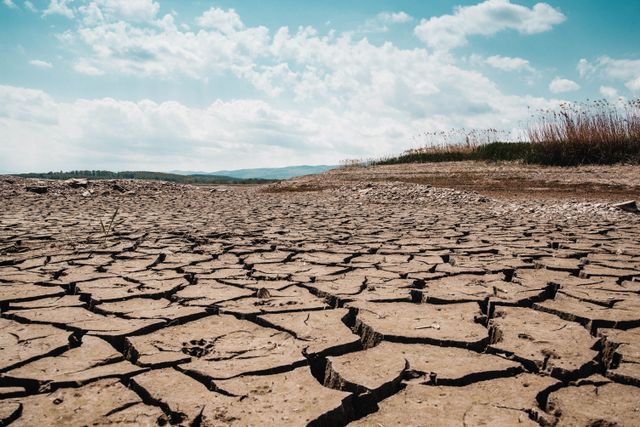
What causes a drought? At its simplest, a drought happens when an area has less water than it normally needs, often because of a lack of precipitation. Some droughts are meteorological, meaning there is not enough rain. Some are agricultural, meaning the soil is too dry for crops. Some are hydrological, meaning rivers, lakes, reservoirs, or groundwater are too low. There are many causes. Some of those are mountain ranges, shifts in ocean temperature, high-pressure weather systems, high temperatures, disruption to the water cycle, over extraction of water, building dams, degrading soil, and general climate change.
A drought can be caused by a mountain range, but this is a mostly permanent condition and not seasonal. A lot of deserts form in the lee of mountain ranges because wet air rises up the far side of the mountains and drops all its moisture before it clears the mountain range. When it comes down the other side, it is dry and there is no rain to drop on the desert. This situation will only change when the mountains go.
There are many other causes that come and go. One of those is shifts in the ocean temperature. A lot of our climate is driven by ocean currents that cycle water from warm areas to cold areas. Warm water moves across the ocean and loses its heat to the air, becoming denser and sinking. This repeats and is the cause of the ocean currents that carry warm weather to certain places. If the temperature of the ocean changes, it can upset these currents and warm air can be carried to places that are not used to it. This can cause strong wind and it can bring droughts and heavy rain to places that are not used to it. Droughts in Australia are often linked to El Niño, when changes in Pacific Ocean temperatures and winds shift rainfall away from Australia.
High pressure weather systems can develop in areas as well. Rainfall is usually brought by low pressure systems and a high pressure system can block the low pressure system from coming in. Pressure systems come and go, but sometimes a high pressure system can get trapped, leading to a drought. High pressure systems can also cause hot weather, which exacerbates the drought. Hot weather increases the rate of evaporation from the soil and bodies of water, worsening the drought situation.
A lot of the causes of drought are human created as well. Deforestation can severely upset the water cycle, leading to droughts. If there are a lot of trees or vegetation, rain falls on them, then evaporates back up into the sky. If the ground is bare, there are fewer roots to hold water and fewer leaves to return water vapor to the air. More rain can run off into rivers instead of staying in the soil and cycling back into the atmosphere. This reduces the amount of rainfall. Farming practices can also degrade the soil so that it becomes much harder. This means the water runs away into rivers and is gone.
Overuse of water is a huge problem. With almost 8.5 billion people on the planet, we need water for drinking, farming, and a huge number of other reasons. All of this water use can reduce local rivers, lakes, reservoirs, and groundwater faster than they can be replenished. and potentially leading to droughts. The droughts then cause a cycle because if there isn’t enough rainfall, there isn’t enough drinking water, and it needs to be piped in from other areas. That can lead to water shortages in those areas as well. We also dam rivers to make reservoirs or hydroelectric power. This can reduce the natural flow of water downstream and create drought-like water shortages far beyond the dam.
Human-caused climate change is making droughts more likely, longer, or more severe in many parts of the world. One of the factors of climate change is that the climate becomes less balanced, with some areas getting far more rain than they used to and some areas getting far less.
Droughts can cause a huge amount of problems. Droughts directly lead to famines because if there is not enough rainfall, crops and animals can’t be raised. Droughts also cause the spread of diseases because a lot of people in the world don’t have access to clean drinking water and when there is a drought, they often have to make do with dirty and contaminated water. This can cause outbreaks of cholera and other diseases. Droughts also cause displacement of people. People cannot live in areas without water, so they have to move. The World Health Organization estimates that 700 million people are at risk of being displaced due to drought by 2030. Climate change is going to worsen this situation and potentially make some parts of the world uninhabitable. And this is what I learned today.
Sources
https://gpm.nasa.gov/resources/faq/what-drought-and-what-causes-it
https://www.internetgeography.net/geotopics/what-are-the-causes-of-drought
https://education.nationalgeographic.org/resource/understanding-droughts
https://www.rescue.org/eu/article/what-is-drought
Photo by Dominika P: https://www.pexels.com/photo/heat-27286879/