
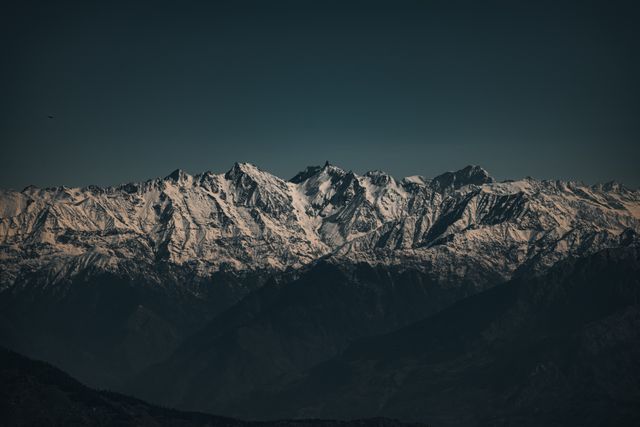
Why do mountains form in chains? Mountains form in chains because they are produced at the point where two tectonic plates meet, but there are different ways that tectonic plates can make mountains. Mountain chains are very long, often thousands of kilometers long, because the major tectonic plates are much larger than we probably imagine.
There are 16 major tectonic plates. There are hundreds of minor plates and microplates as well, but we are going to concentrate on the big ones today. The plates vary but they tend to be 100 km thick or more. They also vary in composition depending on where they were made. Tectonic plates that were produced under the ocean are usually made of dense rocks that are rich in iron and magnesium. They are very dense and a little thinner than continental plates. They are younger as well and are often recycled, usually being younger than 200 million years old. Continental plates form on land and contain silicon and aluminium-rich rocks. They are less dense, often thicker than 100 km, and they can be billions of years old.
Mountains form when tectonic plates interact with one another. Mountains may seem eternal to us, but they come and go in the blink of a geologic eye. Mountains are always formed by tectonic plates, but there are three ways that can happen. Mountains can come from two plates smashing together, from one plate pushing another down, and from two plates moving apart from each other. Let’s look at each of these in turn.
The two plates smashing together produces long and very high mountain chains. They are called fold mountains or collision mountains. The Himalayas are a good example of this. They stretch for about 2,400 km and they have an average height of about 6,000 m. They were formed when two continental tectonic plates ran into each other. The Indian plate moved slowly north at a speed of 5 cm per year until it crashed into the Eurasian plate. The immense pressure forced the rock layers to crumple and fold upwards, creating the mountain range. This happens when two continental plates crash into each other. The mountain chain formed usually stretches the length of the impact zone because the plates are crumpling up in every place they are impacting.
The second way mountains form is when an oceanic plate hits a continental plate. Oceanic plates are much more dense than continental plates. When the two plates collide, the more dense oceanic plate is pushed down underneath the less dense continental plate. The oceanic plate is forced down at a rapidly increasing angle until it goes deep into the earth and is recycled. At the point it enters the earth, there is a trench. The continental plate doesn’t escape undamaged and is bent up, forming mountains. These mountains then increase in size because magma is pushed to the surface by the sinking oceanic plate. The Andes are a good example of this. This is why many volcanoes occur near continental coasts, where oceanic plates sink beneath continental plates, pushing up the magma.
The third way mountains form is through a process called crustal faulting. Tectonic plates don’t always smash into each other or ride over each other. Sometimes they move apart from each other, stretching the Earth’s crust. When this happens, the crust can crack into enormous blocks along faults. Some of these blocks drop down while others are pushed up, forming tall, steep-sided mountain ranges known as fault-block mountains. The Sierra Nevada in California is a good example of this. Mountains can also form when tectonic plates slide past each other. As the plates grind against each other, the crust can crack and huge blocks of rock can be pushed upwards or tilted, creating mountain ranges along the fault.
All of these processes take an incredibly long time. The Himalayas formed over a period of roughly 50 million years and they still haven’t finished. The Indian plate is still pushing north into the Eurasian plate at a speed of about 5 cm a year. The Himalayas are being pushed up by a few millimeters every year. The mountains could technically keep growing for as long as the plates are pushing against each other, but they will always be beaten by gravity. As mountains get taller, they become too heavy and the great pressure at their base forces the rock to spread out and melt, returning to the earth. Geologists estimate that mountains on Earth cannot grow much taller than about 10,000 meters because gravity eventually causes them to collapse under their own weight. And this is what I learned today.
Sources
https://en.wikipedia.org/wiki/Mountain_chain
https://www.britannica.com/science/How-Are-Mountains-Formed
https://en.wikipedia.org/wiki/Himalayas
Photo by urtimud.89: https://www.pexels.com/photo/stunning-view-of-the-himalayan-mountain-range-32261668/