
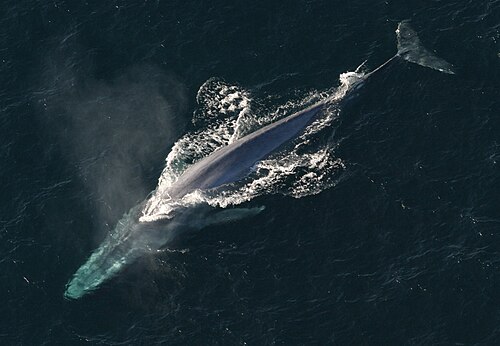
Why are blue whales so big? Blue whales are so big because water can support their weight, it helps them stay warm in cold water, it helps them swim faster, they can carry more energy, and it makes feeding more efficient.
Evolution tends to favor the size that gives an animal the greatest chance of surviving and reproducing in its environment. Size always comes with advantages and disadvantages, and the size most animals are is a balance between those two factors. Bigger animals are safer, can reach higher trees, are faster, retain heat better, and have many other advantages. On the other hand, they need more food, they can’t hide as easily, they take longer to grow to adult size, they cannot reproduce so rapidly, and they have other disadvantages. Over the hundreds of thousands or millions of years that an animal has existed, evolution has honed in on the best size. Animals that are too big find it hard to compete, as do animals that are too small. If the environment changes, their optimal size will change, but if everything stays the same, it is reasonable to assume that the size an animal has become is the best for its environment. Which goes for whales.
The first reason blue whales can grow so large is that water can support them. On land, gravity would make it almost impossible for them to grow so large. There were dinosaurs that were the size of whales or bigger, but they had adaptations such as hollow bones to cope. If whales were on land, it is reasonable to assume that they would not have grown so large. Whales evolved from land mammals; they are in the same family as the hippo, and none of their land-dwelling relatives became anywhere near as large. When an object is in water, there are two forces acting upon it. Gravity pulling it down, and the force of the fluid pushing up. If an object displaces a weight of water equal to its own weight, it floats. This means that blue whales are completely supported by the water and don’t need to support their own weight, as they would have to on land. They can also adjust the amount of air they hold to keep their buoyancy at or just below zero so that can float or dive.
The size of a blue whale also helps it to stay warm in the cold oceans it lives in. There are two reasons for this. Firstly, being large means they can carry more fat, which acts as an insulator. The second reason is because of the volume-to-surface area ratio. As volume gets larger, the ratio to surface area falls. Animals lose heat through their surface area, so if they have a greater volume than surface area ratio, they retain more heat than they lose. This keeps blue whales warm in the sea.
Their shape and mass help them to swim faster and further. They carry a lot of mass, which means it requires energy to start moving, but once they are moving, they have a lot more momentum and can keep moving quickly. Drag doesn’t increase as quickly as body volume, so they can move with less energy. It means they can’t stop or turn quickly, but they are efficient. This is the same for an oil tanker. They can also carry a huge amount of fat, which is an energy store. While they are moving, they might not be able to eat, and they will need energy supplies.
The last reason is because of the way they hunt. Blue whales survive on krill. Krill are tiny crustaceans, about 1 cm long. They grow and live in enormous shoals of hundreds of millions of them. Blue whales need to eat about 16 tons, 40 million individual krill, about 500,000 calories a day. Blue whales swim into a shoal of krill with their mouths open and take in 100,000 liters of water along with several million krill. They do this a few times to get as much energy as they can. This is called lunge feeding, and researchers have shown that below a certain size this strategy isn’t very efficient, but above a certain size it becomes more and more efficient. The bigger a blue whale gets, the more food it can collect in a single gulp relative to the energy it spends getting there.
Their size is connected to feeding because the ocean is not filled with krill, and they accumulate in certain places. When a blue whale finds a krill shoal, it can take in tons, but the sources of krill might be far apart. They need to be big to carry enough energy to survive until they find krill again. It is one of the tradeoffs. They need to be big to survive until they find krill, but they need to be able to find huge quantities of krill in order to be big.
Sources
https://news.stanford.edu/stories/2023/03/whales-need-big
https://www.scientificamerican.com/article/why-are-blue-whales-so-gigantic
https://en.wikipedia.org/wiki/Buoyancy
https://en.wikipedia.org/wiki/Krill
By NOAA Photo Library – anim1754, Public Domain, https://commons.wikimedia.org/w/index.php?curid=17942391