
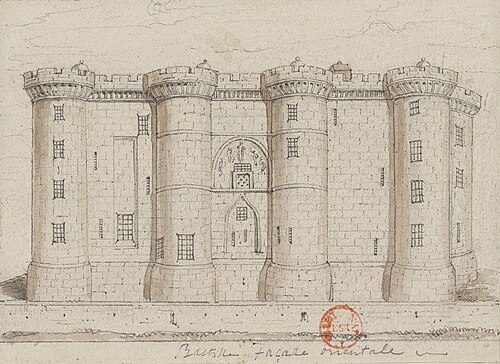
Why was the Bastille so important? The Bastille was important because it represented the absolute power and tyranny of the French monarchy.
The Bastille started off life as a fortress completed in the 1380s. In the mid 14th century, the Hundred Years’ War was happening between England and France. England had invaded into France and Paris was at risk of being taken. The city had outgrown its original walls and fortifications so it was decided to extend them. The Louvre had been the main royal castle but the city had expanded far beyond it. The king of France, John II had been captured and imprisoned in England. The Provost of Paris decided to extend the fortifications. In 1357 he expanded the city walls and protected them with two tall stone towers with a gateway. This kind of fortified gateway was known as a bastille. In 1369, the new king Charles V decided to strengthen the city even more and he and then his son Charles VI added to the walls and the original bastille. They added four more towers to it and the building became known as the Bastille.
The Bastille was a useful fortress and was manned through the beginning of the 15th century. The future king Charles VII took refuge in it in 1418 and it was used as a fortress, a royal palace, and it gradually became a state prison. That wasn’t unusual because the king was there and it had heavily fortified dungeons. It made sense to keep state prisoners near the king. However, in 1420, Paris fell to the English and remained in their control until 1436. Thomas Beaufort, Duke of Exeter became the captain of the Bastille and the English used it more extensively as a prison. The Bastille was recaptured by the French and gradually shifted from being a palace and a fortress to being exclusively a prison. By the reign of Louis XI, 1461 to 1483, it was only used to hold state prisoners.
Over the next 200 years, the Bastille was fortified for defense in war, but was also used to hold more and more prisoners. Cardinal Richelieu is the man most responsible for turning the Bastille from the king’s personal prison into a formal state prison. Louis XIV, 1643 to 1715, drastically increased the number of prisoners imprisoned in the Bastille. 2,320 people were sent there during his reign. France was not the only country to have a state prison, but there were several problems with the Bastille that would come to a head later on. The prison was generally for middle or upper class people and many of them were in the Bastille simply for doing something to irritate the king. Many were imprisoned indefinitely under royal orders without ever receiving a trial, and often the names of people imprisoned were kept secret.
Throughout the second half of the 18th century, the Bastille’s use as a prison continued, but the length of time prisoners were detained there declined. Prisoners were also kept in relative comfort. However, there was a lot of criticism of the place fueled by the writings of previous prisoners and political activists. Historians think that the prison was not actually as bad as people thought, but it was a good focal point for revolutionary sentiment.
By the 1780s, France was in a terrible way. France had been heavily involved in the American War of Independence, on the side of the Americans, and that had cost a fortune. On top of that, the French government, the church, and the nobility were extremely corrupt. They avoided tax and they set laws to better their own situation. French cities were growing rapidly and the people were starving. King Louis XVI was a weak and indecisive king and he didn’t know what to do. With hindsight, he should have reformed the tax system, taxing the wealthy and the nobles, avoided financing the War of Independence, and changing the system of government, along with accepting a constitutional monarchy. He didn’t do any of that and the revolution happened.
The revolution centered around the Bastille, not because it was an important building but because of what it represented. It was a symbol of the king’s complete authority and the corruption inherent in the system. He could imprison whomever he wanted without a trial, and for as long as he wanted. Storming the Bastille was a logical start to a revolution that was aiming to reform the country. Ironically, when the Bastille was stormed there were only seven prisoners inside. The revolutionaries weren’t attacking it because it was full of prisoners. They attacked it because it represented royal tyranny. And this is what I learned today.
Sources
https://www.ebsco.com/research-starters/history/bastille
https://en.wikipedia.org/wiki/Bastille
By Anonymous – This file comes from Gallica Digital Library and is available under the digital ID btv1b103025059, Public Domain, https://commons.wikimedia.org/w/index.php?curid=224406