
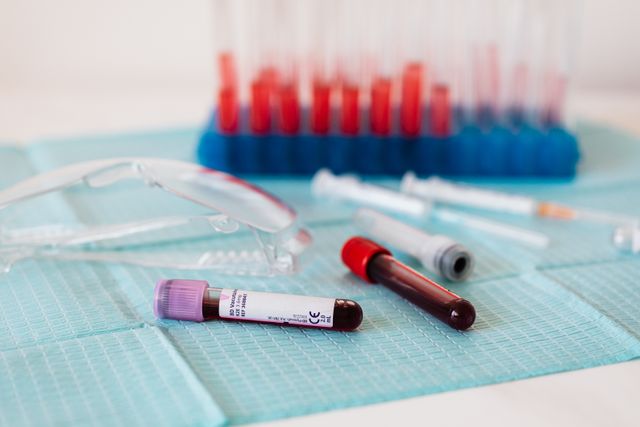
How did we discover blood types? Blood types were discovered by Karl Landsteiner in 1900.
Humans have four blood types. We have A, B, AB, and O. They are further divided into positive and negative, giving 8 different blood types. The positive and negative refer to the Rh antigen. If you have it, you are positive. If you go into the hospital and need a blood transfusion, the hospital has to be very careful what blood they give you. People with blood type AB can receive blood from A, B, AB, or O. People with type A can receive A or O, people with type B can receive B or O, and people with type O can only receive O. O is called the universal donor because they can donate to the other three blood types. Positive blood types can receive blood that is positive or negative, but negative blood can only receive other blood that is negative. If the hospital gets this wrong, it can be fatal.
If you receive a transfusion of the same blood type, or one that you are compatible with, the body goes about its business as normal. The blood enters the circulation and functions just like the recipient’s own blood. However, if you get a transfusion of the wrong blood type, your immune system will go into action. All cells have proteins on them. White blood cells in our blood are always looking out for cells that have alien proteins. When they find one, they trigger an immune response. Your body produces more white blood cells, and they attack the invading red blood cells. Each time they kill a cell, it bursts and releases hemoglobin into the blood. Excess hemoglobin is cleaned out of the blood by the kidneys, but if there is too much, it can shut the kidneys down. The liver has to work hard to break down the red blood cells and that can damage the liver. The number of working red blood cells in the blood drops, so the heart needs to cope with a loss of oxygen, which damages it. Once that happens, other organ failures will follow.
People have tried to transfuse blood for 400 years, ever since 1628, when a British physician called William Harvey discovered that blood circulated. Before that discovery, people thought that the liver created blood from food, which the body then consumed as fuel. They thought the blood ebbed and flowed through the veins and arteries like tides, and the heart heated the blood. If you thought blood was produced from food, then blood transfusions would never occur to you. Doctors soon began experimenting with blood transfusions, but they were often fatal. In 1658, a microscopist called Jan Swammerdam observed red blood cells for the first time. In 1667, blood was transfused from a sheep to a human. Some patients survived, but others died.
Over the next two centuries, doctors continued to experiment with blood transfusions, although progress was slow after the early failures. People transfused animal blood into humans and blood from human to human. It was almost impossible for them to work out why the transfusions sometimes worked and sometimes didn’t. Statistically, if you have a random blood transfusion without knowing the blood type of either patient, you would have a 40% chance of being ok, and a 60% chance of a potentially fatal reaction. That would make it very difficult for doctors to work out that it was the blood that was killing people.
Everything changed in 1901 when an Austrian physician called Karl Landsteiner discovered blood types. In 1900, he drew blood from members of his staff. He discovered that when he mixed some of the bloods together, the red blood cells would clump together. From this, he realized that there were some differences in blood from different people. With hindsight, this seems like a pretty straightforward and obvious experiment, but that is always the way with hindsight. The next year, 1901, he experimented with mixing different samples of blood together, and he worked out that there were three different types of blood. He called the three groups A, B, and C. His students discovered a fourth group, AB, the following year, and C was later renamed O.
Nobody knows for sure why we have different blood types. The fact that we do is some evidence that it had an evolutionary benefit. One idea is that different blood types offer protection against different infectious diseases. For example, blood type O appears to provide some protection against severe malaria, while other blood types may help protect against different diseases. And this is what I learned today.
Sources
https://pmc.ncbi.nlm.nih.gov/articles/PMC3595629
https://www.bbc.com/future/article/20140715-why-do-we-have-blood-types
https://en.wikipedia.org/wiki/ABO_blood_group_system
https://int.livhospital.com/what-happens-if-you-transfuse-the-wrong-blood-type
https://medlineplus.gov/ency/article/001303.htm
https://pmc.ncbi.nlm.nih.gov/articles/PMC2776239
Photo by www.kaboompics.com: https://www.pexels.com/photo/full-vials-of-blood-near-various-medical-equipment-for-taking-blood-4226924/