
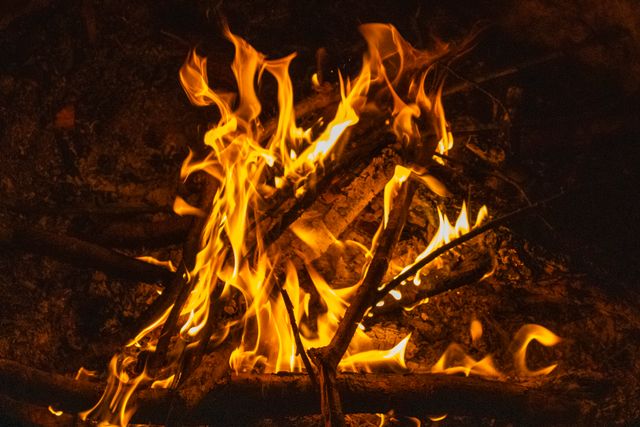
Why is fire hot? Fire is hot because thermal energy is released from the materials when chemical bonds are rearranged during a combustion reaction. New, stronger bonds form and the energy difference comes out as heat and light
When you burn most fuels, you are releasing the chemical potential energy that they have stored inside them. Almost all fuels that we burn today were alive at one point. Wood was part of a tree. Charcoal was wood, which was part of a tree. Coal, oil, and natural gas were formed when algae, plankton, bacteria, and other organisms were crushed through millions of years of intense pressure. As autotrophs, when they were alive, they photosynthesized and turned energy from the sun into energy that they could use. The energy that they didn’t use, they stored inside them. When we burn them, we are releasing that stored energy and basically running photosynthesis backwards. To make their energy, plants need sunlight (energy), carbon dioxide, and water. In the same process, they store energy and produce oxygen. When we burn them, we need energy and oxygen, and we produce more energy, carbon dioxide, and water. It is reverse photosynthesis.
The process of turning oxygen and fuel into carbon dioxide, water, and released energy is called combustion. For combustion to start, the fuel needs an initial input of energy, and the combustion process needs to release enough energy to start a chain reaction and keep the process going. If we use wood as an example, it obviously doesn’t burst into flame when it is exposed to oxygen. The wood needs enough energy to start the chemical reaction and that comes from heating. If you heat the wood to a few hundred degrees Celsius, it reaches its ignition point. At that temperature, the wood starts to break down in a process called pyrolysis. Wood is made of several substances, especially cellulose and lignin, which contain carbon, hydrogen, and oxygen. Pyrolysis breaks these large molecules into smaller, flammable gases and vapors, and it leaves behind a carbon-rich solid called char. When the gas comes into contact with oxygen, it can ignite. In the flame, old chemical bonds (in the fuel and in O₂) are broken and new bonds form, mainly the strong C=O bonds in carbon dioxide and the O–H bonds in water. Breaking bonds costs energy, but forming these new bonds releases even more energy than was needed to break the old ones. The “extra” energy is given off as heat (fast-moving molecules) and as light, which is why the fire is hot and bright. A fire needs fuel, oxygen, and energy to burn. If you take away any one of these three things, the fire will go out, which is what fire extinguishers try to do. The fire will also extinguish itself when it runs out of fuel.
The thermal energy from the fire can travel through radiation, convection, and conduction. The chemical reaction in the fire produces thermal energy. Some of that energy is released as infrared radiation. This radiation travels in a straight line and imparts its energy into whatever it comes into contact with. That is why, if you are standing side on to a fire, one side of your body will be hot and the other cold. The heat also moves by convection, but this is only above the fire. The hot gases heat the air molecules above the fire. Those molecules start to move more as they are heated, become less dense, and rise. This carries the heat upwards from the fire and is why trees over a fire can start to burn as well. And the heat also travels through conduction. If anything is touching the fire, the heat will transfer through into that thing as well, unless it is a bad conductor.
Before the chemical reaction in combustion was understood, scientists thought materials that burned contained a substance called phlogiston. When these substances burn, they dephlogisticate and release their phlogiston into the air. They also reasoned that the reason a fire extinguished in a closed space was not because it ran out of oxygen but because the air became completely saturated with phlogiston. They also thought that when matter was burned, it lost mass because it was losing phlogiston. This theory was finally disproved by Antoine-Laurent Lavoisier in the 1770s.
The sun produces heat in a different way, but the thermal energy from the sun travels through space in the same way. Anything that gets in the way of that infrared radiation will absorb its energy and start to heat up. The difference between the sun and a fire on Earth is that there are no molecules in space to absorb the thermal energy until it hits Earth. The space between stars and planets is almost at absolute zero because there is nothing to heat there. And this is what I learned today.
Sources
https://en.wikipedia.org/wiki/Fire
https://www.thoughtco.com/why-is-fire-hot-607320
https://www.plasticstoday.com/materials/sorry-folks-oil-does-not-come-from-dinosaurs
https://saunacloud.com/when-sitting-next-to-a-fire-are-you-feeling-infrared-heat-or-heated-air
https://en.wikipedia.org/wiki/Phlogiston_theory
Photo by Zion Smith: https://www.pexels.com/photo/vibrant-campfire-flames-in-north-carolina-wilderness-38741836/