
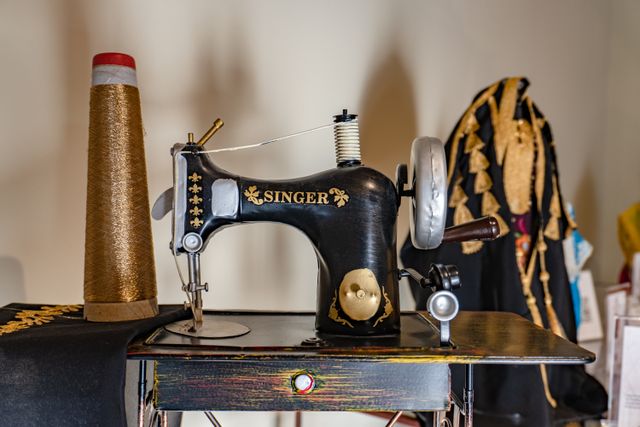
Who invented the sewing machine? Just like many inventions, it wasn’t only one person who invented the sewing machine but four people over a gap of roughly 60 years.
Modern sewing machines can create many different types of stitches, from decorative to purely functional. The earliest sewing machines could only make a stitch called a chain stitch, which is the simple stitch you would make if you were using a needle and thread. The thread merely loops up and down through the material. The problem with a chain stitch is that the thread has to be tied at both ends and if it is broken anywhere in the middle, the whole thread can come loose. The big improvements came with the lockstitch. The lockstitch is made using two pieces of thread. One is fed up from the bottom and the other from the top. The two threads lock together as they are twisted, making the stitch much more secure if the thread breaks.
People have been sewing for over 20,000 years. The earliest sewn garments were made by sewing animal skin together using bone needles and thread made from animal sinew or twisted flax fibers. The metal needle was invented in 5500 BC and needles made of copper, bronze, and iron made sewing much easier because they could more cleanly penetrate the material. About the same time, the Egyptians learned how to spin fine linen thread from flax. The Chinese made thread from silk not long after. And sewing became a profession. People made and mended clothes to be sold. And for thousands of years, hand stitched clothing was fine because there was never so much demand that the tailors couldn’t keep up with it. That changed in the Industrial Revolution. Weaving machines made it possible to produce large quantities of material that could then be made into clothes and sold all over the world. Hand stitching couldn’t keep up with the new design, and people started looking round for automatic alternatives.
The first attempt at an automatic sewing machine was in 1755 by a German engineer working in England called Charles Wiesenthal. He wanted to sew tough leather, such as for saddles, and his device had two needles next to each other. The machine was hand cranked and each time it moved, both needles came down at the same time. The first needle punched a hole and the second needle pushed the thread through the hole that had already been made. He patented the device, but it is unclear if he actually built one. Someone built it later from the designs and it did actually work. It used cross stitches.
An English cabinet maker called Thomas Saint also invented a sewing machine for leather a few years later, in 1790. He had a very catchy name for it on his patent: “An Entire New Method of Making and Completing Shoes, Boots, Spatterdashes, Clogs, and Other Articles, by Means of Tools and Machines also Invented by Me for that Purpose, and of Certain Compositions of the Nature of Japan or Varnish, which will be very advantageous in many useful Appliances.” Unfortunately, the patent was misplaced by the patent office and no one knows if he actually made and used any of his machines either.
Several people tried to invent sewing machines in the years that followed, but none of them could make a working machine. Then, in 1829, a French tailor called Barthelemy Thimonnier invented a sewing machine that actually worked. It sewed straight lines of cross stitches. He patented it and set up a machine-based clothes shop and received an order to make uniforms for the French Army. Unfortunately, his factory was burned to the ground by workers who were afraid that the new sewing machine would take their jobs. Thimonnier survived, but he lost all of his money and died bankrupt.
In 1838, an English inventor called Walter Hunt came up with a sewing machine design that was hand cranked and worked well. However, he realized that his invention would put a lot of people out of work, so he never patented it. In 1846, another inventor, called Elias Howe, this time an American, came up with a design as well. His was a little different because he had invented a machine that used lock stitch. It had two spools of thread, one from above and one from below, and each time the needle went through the material, it was looped through the other thread, locking them tight. It was much stronger than cross stitch. Howe did patent his invention.
Howe moved to England and carried out several tests on his machine. He challenged 5 seamstresses to a race and he beat them all. However, his wife’s health failed and he ran out of money. He had to pawn all of his patents to get her back to the US. His wife died, but he realized that sewing machines were proliferating and they were all based on his patented design. He used money from his family and friends to buy back the patents and hit the courts. Many people had copied parts of his design, including Isaac Singer, he of the famous Singer sewing machines. Howe took them all to court and won every case. They had to pay him royalties and when he died, Howe was a very rich man. And this is what I learned today.
https://en.wikipedia.org/wiki/Sewing_needle
https://en.wikipedia.org/wiki/Lockstitch
https://www.bl.uk/stories/blogs/posts/sewing-machines-who-really-invented-them
https://www.smithsonianmag.com/arts-culture/the-many-many-designs-of-the-sewing-machine-2142740
https://historycambridge.org/innovation/Sewing%20Machine.html
Photo by Zulfugar Karimov: https://www.pexels.com/photo/vintage-singer-sewing-machine-with-embroidery-33952439/