
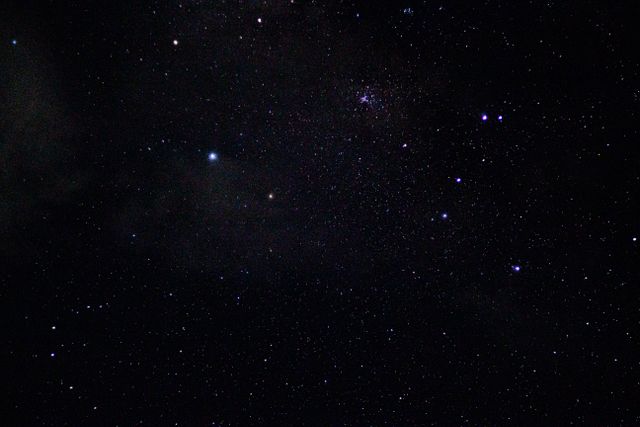
Why do stars twinkle but planets don’t? Stars twinkle and planets don’t because of how far away they are and the atmosphere.
I live in a city and you can’t see that many stars because of light pollution. A while ago I was staying at my brother’s house, and he lives in the countryside. I could see so many stars that it was truly humbling. I believe I even saw the International Space Station going over. Some of the points of light were twinkling and some were not. And this is the easiest way to tell the planets from the stars because the stars twinkle and the planets don’t. So, why is that?
It is because of our atmosphere. Our atmosphere is made up of layers of air that generally become less dense as you get higher. The atmosphere reached from the surface of Earth to a height of about 10,000 km. Light travels at different speeds through different densities and through different temperatures. The trouble is, these densities and temperatures are not uniform. There are pockets of different densities and temperatures that are constantly moving all over the atmosphere, bending light from the stars in many different directions. This is called atmospheric scintillation and it is what makes the twinkle.
Stars twinkle and planets don’t because of the size of the light source. Stars are obviously much bigger than the planets that orbit our sun. Our sun is enormous but there are many starts that are even larger, so there are a lot of enormous stars out there. However, the distances from us to those stars are staggering, which reduces the light from an enormous star down to one tiny point of light in the sky. This one tiny point of light has much more chance of interacting with the moving pockets of air in our atmosphere and getting bent. Planets are vastly smaller than stars, but they are orders of magnitude closer to us. The light appears like a point of light, like a star, but it is actually a tiny disk. The light from a star becomes one tiny dot, but planets reflect a lot more light back at us. Light coming from different parts of a planet’s disk passes through slightly different parts of our turbulent atmosphere. Some parts may become brighter while others become dimmer, but when all of that light reaches our eyes, the changes tend to average each other out, giving the overall impression of a point of light that doesn’t twinkle.
Planets can twinkle, though. When planets are low on the horizon, they appear to twinkle because their position means their light has to travel through a lot more atmosphere to reach us. A point of light straight above only has to travel through the atmosphere vertically above us, but a point of light on the horizon has to travel across the atmosphere to reach us and has more chance of hitting those pockets of different air density,
This is why most of the major telescopes on Earth are located high up on mountains with the driest conditions possible. They want to ensure that the atmosphere is as thin as possible and the air as stable as possible to cut down on atmospheric turbulence and stop the stars twinkling. They also have enormous mirrors that collect huge amounts of light, but even the largest mirror cannot remove the distortion caused by the atmosphere. If you have ever been lucky enough to go to the Atacama Desert in Chile, you will know the effect being high up in dry conditions can bring. The Atacama Desert is famous for its views of the Milky Way because it is very dry, high up, and there is minimal light pollution. Modern large telescopes also have computer controlled mirrors. They can fire a laser into the night sky so the computer can measure how much distortion there is. Then, the computer makes tiny adjustments to distort the mirrors to compensate. They can make hundreds or even thousands of adjustments a second. This helps, and Earthbound telescopes can take amazing views of the stars, but they will never be perfect.
The only way to solve this problem is to take the atmosphere out of the equation. Space based telescopes don’t have to cope with the atmosphere bending light, and they can take incredibly clear pictures of stars and galaxies. And this is what I learned today.
Sources
https://www.skyatnightmagazine.com/space-science/why-do-stars-twinkle
https://earthsky.org/space/why-dont-planets-twinkle-as-stars-do
Photo by Francisco Ferreira: https://www.pexels.com/photo/a-night-sky-with-stars-and-clouds-27601056/