
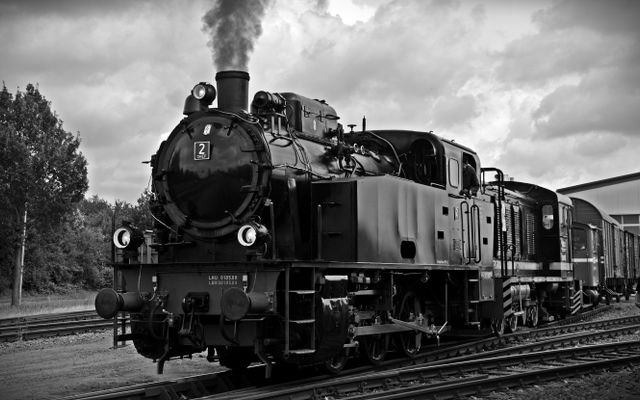
What was railway time? Railway time was the standardized time introduced by railway companies in several countries to synchronize train times across a country.
The steam engine was invented in the eighteenth century and the first steam railway train made its first journey in 1804. 21 years later, the Stockton and Darlington Railway was the first public railway to use steam locomotives. By the 1830s, there were a number of railway lines and they were growing year by year. The trains were improving and the number of passengers was increasing.
There were several problems that these emerging train companies needed to deal with. Obviously, building their tracks, finding ways to build tunnels or bridges, making faster engines, carrying more passengers, and proving their safety. However, one of the problems that they had probably never expected to have to deal with was time.
It is not something we think about much today unless we are travelling internationally, but time varies because the sun constantly moves. That seems like a simple thing to say, but it affected early railways a lot. At the equator, the sun moves one degree every four minutes. One degree is about 111 km on the Earth’s surface. That is at the equator and it drops slightly as you go north or south. That means, in a small country like the UK, which is 500 km across at its widest point, sunrise on the eastern most point will be roughly 16 minutes earlier than sunrise on its western most point. In larger countries, that change will be even larger. Because most places set their clocks to be 12 at noon, local time across the UK varied by up to 16 minutes. People living in those towns didn’t mind, or probably even know. The majority of people would not have owned a watch or a clock and they would have governed their day by the sun.
Before the invention of the train, travel was either by cart, horse, or walking. In none of these methods of transportation does a difference of 16 minutes in the local time make any difference whatsoever. It only starts to make a difference when you have a faster mode of transport, such as a train. Train drivers needed to set their watch every time they came to a new train station to the local time. This caused numerous problems. At best, trains would either leave early or late because the driver had the wrong time. At worst, trains would collide with each other because they were running on different times. Something needed to be done.
The railway companies realized that the only way to solve the problem was to have a standardized time for the railways. This became known as railway time. They decided that all train stations along the route should work on central London time. However, they didn’t know how to transmit the time at London to those stations. That was, until the timely invention of the telegraph in 1840. It was suddenly possible to send electronic signals along telegraph lines that could tell station masters the time at London. They could then set their station clocks to the correct time and all of the trains in the UK would work to a standardized train time. This led to some confusion in the early days. Here is an excerpt from an 1844 timetable on the Great Western Line from London to Bridgewater.
LONDON TIME is kept at all the Stations on the Railway, which is about 4 minutes earlier than READING time; 5½ minutes before STEVENTON time; 7½ minutes before CIRENCESTER time; 8 minutes before CHIPPENHAM time; 11 minutes before BATH and BRISTOL time; and 14 minutes before BRIDGEWATER time.
As telegraphs improved it became easier to transmit signals and the time over them. Station clocks became more accurate and showed London time. At the same time, because the number of trains were increasing, more people were traveling on them. It became more important to know the time and the number of clocks owned by people also increased. Towns realized that there was no point having a different time on station clocks and other clocks, so, by the 1855, pretty much every public authority in the UK had changed their church clocks and town hall clocks to London time. And that is why noon on the clock in the UK is only really noon in London. The USA and India followed suit in the 1860s, but they are much bigger countries and needed separate time zones. And this is what I learned today.
Sources
https://en.wikipedia.org/wiki/Railway_time
https://www.networkrail.co.uk/stories/180-years-of-railway-time
https://uw.pressbooks.pub/honors211ctime/chapter/railway-time-abby-burtner
https://en.wikipedia.org/wiki/Rail_transport_in_Great_Britain
Photo by Pixabay: https://www.pexels.com/photo/train-on-railroad-tracks-against-sky-258455/