
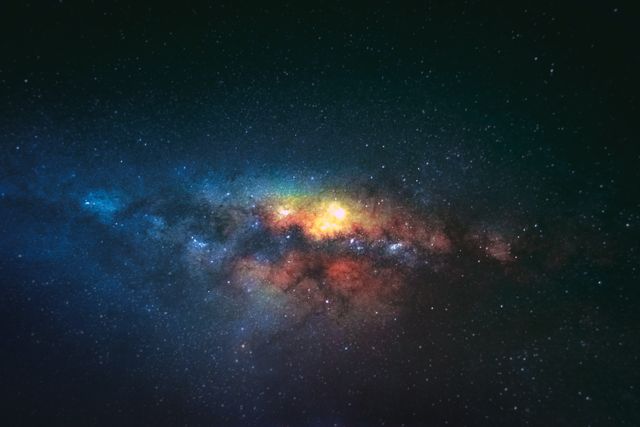
How did astronomers discover dark matter? Strong evidence for dark matter first appeared in 1933, when Swiss astronomer Fritz Zwicky found that galaxies in the Coma Cluster were moving too fast for the gravity of the visible matter to hold them together.
The universe appears to be full of something that we cannot measure and we cannot see, but it has an observable effect on the universe. It is called dark matter but it is not dark because if something is dark, it still reflects some light. Dark matter would better be called Invisible matter because it doesn’t interact with light and therefore cannot be seen. It makes up roughly 85% of the total matter in the universe.
Nobody knows what dark matter is. There are several theories. Dark matter could be Weakly Interacting Massive Particles (WIMPs). They are hypothetical particles that would be much more massive than the particles that make up ordinary matter. They don’t interact with light, which is why they are invisible. However, they would interact with gravity and possibly some other forces. They would pass through matter without interacting with it. A second theory is axions. These are also hypothetical particles. They are subatomic and they would be low-mass and low-energy. Another possibility is primordial black holes. These are hypothetical black holes that may have formed shortly after the Big Bang. If enough of them exist, they could themselves account for some or all of the dark matter. We may one day know what dark matter is, but probably not in my lifetime.
So, if it is invisible, how was it discovered? Dark matter was discovered because of the effects it has on other bodies in the universe. Lord Kelvin, he of the Laws of Thermodynamics and the Kelvin unit of measurement fame, was the first person to theorize that something might be there. By the late 1800s, when he was observing the stars, astronomers had become quite good at working out how fast stars were moving. Lord Kelvin wondered wether, if astronomers knew how fast stars were moving, they should be able to estimate how much matter was holding the Milky Way together. He did the calculations and he worked out that there were not enough visible stars to make up the mass required to hold the Milky Way together. He surmised that there must be other ordinary stars that we just couldn’t see. He thought they might be faint stars, burnt out stars, or stars too dim to detect with the telescopes they had. He didn’t get the right answer, but he was the first person to realize that you can infer the existence of unseen matter from its gravitational effects. Henri Poincare, a French mathematician and physicist, used the term dark matter to refer to Lord Kelvin’s conclusion.
Several more people theorized the presence of dark matter during the 1920s. They all thought that the mass of our galactic neighborhood must be greater than what we could see to explain the velocities of the stars.
The first person to find really strong evidence that something was missing was a Swiss astrophysicist called Fritz Zwicky. He was studying the Coma Cluster, which is a huge cluster containing over a thousand galaxies. Using the Doppler effect, he was able to measure the speed of the galaxies. The Doppler effect is when the wavelength of light coming off something is shifted into the red spectrum or the blue spectrum depending on whether it is moving away from you or towards you. And how far it has shifted shows how fast the object is moving. Zwicky worked out that the galaxies were moving at about 1,000 km per second. He estimated how much visible matter was present from the light coming from the galaxies. He worked out that the visible matter he could see would not provide enough mass to keep galaxies moving at 1,000 km per second from flying off into space. That meant either our understanding of gravity was incomplete, or there was much more mass than astronomers could see.
For various reasons, not many people believed him. It was Vera Rubin in the 1970s who showed the same thing but with individual galaxies, rather than clusters. According to Newton’s laws, the stars far from the center of the galaxy should orbit more slowly because most of the visible mass is concentrated in the center. However, she found that the outer stars were orbiting at almost the same speed as the inner stars. That was only possible if there was a vast halo of invisible matter surrounding every galaxy. And that is what I learned today.
Sources
https://science.nasa.gov/dark-matter
https://en.wikipedia.org/wiki/Dark_matter
https://www.energy.gov/science/doe-explainsdark-matter
Photo by Rafael Cerqueira: https://www.pexels.com/photo/amazing-galaxy-with-bright-blots-4737522/