
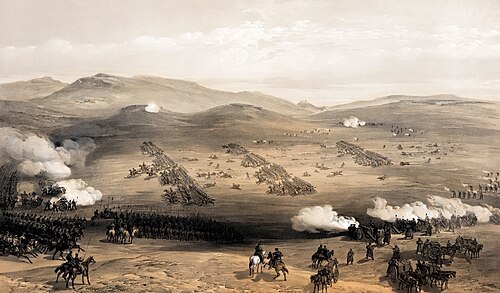
Was the Charge of the Light Brigade real? The Charge of the Light Brigade did really happen. It was during the Battle of Balaklava in the Crimean War. It happened on 25 October 1854. The Charge of the Light Brigade was made famous by Alfred, Lord Tennyson’s poem of the same name. It was a stunning example of bravery and incompetence at the same time.
The Crimean War was fought between the Ottoman Empire, France, and the United Kingdom against Russia. By the time we get to the Charge of the Light Brigade, the reasons for the war have changed, but, in the beginning Britain and France went to war to defend the Ottoman Empire. By 1853, the once powerful Ottoman Empire was declining. Russia was slowly getting more powerful and took advantage of the weakening Ottoman Empire to extend its empire south. Britain and France were worried about a stronger Russia’s influence in Europe and how it would upset the European balance of power. There was a dispute over Christian Holy places in Palestine and Russia demanded the right to protect all Russian Orthodox Christians living in the Ottoman Empire. The Ottomans refused and Russia occupied Moldavia and Wallachia and destroyed the Ottoman fleet at Sinope. Britain and France declared war on Russia and sent troops.
When Britain and France declared war, Russia withdrew from Moldavia and Wallachia, effectively removing the reason for the war. However, Britain and France really wanted to push Russia back, so they carried on. They landed in Crimea, hoping to destroy the Russian Black Sea fleet at Sevastopol. They thought Sevastopol would fall quickly, but the Russian’s had time to heavily strengthen the defenses and the Allies ended up besieging it. The British established Balaklava as their main supply port. It would take a whole year before the city could be taken, and in this siege, we have the Battle of Balaklava. It was an attempt to stop Russia from taking the disrupt Britain’s supply and communication lines, which was Britain’s only real supply route for the siege. If that harbor fell, Britain would have had to withdraw.
The Russians attacked and, in the beginning, they looked like they might win. They managed to capture some of the ridges surrounding the port and they took control of the British guns that were up there. The British were finally able to stop the Russian advance, and they decided to get their guns back. And this is where the Light Brigade enter the story.
There were two types of cavalry in the British army: light and heavy. This referred to how heavily they were armed and armored. Light cavalries were lightly armed and their purpose was mostly raiding and reconnaissance. They used horses to get somewhere quickly and then fight until the main army arrived.
The British commander-in-chief at Crimea, Lord Raglan, had a high vantage point and he could see that Russian forces were about to carry away the British artillery guns on the south side of the valley, so he sent an order for the light cavalry brigade to immediately ride up and try to stop them. The cavalry would arrive very quickly and the Russians would most likely withdraw. The commander of the cavalry forces was the 3rd Earl of Lucan and the commander of the Light Brigade was the 7th Earl of Cardigan. Cardigan and Lucan were brothers-in-law who hated each other. The order from Lord Raglan was relayed to Lucan by a Captain Nolan. In their location in the valley, Lucan couldn’t see the Russian forces on the south side of the valley and he asked Nolan where they were meant to attack. Nolan, apparently disrespectfully, indicated that the enemy were at the end of the valley. Lucan ordered Cardigan to head down the valley. Lucan said he would follow with the heavy cavalry and the infantry. They both doubted their orders, but because they hated each other, they never talked about it. Cardigan ordered his 670 troops to head down the valley.
The Russians were holding guns on both sides of the valley, and they fired as the Light Brigade charged down the valley, Cardigan leading. Lucan readied his forces but realized what was happening and held back. Shortly after the charge began, Nolan suddenly rode across the front of the brigade, apparently trying to communicate something. Before anyone could discover what he wanted, he was killed by one of the first Russian shells. By his own account, Cardigan reached the objective, fought for a while, and then rode back. He survived. However, he did not stop to see how the rest of his forces were doing or try to help survivors and he gave no directions. Of the roughly 670 men who charged, around 260 were killed, wounded or captured, and hundreds of horses were killed.
Thanks to war correspondents and the new telegraph, the Crimean War was one of the first wars that the public back home could follow closely in the press, and news of the disastrous charge soon reached Britain. Then the arguments over who was responsible began. Raglan blamed Lucan for misunderstanding his order, while Lucan argued that Raglan’s order had been unclear and that Captain Nolan had pointed him toward the wrong guns. Cardigan also defended his own actions, saying that he had simply followed Lucan’s orders. Cardigan became a popular hero in Britain, but Lucan was recalled from Crimea after publicly challenging Raglan’s version of events. In the end, no single person was officially held responsible for the disaster. The men of the Light Brigade had followed their orders with extraordinary courage, but the commanders above them spent years arguing about whose mistake had sent them down the wrong valley.
The Crimean War did expose serious problems in the way the British Army was organized and supplied. During the winter of 1854–55, soldiers suffered from shortages of food, clothing, shelter, and medical care, partly because responsibility was divided between different authorities and supplies could not be efficiently moved from the port at Balaclava to the troops. The war also increased criticism of the system that allowed wealthy officers to buy commissions and promotions. This was most likely because of the new ability of the press to report directly from the front and inform the public of what was happening. Commanders could not so easily get away with mistakes anymore. Reforms followed gradually, improving military administration, transport, training, and medical care, but the purchase of commissions survived until the Cardwell Reforms finally abolished it in 1871. By World War I, therefore, British officers could no longer buy their commands, although the officer corps remained strongly influenced by Britain’s class system. And this is what I learned today.
Sources
https://en.wikipedia.org/wiki/The_Charge_of_the_Light_Brigade_(poem)
https://en.wikipedia.org/wiki/Charge_of_the_Light_Brigade
https://en.wikipedia.org/wiki/Light_cavalry
https://www.ebsco.com/research-starters/military-history-and-science/charge-light-brigade
https://www.historic-uk.com/HistoryUK/HistoryofBritain/Charge-Of-The-Light-Brigade