
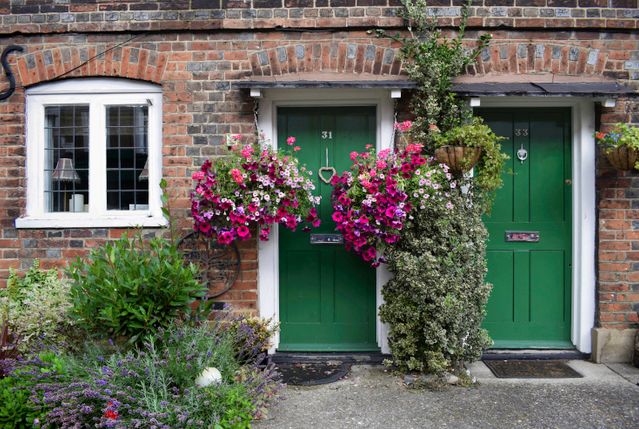
When were houses first numbered? Houses were first numbered in France in the 15th century, but they were first widely numbered through Europe for the purpose of administration and not post.
Every country in the world has some system for addressing houses and buildings. The Internet has vastly reduced the amount of post that is sent, but it is still necessary to deliver things to specific places. Especially with Amazon. Without a way of identifying individual buildings, that would not be possible.
For the majority of history, there was no need for an address of any kind. The vast majority of people were farmers of some kind, and they probably didn’t send or receive anything. If they had to give something to a neighbor, they would take it there themselves. The people who sent things knew who they were giving it to, and they would entrust it to a servant who knew where they were going. If something needed to be sent to an unknown person, the location could be explained easily enough. Once the person carrying the item reached the area, they could ask around to find the location and the person because everyone knew their community. Addresses were therefore just descriptors of a person and a place. In most cases, that was enough. Then, populations increased and more people moved into cities.
The first step was street names. These usually followed on from the location. River street. Bridge street. Castle street. And that was again fine because it was easy enough to ask where Mr. Smith on Castle Street was. Then towns became even bigger. One town probably had several rivers and bridges, which made it confusing.
The first known attempt at numbering houses in Paris was in 1463, when 68 houses on the Pont Notre-Dame were given numbers. We don’t know exactly why they were numbered, although it may have been to help identify properties for administrative or taxation purposes. And this is the main reason why numbering buildings started. It is not so that the post office can deliver letters, it is so that the government can identify where people are. When the postal service appeared in the mid 19th century, it made use of a system that already existed. It didn’t invent it.
After the house numbering attempt in Paris, the next one seems to be in Prague in the 1720s. In 1727, houses in the Jewish quarter of Prague were numbered as part of a government registration of the Jewish population. Even individual apartments within the houses were numbered. The authorities were placing strict limits on the number of Jewish families allowed to live in the region, so numbering their homes made it much easier to keep track of exactly who was living where. Again, this had nothing to do with post.
Then, in the 1750s, house numbering appeared again because of war. Prussia was involved in a series of wars through the 1700s. These wars transformed Prussia from a small regional state into a dominant European power. Troops were constantly on the move and they needed places to stay. Just before they arrived at a village, the authorities ordered the villages to fix numbers to their houses so that the troops would know where to stay and the authorities could find them. This was such a good idea that King Louis XV of France ordered that every house outside of Paris have a number on it in case troops needed to stay.
When Napoleon I took over and invaded large parts of Europe, he took the house numbering idea with him. He also decreed that Parisian houses needed numbers as well. He is the person that came up with the idea of odd numbers on one side of the street and even on the other. However, these numbers were still to keep track of where people lived. They were used for administration and tax purposes.
The postal service that we know today opened with Charles I in 1635. But letters were simple to deliver because there were not many sent. Over the next few hundred years the number of letters sent increased year by year until some kind of reform was needed. The 1839 to 1841 postal reform acts in the UK introduced the idea of prepaid stamps and in 1855 the Metropolitan Management Act was passed to regulate house numbers. From 1857, house numbers and street names were simplified. London was also split into ten districts, and each district was given a code. This is the origin of the post code, or zip code. It took over 50 years to renumber all of the houses in London. And this is what I learned today.
Sources
https://en.wikipedia.org/wiki/House_numbering
https://www.postalmuseum.org/blog/house-numbering
https://en.wikipedia.org/wiki/Timeline_of_postal_history
Photo by Jocelyn Erskine-Kellie: https://www.pexels.com/photo/a-green-wooden-doors-on-a-brick-house-with-flowers-and-plants-8316843/