
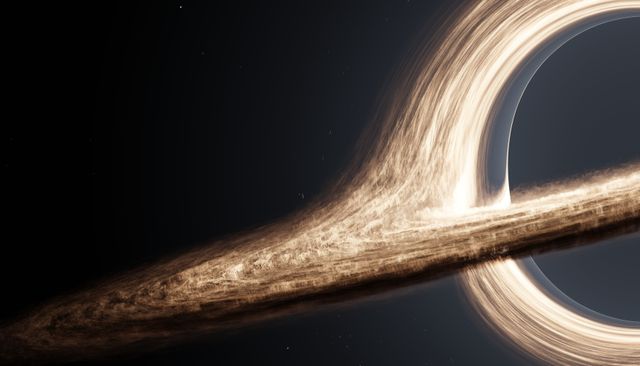
How were black holes discovered? Black holes were theorized long before they were actually detected or seen. The first theory of a black hole was presented by John Michell in 1783.
Black holes were first theorized shortly after Newton introduced his laws of gravity. It was a natural progression from these theories. Newton had proposed that light was made of actual particles. He wasn’t the first person to propose this, but he popularized the idea and he argued that because light was made of particles, it could be affected by gravity. As light passed a planet with a high gravity, it could be bent. An English astronomer and clergyman called John Michell proposed that by studying the speed of light as it passed by celestial bodies it would be possible to calculate their size. This led to the argument that if gravity was strong enough, it could pull light in and not let it escape, which is the principle behind black holes.
Light can’t escape a black hole because the escape velocity is greater than the speed of light. Every celestial object has gravity and the speed necessary to overcome that gravity and leave the surface of the body is called its escape velocity. The escape velocity of Earth is approximately 11.2 km/s. That means, if you go faster than that you will leave Earth and if you go slower, you will go into orbit or drop back down. As gravity increases, the escape velocity increases. The escape velocity of Jupiter is 60.2 km/s. The escape velocity of the sun is 617.7 km/s. Michell reasoned that the gravity of some objects could be so high that the escape velocity was greater than the speed of light, which meant that even light itself could not escape them. Michell theorized that you obviously wouldn’t be able to see these bodies because they didn’t emit light, but you would be able to see the effects they had on nearby visible bodies. He said, therefore, that if a star were sufficiently large, it could be invisible. He didn’t know that black holes were so massive that they would collapse and be very small. John Michell wasn’t the only person to come up with this idea. A French astronomer called Pierre-Simon Laplace independently came up with the same theory.
And, after these two astronomers came up with the theory, it died for a whole century. Thomas Young proved the wave nature of light and the theory behind these invisible stars depended on light being particles. If light was only a wave, then it couldn’t be affected by gravity. This meant people stopped looking into dark stars.
Things changed in 1915 when Albert Einstein published his General Theory of Relativity. Before Einstein, it was assumed that gravity was a force that pulled things through space. Einstein showed that mass and energy curve spacetime, which means that objects with a large gravity can curve light because they curve the spacetime light is traveling through. That made dark stars a possibility again. Another scientist called Karl Schwarzschild found an exact solution to Einstein’s equations for the spacetime around a spherical mass. His calculations contained a critical radius that is now called the Schwarzschild radius. For Earth, it is about 9 mm. If all of Earth’s mass could somehow be compressed inside a sphere with a radius of about 9 mm, it would form a black hole. However, this was still just an interesting observation, not something that people thought actually happened.
Then, in the 1930s, Subrahmanyan Chandrasekhar showed that there was an upper limit to the mass of a white dwarf and that if they exceeded that upper limit, they would collapse. This was the first step to seeing that enormous stars could collapse down to the Schwarzschild radius. J. Robert Oppenheimer and Hartland Snyder calculated what happens when a massive star collapses. To a distant observer, the star would become progressively redder and fainter as it collapsed toward its gravitational radius, eventually cutting itself off from communication and leaving only its gravitational field. They were the first to see that the Schwarzschild as a horizon during the collapse of a star. However, all of the people working on this, including Einstein, didn’t think dark stars were actually possible in nature.
In the 1960s, evidence began to appear that extremely compact objects really did exist. Quasars were discovered in 1963, and pulsars were discovered in 1967. In 1965, British physicist Roger Penrose showed mathematically that gravitational collapse could really produce the extraordinary objects predicted by general relativity. Then, in the late 1960s, American theoretical physicist John Wheeler popularized the name “black hole.”
In 1964, astronomers discovered an extremely powerful X-ray source called Cygnus X-1. They eventually discovered that it was part of a binary system in which a visible star was orbiting an invisible and extremely massive compact object. Matter falling toward the invisible object was heated to enormous temperatures and producing X-rays. By 1972, measurements showed that the invisible object was too massive to be a neutron star. Cygnus X-1 became the first object convincingly identified as a black hole. And this is what I learned today.
Sources
https://en.wikipedia.org/wiki/Black_hole
https://en.wikipedia.org/wiki/Pierre-Simon_Laplace
https://en.wikipedia.org/wiki/John_Michell
https://www.skyatnightmagazine.com/space-science/black-holes-first-discovered
Photo by Adis Resic: https://www.pexels.com/photo/stunning-visualization-of-a-black-hole-37149440/