
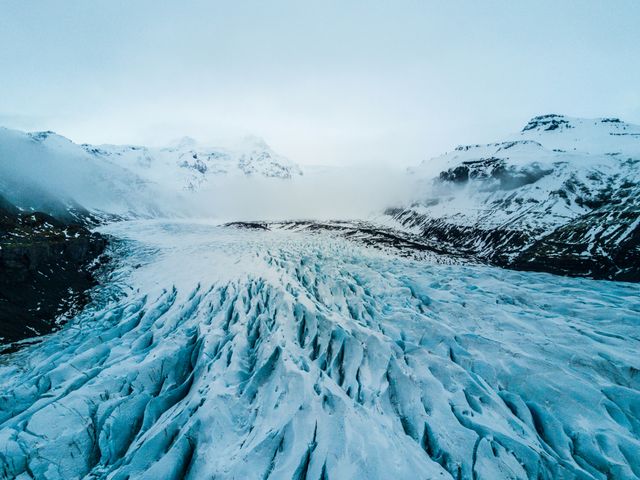
How did people first discover Ice Ages? The first scientific theory of ice ages was proposed by Louis Agassiz in 1837. However, people had theorized about them for several hundreds of years before that.
Earth has been through five ice ages so far. At least as far as we know. There may have been more, but it is difficult to find evidence for them. The first one was called the Huronian and it lasted from 2.4 to 2.1 billion years ago. The second was the Cryogenian and it lasted from 720 to 635 million years ago. The third was the Andean-Saharan and it lasted from 460 to 420 million years ago. The fourth was the Late Paleozoic / Karoo and it lasted from 360 to 260 million years ago. And the fifth, which we are currently in, started 2.6 million years ago and is called the Quaternary. The Cryogenian was probably the one where the Earth reached its coldest and the ice stretched its furthest. At some points, the ice may have reached tropical latitudes and this is the origin of the famous snowball Earth idea. The majority of the oceans might ave frozen.
What is an ice age? An ice age is defined as a very long interval during which Earth has permanent large ice sheets somewhere on its surface. Since we currently have enormous ice sheets covering Antarctica and Greenland, we are still in an ice age. Within an ice age the climate can oscillate between colder glacial periods when the ice sheets expand enormously and warmer interglacial periods when they retreat. We are in an interglacial period called the Holocene, which began about 11,700 years ago. That means the ice sheets started to retreat about then.
So, how did people first discover that there had been ice ages? From hundreds of years ago, people living around the Alps in Europe had noticed enormous boulders that were sitting far away from the mountains that they had come from. They also noticed scratches and grooves cut into exposed rock and deposits of rubble that were far too heavy for even the largest rivers to have deposited. Before the idea of ice ages was put forward, a common theory was that the flood in the bible had moved the boulders and left the rubble.
People who lived in the Alps knew that the glaciers grew and retreated as the years passed and that they could transport rocks and rubble and deposit them when they retreated. A farmer and mountain guide who lived in the mountains called Jean-Pierre Perraudin argued in 1815 that the glaciers had once extended much farther down the valley than they did in his day. His reasoning was that the scratches on the rocks showed where the glaciers had scraped through and the huge boulders showed the limit of how far they had reached. Perraudin tried to convince several geologists of his theory, but they still believed that floods had made the scratches and moved the boulders.
Then, in 1818, a Swiss engineer called Ignaz Venetz was convinced by Perraudin’s argument. An enormous lake had formed behind a glacier high in the Aps. Geologists knew that if the glacial dam failed, the lake would flood the valley and cause a catastrophic flood. The dam finally failed in 1818 and there was a huge flood. Afterwards, Venetz examined the path that the flood had taken and looked for scratches and boulders, but there were none. It was clear that a flood wasn’t enough and he came to understand about the power of glaciers. From his observations, he began to argue that glaciers had formerly extended across most of Europe.
Shortly after, a geologist called Jean de Charpentier became convinced and studied the geology left by glaciers. He explained the evidence to Louis Agassiz, who became a very enthusiastic convert. In 1837, he presented at the Swiss Society of Natural Sciences that the Earth had experienced a great “Ice Age” during which enormous ice sheets had covered large portions of the norther hemisphere. And this was the beginning of the theory. He published his theory in 1840.
In the 1860s, a Scottish scientist called James Croll studied the changes in the Earth’s orbit and worked out how those small changes could affect the climate. He theorized that changes in the Earth’s orbit were enough to cause the Gulf Stream to be diverted. This would bring less heat to the Arctic, which would mean more ice forms. More ice means more sunlight is reflected and it becomes a feedback loop of cooling. This was the first explanation of how ice ages worked. And this is what I learned today.
Sources.
https://en.wikipedia.org/wiki/Ice_age
https://en.wikipedia.org/wiki/James_Croll
https://www.history.com/articles/ice-age
Photo by Willian Justen de Vasconcellos: https://www.pexels.com/photo/glacier-in-mountains-21207306/