
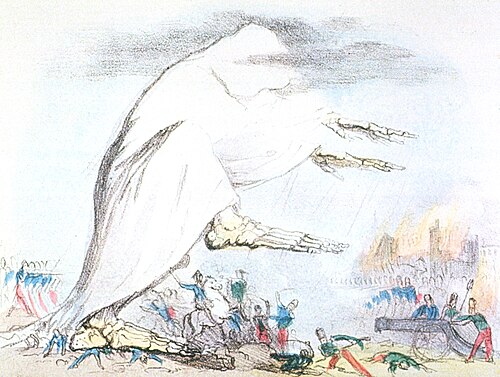
What was miasma theory? Miasma theory was the idea that diseases such as cholera and the plague were caused by a noxious form of bad air called miasma, which is the ancient Greek word for pollution. Miasma as a theory lasted for over two thousand five hundred years and only disappeared when microorganisms were discovered in the late 19th century.
We now know that infectious diseases can be caused by pathogens such as viruses, bacteria, fungi, and parasites, and we know a great deal about how these pathogens spread. With that knowledge, it seems ludicrous that people could once have believed that many diseases were caused by bad air, but it is actually a very obvious conclusion, if you think about it. There are far more diseases in places that are filthy and smell bad. There are far fewer diseases in places that are clean. Food that smells bad can make you sick. Dead bodies smell bad and are naturally associated with death and disease. If there are a lot of dead bodies lying around, there will probably be more death. Neighborhoods with raw sewage and contaminated water smell terrible, and diseases such as cholera are more common there. Disease also spreads more easily in crowded places, where the air can quickly become hot, stuffy, and filled with people’s breath. Without any knowledge of bacteria or viruses, how would people not conclude that there was something in the bad air that was making them sick?
The idea of miasma goes back to Hippocrates in the 5th century BC, but it is probably far more ancient than that. Animals, and early humans, evolved to dislike and avoid certain smells. We don’t like the smell of rotting things and sewage because it is dangerous. There is nothing in the smells produced themselves, just the way we have evolved to deal with them. Some animals like the smell of rot and are drawn to it. So, avoiding bad smells goes a long way back because it kept us safe.
Hippocrates said that when a doctor was treating a patient, they had to think about many things, not just the patient. They needed to think about the seasons, the winds, the temperature, the quality of the water, and many other things. This brought about the idea that disease could be carried. The Romans carried the idea on and a Roman writer called Vitruvius wrote about how the foul mists from a marsh could carry disease from the bodies of the creatures that lived there into the city.
The idea continued all through the middle ages and was even written about by the chemist Robert Boyle. He write a book called “Suspicions about the Hidden Realities of the Air”. Then, the Industrial Revolution happened and many countries rapidly industrialized. Lots of people started to live together in cramped, dirty conditions. They all shared a water supply which was often unclean and there was no sewage system. The number of diseases started to increase, which, to the people at the time, proved the miasma theory. What but the miasma coming from rotting organic matter or the breath of humans and animals could cause it?
People started to think that there might be a different reason in the mid 19th century. John Snow was one of the first people to question the idea. He was investigating a spate of cholera deaths in a place in London called Broad Street. He didn’t accept the conventional explanation that the cholera was spreading through miasma. He through that it was probably coming from the contaminated water. By plotting the deaths, he found a strong association with the water pump in Broad Street. When he blocked up the pump, the cholera disappeared. He didn’t know that it was being caused by bacteria, but he had guessed the route of transmission.
During the second half of the 19th century, evidence for germ theory slowly accumulated. More and more scientists began to see that the miasma wasn’t real. Louis Pasteur demonstrated the role of microorganisms in fermentation and challenged spontaneous generation. Joseph Lister applied germ ideas to surgery. Robert Koch subsequently connected particular microorganisms with particular diseases. And cholera eventually supplied particularly strong evidence: Robert Koch identified the cholera bacterium in 1883–84 during investigations in Egypt and India. By the late 19th century, miasma was being displaced by germ theory.
Miasma theory was wrong about the mechanism but sometimes right about the remedy. They cleaned streets, removed sewage, drained stagnant waste, improved ventilation, and supplied clean water. Those things genuinely reduced disease. So people could implement sanitation measures, observe disease declining, and understandably think they had got rid of the bad air and disease decreased. Miasma theory works! When they’d actually removed many of the conditions in which pathogens spread. And this is what learned today.
Sources
https://en.wikipedia.org/wiki/Miasma_theory
https://en.wikipedia.org/wiki/Robert_Boyle
https://www.sciencedirect.com/topics/medicine-and-dentistry/miasma-theory