
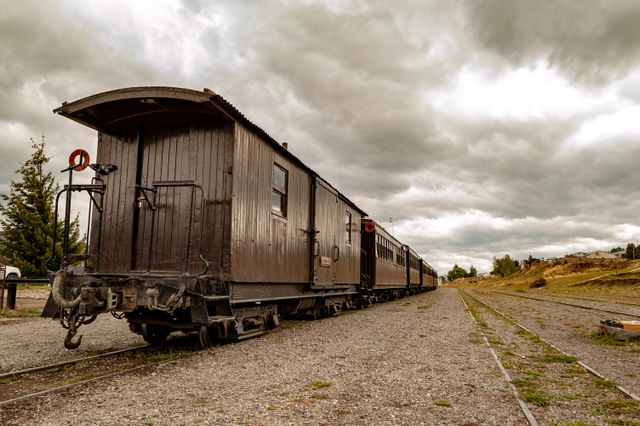
When was the first train robbery? It depends what you mean by robbery. Things had bee stolen from stationary trains since they had become popular. The first robbery from a moving train is unknown, but a good example was an 1849 robbery in the UK. And the first hold up of a train in true Wild West style happened in America in 1866.
Before the invention of the train, if you needed to send something valuable across the country it was sent by stagecoach. If you had the money, you could send an armed guard with it as well. Stagecoaches were used to transport mail across the country as well as valuables and people. They were called stagecoaches because they traveled a short stage to a staging post where the horses were swapped over. The staging post probably had an inn as well and several of these staging posts grew into towns. As stagecoaches travelled a known route and were often carrying valuables, they were a target for robbery. Highway men would sometimes hold up the stagecoach and steal whatever they could. They might avoid an armed stagecoach, or they might not.
When trains were invented and started to criss cross countries, people moved their valuables and the mail from stagecoaches to trains. They were made of metal and traveled much faster, so they were generally viewed as much safer. That would prove not to be true.
In the early days of the railway, trains were usually not guarded. Enterprising criminals could steal from the busy and rapidly expanding stations. They could also take trunks, valuables, and other goods from these train stations. People could also steal things such as mail and valuables from within the trains themselves when they were stationary. Interestingly, most places did not have a police force, but Britain did already had one force that was tasked with policing the railway lines. However, this force had bee formed in 1829 and it had been formed to police the people building the railway lines, rather than the theft that took place on them once the railways were in place.
As trains improved, they started to carry more valuable things and criminals upped their game. An early theft from a moving train was in the UK in 1849. Two men, called Henry Pooles and Edward Nightingale robbed a train twice. Poole was a dismissed former train guard and someone who knew the ins and outs of the trains. The two men traveled as passengers on the train and while it was moving they climbed from the passenger carriage into the mail carriage and stole the mail. They got away with it the first time, but were caught when they tried it again.
Then, there was another major robbery in 1855. A train was carrying gold from London to a city called Folkestone, and then on to Paris. One of the thieves was the guard on the train. He and his gang managed to get their hands on keys to the safes the gold was being transported in. While the train was moving they opened the safes, replaced all of the gold with lead shot, and took the gold off the train later. The safes full of lead were weighed and sent to Paris, where the theft was discovered. They took over a million dollars of gold (at 2026 prices), but they were all caught.
The first train robbery where a train was actually stopped, and the kind of Wild West robbery we imagine when we think of a train robbery happened in America in 1866. A gang led by the Reno brothers, John and Simeon, boarded the Ohio & Mississippi Railroad train near Seymour, Indiana. They entered the guard’s car and threatened the guard holding the safes. He could only open one safe, so they emptied the money out of that one and threw the other off the train. Then they went to the front of the train and made the engineer stop the train. Thereby becoming the first people in history to stop a moving train in order to rob it. Other gangs heard about what the Reno brothers had done and they loved the idea. The number of train robberies following this one skyrocketed. The robberies kept going up, so the train companies had to use stronger safes and employ armed guards on the trains. The number of robberies peaked in the 1880s and trains became more sophisticated and it became more difficult to stop them. There are still train robberies, but they are very rare. The last traditional train armed robbery was actually in 1970 when the mini train at the San Antonio Zoo was held up by two men. And this is what I learned today.
Sources
https://thehistorypress.co.uk/article/a-short-history-of-the-british-transport-police
https://www.loc.gov/item/today-in-history/october-06
https://www.history.com/this-day-in-history/october-6/first-u-s-train-robbery
https://en.wikipedia.org/wiki/Train_robbery
https://en.wikipedia.org/wiki/Great_Gold_Robbery
Photo by Victor Lifchitz: https://www.pexels.com/photo/brown-wooden-train-under-gloomy-sky-11667353/