
Where does the Scottish accent come from? Scottish accents developed over centuries as different languages spread across Scotland and influenced the way people spoke. They vary from town to town, just like any other country.
The Scottish accent has a few features that are instantly recognizable. It is a rhotic accent for one. That means that all of the “r” sounds are pronounced. The American accent tends to be rhotic as well, while the general English accent isn’t. Scottish also uses a rolled “r” sound. The intonation of Scottish tends to be more musical than southern English. Vowel sounds and consonant sounds also tend to be quite different to those of southern English accents. The generally spoken modern form of Scottish accented English has come about through the mix of three languages: Scottish Gaelic, Scots, and English.
Scottish Gaelic is a Celtic language. Britain was first settled by people who came over the land bridge from Europe. During the last ice age, sea levels were lower and Britain was connected to Europe by a large piece of land to the east called Doggerland. It was almost the same size as modern mainland UK and a lot of people lived there. It appeared in roughly 16,000 BC and the sea had swallowed it up by 6500 BC. The people who had lived there had gradually moved on and up into Britain and they were now cut off from Europe. Nobody knows what languages they spoke because it was long before writing. Celtic came to Britain in roughly the Iron age.
Celtic was the language spoken across most of western Europe and this was the language carried into Britain. Over time it evolved into different regional accents. The main version spoken in Scotland was Pictish, spoken by the Picts, possibly related to Welsh. From roughly the 4th century AD, Gaelic speakers in Ireland began to settle in Scotland and their language gradually replaced Pictish. By the 9th century, Scotland had become mostly unified, and the main spoken language was Scottish Gaelic. The Picts didn’t die out, they just changed the language they spoke. There is actually very little known about Pictish because they left many beautifully carved stones, but not a lot of writing that we can understand. Scottish Gaelic eventually replaced Pictish across much of northern Scotland and became particularly strongly established in the Highlands and Islands.
Lowland Scotland began to develop a different language, quite unrelated to Scottish Gaelic. This was Scots and it had the same Germanic roots that English did. From the 5th century onwards, Anglo-Saxon settlers established themselves in northern England and southeastern Scotland. They brought Old English, a Germanic language that was quite different from Gaelic. Over the following centuries, northern varieties of Old English developed into Scots, which spread across Lowland Scotland, particularly from the 12th century onwards. Scots and Scottish Gaelic were completely different languages, but they were spoken so close together that they did influence each other. The distinctive musical sound of modern Scottish was also picked up to some extent in Scots as well.
Then there was English, spoken in the south of Britain. Scots became an important language of government and literature in medieval Scotland. However, from the 16th century onwards, English began to exert increasing influence, particularly through religion, printing, education, and political connections with England. When James VI of Scotland became James I of England in 1603, the two kingdoms came under the same monarch. English became increasingly prestigious, and by the 18th century many educated Scots were using English in formal situations. However, the English they used was colored by the Scottish Gaelic and Scots that their ancestors had spoken. They had the musicality of Gaelic and many of the words of Scots.
Because the north of Scotland was mostly Gaelic and the south mostly Scots, the accents in these areas are heavily influenced by those roots. Today, most people in Scotland speak Scottish English, but there are many words that have come from Gaelic and from Scots. Loch, ben (mountain), glen, clan, slogan, and whisky have come from Gaelic. Ken (to know), wee, aye, and bonnie have come from Scots. And this is what I learned today.
Sources
https://www.scottishvoiceovers.com/the-history-of-the-scottish-accent
https://en.wikipedia.org/wiki/Scottish_English
https://en.wikipedia.org/wiki/History_of_Scotland
https://en.wikipedia.org/wiki/History_of_the_Scots_language
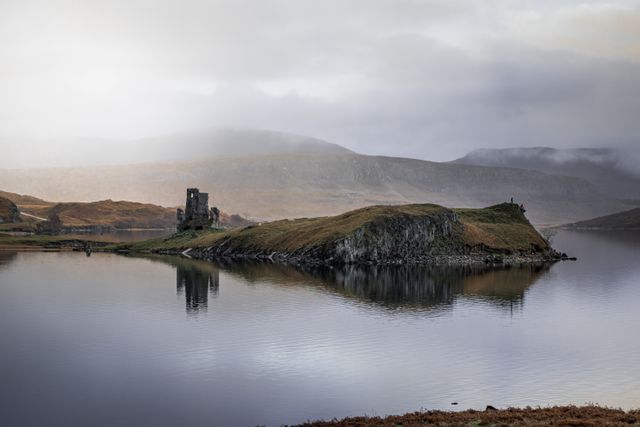
Photo by Clément Proust: https://www.pexels.com/photo/ruins-of-ardvreck-castle-on-lake-assynt-on-a-foggy-day-18510494/