
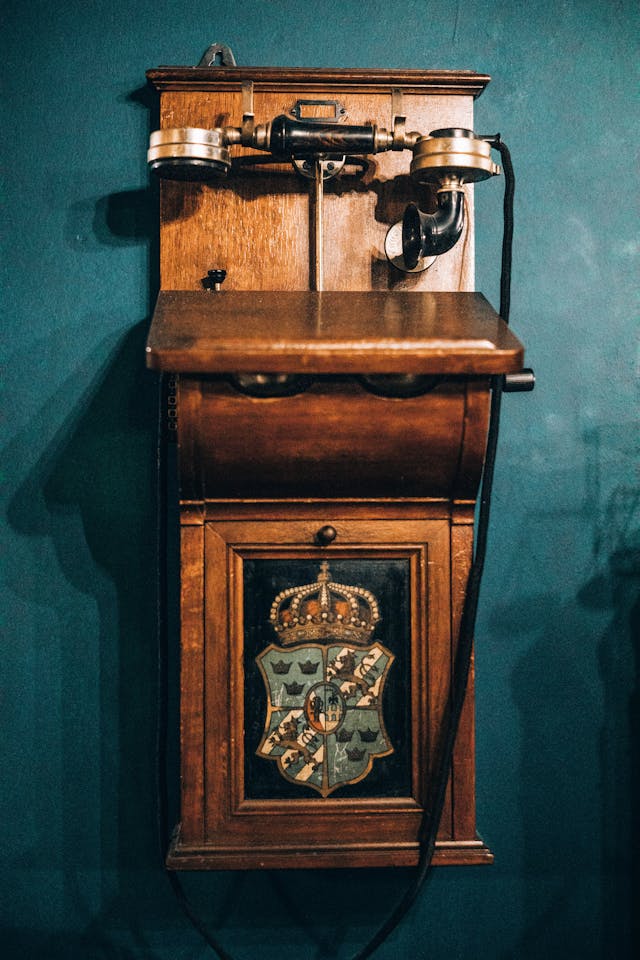
When did telephone operators become obsolete? The tools to make them unnecessary were invented in 1888, but telephone operators kept working, in one form or another, well into the late 20th century – and the job has still not completely disappeared.
Alexander Graham Bell is usually named as the inventor of the telephone, but he could only do that because of a long chain of discoveries and inventions that came before him. He was granted a patent for the first telephone in 1876. As with any new technology, uptake was slow at first because the infrastructure was not in place. New telephone lines had to be laid before telephone calls were possible, and those lines gradually spread out from the centres where phones were invented and manufactured.
In the very early days, phones were sometimes connected directly to each other, and there was no need for a switchboard. As more people came on board, that started to change. The very first switchboard operator was hired in January 1878 in Boston. If you owned a phone at that time, there was no way to dial and no dial tone. When you lifted the receiver, you were connected directly to the operator, and they asked what number you wanted. So few people owned telephones that just saying the person’s name was usually enough. The telephone operator would connect the cable of your phone line to the cable of that person’s phone line, and you could make the call. If the call was long distance, the operator would connect to another telephone exchange, and they would connect the call. As people realized the value of the telephone, more and more were sold. As the number sold increased, the price came down, and even more were sold. Soon, telephone exchanges and operators became vital. By 1881, there were 48,000 telephones in use. By 1900, there were 600,000. By 1905, there were 2.2 million and by 1910, there were 5.8 million phones in use.
By the late 1880s, “telephone operator” was becoming a common job. The early telephone operators had been teenage boys and young men, but they were gradually replaced by women because customer service was a concern, and management felt that women were more polite and friendlier. Soon, most of these positions were filled by women. It wasn’t only their phone manner, though. They could also be hired at about a third of the price of a man. Their job was to connect calls, and the profession bloomed. Their working conditions were terrible, and they had to endure very strict dress codes. Their private lives were controlled and monitored. It was a pretty thankless job.
In 1888, Almon Brown Strowger invented the automatic telephone exchange, something that we take for granted today. There is a famous story about why he did it, although there is no direct evidence for it. He was an undertaker in the 1880s, and he was slowly losing business. According to the story, he came to believe that the wife of his main competitor worked in the local telephone exchange. Every time somebody rang up and asked for his funeral home, he thought she redirected the call to her husband’s funeral home instead. There is no proof that this actually happened, and he never mentioned it in any of his letters or diaries, but it has become part of telephone history.
An automated telephone exchange makes the connections between the user’s phone and the recipient’s phone without any input from a human. Strowger’s automated exchange took the incoming phone signal and automatically connected it to the correct outgoing line. It looked like the perfect invention, something that would wipe out the job of telephone operator overnight, but that didn’t happen. In fact, it took decades.
Several things had to change before fully automatic calling could spread, and they all moved at different speeds. The first was the ability to dial a phone number. Early phones only had a mouthpiece that you lifted, and that automatically connected you to the operator. Later phones had a rotary dial that could dial a phone number by sending pulses down the phone line. The second was an instant connection to the exchange. When you pick up a phone, it sends a signal to the telephone exchange, which sends back the dial tone in return. The dial tone you hear comes from the telephone exchange, not your phone. That is why, if you disconnect the phone, you lose the dial tone sound.
The infrastructure that was necessary and the machine parts that were needed to automate the exchanges took a long time to roll out. Many companies started in one town and then moved to the next when the first was done. AT&T did it this way, and they finally finished automating their last manual switchboard in 1978. Even then, until the mid 20th century and beyond, there were many things that the automated system couldn’t do, such as setting up some international calls or handling certain special services. Even today, it is said that there are still around 69,000 switchboard operators in the USA, so the job is not completely obsolete.
So, when did telephone operators become obsolete? In one sense, in 1888, when the machine that could replace them was invented. In another sense, they never really have. The job shrank, changed, and moved into the background instead of disappearing overnight. The ability of AI to do more and more of these remaining tasks may change that soon, though. And this is what I learned today.
Sources
https://www.history.com/articles/rise-fall-telephone-switchboard-operators
https://en.wikipedia.org/wiki/Almon_Brown_Strowger
https://en.wikipedia.org/wiki/Telephone_exchange#Early_automatic_exchanges
https://en.wikipedia.org/wiki/Rotary_dial
https://en.wikipedia.org/wiki/Switchboard_operator
https://en.wikipedia.org/wiki/History_of_the_telephone
Photo by Lokman Sevim : https://www.pexels.com/photo/vintage-telephone-on-wall-9704111/