
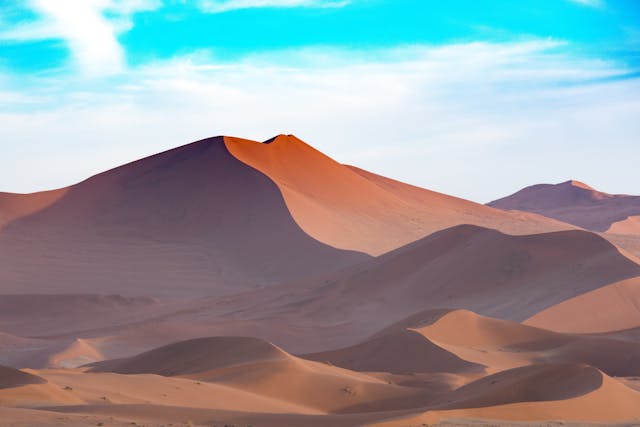
Why do some sand dunes sing? Sand dunes sing because the grains of sand slide down their sides and make vibrations that become sound waves.
Sand dunes can form anywhere with sand, but the really large ones are more common in deserts. Different types of sand can make different dunes, but they are formed in the same way as snowdrifts. Wind either picks up and carries smaller grains of sand or repeatedly picks up and drops the grains so that they bounce along the ground. The wind keeps pushing the sand along until it comes up against a larger piece of sediment, or a natural bump in the ground. When that happens, the front edge of the sand hits the obstacle and stops. The sand behind that starts to pile up behind the front layer until a drift forms. Sand dunes always have a slope on the side facing the wind because sand is always being pushed up, and a sharp drop on the side out of the way of the wind. The sand dune keeps growing until the wind doesn’t have enough energy to push the sand to the top of the dune, or until there is too much sand on the dune and it becomes unstable. When the dune is unstable the sand starts to slide down the side out of the wind before it is picked up by more wind and starts to build a second dune. In this way, sand dunes form in waves. On beaches, dunes get bigger as you move away from the sea because grasses and other plants grow on them, holding them together. Sand dunes on a beach partly get bigger as the move inland because the ground inclines. That doesn’t happen with deserts. The ground is not perfectly flat, of course, and there are hills, but sand dunes are more evenly balanced than on a beach. Although, again, that does depend on what kind of sand it is. Many deserts have rocky sand, which doesn’t blow as easily as the soft sand we picture when we think of a desert like the Sahara Desert.
Sand dunes in deserts can grow to be over 40 m in height. That is a lot of sand and more sand is constantly added. These sand dunes will inevitably become unstable and the sand will cascade down the steep side in an avalanche. All sand dunes do this, but if there is the right kind of sand, they can make a noise. The sand has to be between 0.1 mm and 0.5 mm in diameter. It has to be silica-based sand. When the dune becomes unstable and the sand cascades down the side, the friction causes vibrations, which are emitted as very low frequency sound waves. Different sand dunes produce different sounds. Dunes from the Sahara Desert in southwestern Morocco produces a sound that was 105 Hertz and sounded like a G-sharp, two octaves below middle C. Another dune in southeastern Oman produced a range of notes that were between 90 and 150 Hertz, notes between f-sharp to D.
Scientists don’t exactly know what is causing the sounds, but they think it is probably down to resonance. Resonance is when one vibrating object makes another object vibrate. If the first vibrating object vibrates at the natural frequency of the second vibrating object, their vibrations will add to each other and increase. The frequencies have to be the same. If they are opposites, they will cancel each other out and if they are close but not the same they might get bigger or smaller. If they are the same, they will increase. On the sand dune, the sand sliding down the outside of the dune vibrates at the natural frequency of the sand underneath, which sets that sand vibrating, and the vibration goes on. The vibrating sound pushes out sound waves in the same way a speaker does. The sheer size of the sand dune makes the speakers enormous and they blast the sounds out over kms. The difference in the sounds between the different sand dunes seems to come down to the size of the grains. The grains in the Moroccan dunes were a uniform size and those in the Oman dunes were a variety of different sizes. Therefore, each size of grain makes a different sound.
The way the sand grains flow down the side of the sand dune is called granular flow. Granular flow is when a collection of individual particles, which are a solid, move like a liquid. An avalanche is also an example of granular flow. You can see granular flow for yourself if you own an hourglass. The way the sand moves through the small hole is the same way it pours down the side of a dune. And as it pours, it vibrates and makes the dunes sing. And this is what I learned today.
Sources
https://www.cam.ac.uk/research/features/what-makes-a-sand-dune-sing
http://www.bourbaphy.fr/pouliquen.pdf
https://www.abqmr.com/abqmr-granular-flow.html
https://en.wikipedia.org/wiki/Singing_sand
https://science.howstuffworks.com/environmental/earth/geology/sand-dune.htm
https://www.livescience.com/24268-singing-sands.html
Photo by Pixabay: https://www.pexels.com/photo/scenic-view-of-desert-against-sky-248796/