
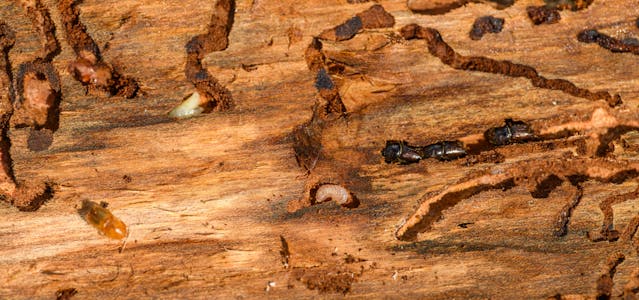
Why do termites eat wood? Termites eat wood to get its cellulose.
Termites are small insects that tend to live in nests. They look like ants and are often called “white ants”, but they are more closely related to cockroaches than ants. Termites are also not all the same. There are 3,000 different species of termite. The smallest termites are Cryptotermes cynocephalus, which are about 2.5 mm long, and the largest termites are Macrotermes bellicosus, the queens of which are about 11 cm long. Termites are often mistaken for ants, not just because of the way they look, but also because of the way they live. They make nests, which are sometimes underground, and sometimes in the giant termite nest towers you see in photographs. They have queens, workers, and soldiers in the same way that ants do. A colony can range from thousands to millions of individuals. Termite queens lay up to 40,000 eggs a day, and some of them can live for fifty years.
So, why do termites eat wood? Well, they don’t only eat wood. Termites are known as detritivores, which means they generally eat decomposing plants and animals. Earthworms are also detritivores, and they are vital to the ecosystem because they break up and digest matter that bacteria alone cannot deal with. If there were no detritivores, dead matter would slowly build up on the ground, and plants wouldn’t have access to the nutrients and chemicals that are tied up in them. That being said, the majority of termites do eat a lot of cellulose, which they tend to find in wood. The majority of animals that can actually digest cellulose tend to focus on grass and plants, not trees. By targeting wood and trees, termites have made themselves a little niche and a food source just for them.
There are not many animals and insects that can digest cellulose, and those that do require special microbes in their guts to do it. Cellulose is a very tough molecule because it is made up of chains of glucose molecules that are stuck together by hydrogen and oxygen molecules. This is called hydrogen bonding, and it produces incredibly strong chains. The positive charge of the hydrogen molecule and the negative charge of the oxygen molecule attach to each other like magnets, and the more of them you have, as in the longer the chain is, the stronger they get. The long chains that make up cellulose are extremely strong, and it is very difficult to break them apart to get at the glucose. We can’t digest cellulose, and it goes straight through us. It is vital for our diet, even though we can’t digest it, because it acts as roughage and helps the rest of our digestion. Ruminants, such as cows, herbivores, such as horses, and insects, like termites, can digest cellulose. They all have the microbes and enzymes in their guts that can do the job.
To digest cellulose, they first have to separate it from the tree or the wood that they are feeding on. To do this, they have specially adapted mouthparts to separate the cellulose. They can then chew and partially break up the cellulose in their mouths. They swallow the broken-up cellulose pieces, and they head down to the termite’s hindgut. Once there, specialized bacteria and protozoa produce enzymes that can break the bonds between the sugars and the hydrogen, and make chains of simple sugars and fatty acids. The termites can absorb these sugars and fats to get energy.
Termites will eat anything with cellulose in it, and they usually prefer dead and decaying trees because they are easier to eat. However, they will eat almost any kind of wood. They often cause a lot of trouble in houses because they can get inside the wooden frame of the house and start eating away. They can make a nest inside the wood, and as they keep reproducing, they keep eating. They will eat almost any kind of wood, but they don’t like woods that have natural oils and resins inside them. They don’t like woods like cypress, heartwood, redwood, and teak. Although if there is not much other food around, termites will eat those types of wood as well. It is almost impossible to make or find completely termite-proof wood. You would need to treat it with a fairly strong poison. Termites will also eat paper and cardboard, which are made of cellulose, so they could be used in recycling centers. However, in the process of breaking down the cellulose, they produce a lot of methane, which is one of the worst greenhouse gases. And this is what I learned today.
Sources
https://en.wikipedia.org/wiki/Termite
https://en.wikipedia.org/wiki/Detritivore
https://www.orkin.com/pests/termites/why-do-termites-eat-wood
https://www.terminix.com/termites/what-do-termites-eat
https://en.wikipedia.org/wiki/Macrotermes_bellicosus
https://en.wikipedia.org/wiki/Cryptotermes_cynocephalus
https://en.wikipedia.org/wiki/Cellulose
https://pslc.ws/macrog/kidsmac/cell.htm
https://www.biointeractive.org/sites/default/files/Termites-Educator-film.pdf
Photo by Petr Ganaj: https://www.pexels.com/photo/close-up-of-termites-18021337/