
What did Marie Curie win two Nobel Prizes for? She won the Nobel Prize in Physics in 1903 for her research in radiation (shared with her husband), and she won the Nobel Prize in Chemistry in 1911 for discovering radium, polonium, and isolating radium.
Marie Curie is not the only person to have won two Nobel Prizes. Linus Pauling won the Nobel Prize for Chemistry in 1954 for his work on the nature of chemical bonds and the Nobel Prize for Peace in 1962 for campaigning against nuclear testing. John Bardeen won the Nobel Prize for Physics in 1956 for inventing the transistor with his colleagues, and again in 1972 for developing the BCS-theory of superconductivity. Frederick Sanger won the Nobel Prize for Chemistry in 1958 for his work on the structure of proteins and insulin, and again in 1980 for pioneering developments in DNA sequencing methods. The Red Cross has won three times: in 1917, 1944, and 1963, but we are only talking about people. Marie Curie stands out from this group because she won two Nobel Prizes at a time when women were actively discouraged from working in the field of science, and for working in research conditions that were almost medieval. Interestingly, Marie Curie’s daughter, Irene, also won a Nobel Prize. She won the Nobel Prize for Chemistry in 1935.
The first Nobel Prize that Marie Curie won, she won with her husband, Pierre Curie, and a French physicist called Antoine Henri Becquerel. Marie Curie’s father was a physics teacher, and she had a love of physics and chemistry from an early age. She went to study at the Sorbonne in Paris at the age of 23. The Sorbonne is one of the most famous universities in France. She earned degrees in physical science and mathematics before starting on her doctoral thesis. She began to study uranium, which led her to the work of Antoine Becquerel. He had discovered radioactivity in 1896, just as Marie Curie was embarking on her doctorate. Although the word “radioactivity” was coined by Marie Curie, not Becquerel. With Pierre, in a small and poorly equipped laboratory, she studied a mineral called pitchblende. Her measurements showed that pitchblende was far more radioactive than it should be if it contained only uranium. If uranium were the only radioactive source in the mineral, the readings should have matched what the uranium content could explain. Since they did not, she reasoned that pitchblende must contain at least one other, unknown, highly radioactive element. It took a lot of research, but she finally found one of those elements, and she named it polonium, after Poland, her native country. She went on to discover radium, another of those elements. She was not only measuring a strange effect. She was using that effect as a tool to hunt down new substances hidden inside an ordinary-looking rock, and then proving those substances were new elements.
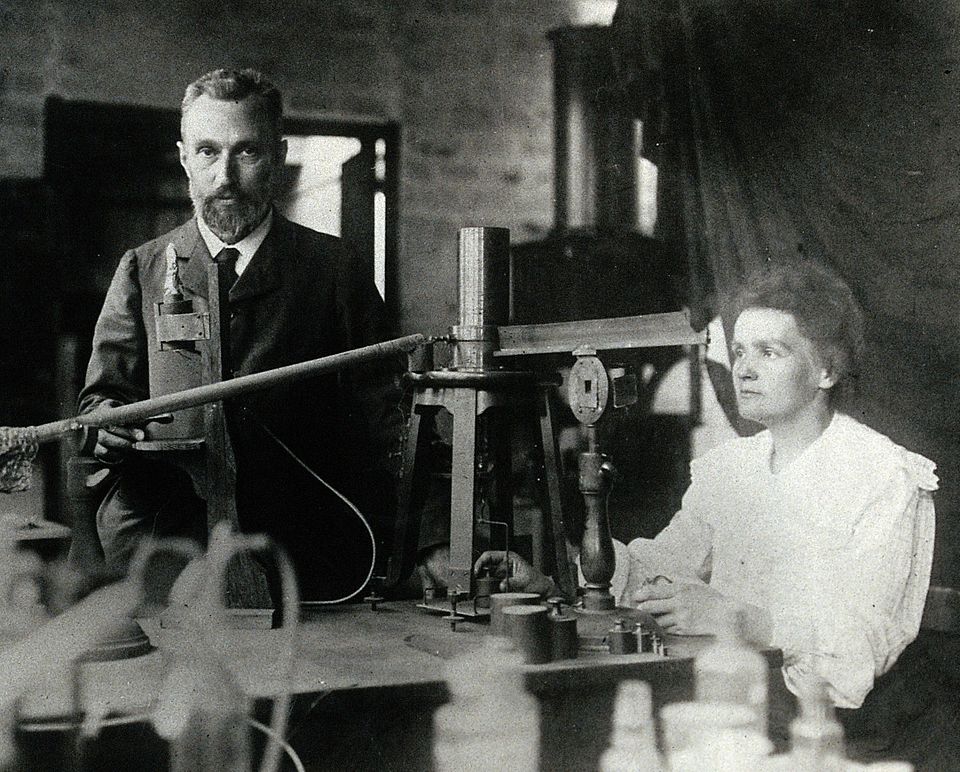
For this research, she jointly won the Nobel Prize for Physics in 1903. However, she almost didn’t win it. Because she was a woman, a lot of people didn’t believe the research was hers and thought it was her husband’s. The Nobel Prize committee were going to give the Nobel Prize to only Becquerel and Pierre Curie, until Pierre found out and complained. This was the environment in which Marie Curie was working. She was the first woman to win the Nobel Prize, and this was in an era where it wasn’t believed women were capable of the thinking required for the sciences. A picture published in Vanity Fair in December 1904 shows Pierre Curie holding Radium, while Marie Curie holds his shoulder and looks on admiringly from behind. In actual fact, the roles should be reversed.
Marie Curie continued her research into Radium. Her husband was killed in an accident in 1906, and she threw herself into her work. She wanted to isolate it, but it was very difficult to do because it is extremely scarce. She processed huge quantities of pitchblende, crushing it, dissolving it, filtering it, and repeating the same steps again and again. At first, she did not realize how much material would be needed, and the scale of the task became enormous. Over the years, she and her collaborators processed tons of ore in order to concentrate tiny amounts of radium compounds. Eventually, there was enough purified material to measure radium’s properties and prepare relatively pure radium salts. For discovering Polonium and Radium, and for isolating Radium, she won the Nobel Prize for Chemistry in 1911.
She won these awards despite the pressure put upon her not to work in science. She was also treated as a foreigner in France, although that lessened after her second Nobel Prize. She had a relationship with a married physicist called Paul Langevin, and when the scandal became public, the Nobel Prize committee tried to use it as a reason not to allow her to come to the award ceremony. Something that a male winner would never have had to deal with. Marie Curie’s long years spent working with radioactive materials finally caught up with her. She died in 1934 from aplastic anemia, a disease that can be caused by damage to the bone marrow, and it is widely believed that her exposure to radiation over many years played a major role. An amazing person. And this is what I learned today.
Sources
https://phys.org/news/2022-10-scientists-won-nobel-prizes.html
https://en.wikipedia.org/wiki/Marie_Curie
https://en.wikipedia.org/wiki/Uraninite
https://en.wikipedia.org/wiki/Henri_Becquerel
https://www.history.com/this-day-in-history/december-10/curies-isolate-radium
Image By Unknown photographer – hp.ujf.cas.cz (uploader=–Kuebi 18:28, 10 April 2007 (UTC)), Public Domain, https://commons.wikimedia.org/w/index.php?curid=20426111