
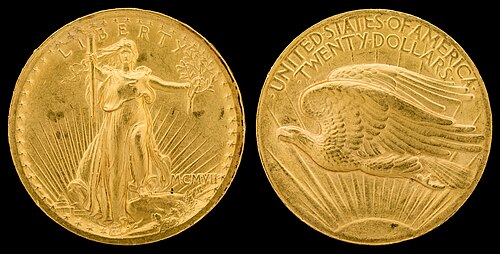
What is the rarest coin in the world? There are several possible candidates for the rarest coin in the world, but the most widely recognized contender is the 1933 Saint-Gaudens Double Eagle.
This is a difficult question because there have been so many different coins over the thousands of years since coins were first used that the majority of them no longer exist. If one of those coins from thousands of years ago were to appear, it might suddenly become one of the rarest coins in the world. Coins were first used in Anatolia, which is in modern-day Turkey, in roughly the 7th century BC. In early civilizations, trade was generally carried out through barter. It was not always easy to carry around everything that was going to be traded, so money was invented to replace the actual object.
There was money of account, which represented how much of something somebody owed or had on credit, and there was money of exchange, which represented the actual item being traded. There were different systems for recording these two types of money. Some were large pieces of stone and some were smaller things, such as shells. The problem with all of these systems was that they could be forged pretty easily. Coins arose as a system that was much harder to forge.
Over time, money stopped representing something directly and became valuable in and of itself. It still represented a quantity of something, perhaps silver, as it technically still does today, but nobody would ever exchange it for the silver because the coin itself held the value. Once this happened, it became necessary to have coins that could not easily be forged. The first metal coins appear to have come from the kingdom of Lydia, in Anatolia, and they were hammered and stamped metal discs. All modern coins ultimately developed from this idea.
The 1933 Saint-Gaudens Double Eagle coin was designed by Augustus Saint-Gaudens, an American sculptor who lived between 1848 and 1907. He created many famous monuments that still stand in America, but he also designed the $20 Double Eagle gold coin and the $10 Indian Head Gold Eagle. The double eagle was called “double” because the US Congress had decided that the value of an “eagle” was $10. There were quarter eagles, half eagles, eagles, and double eagles. They were made of gold. A Double Eagle had 30.09 g of gold, which was worth $20 in 1849 when it was first created. Today, that same amount of gold would be worth far more. All of the gold eagle coins were discontinued in 1933 when the US government abandoned the gold standard and the price of gold began to rise.
Saint-Gaudens was hired by President Theodore Roosevelt to make the eagle coins more beautiful. It took a while to get his design ready for production, but the US Mint started making it in 1907, just after Saint-Gaudens had died. The coin was used as currency until 1933, during the Great Depression, when the US government made it illegal for people to hold gold coins. Because of the failing banking system, many people were hoarding gold coins, which made the economic crisis worse. Roosevelt wanted to get the economy moving again, so he took the US off the gold standard and made it illegal for private citizens to keep most gold coins. They had to turn them in in exchange for normal money. All of the gold coins in the possession of the US government were ordered to be melted down.
The 1933 Saint-Gaudens Double Eagle went into production one month before Roosevelt’s order. A total of 445,500 were produced. Of those, 445,478 were melted down. Of the remaining 22 coins, two were given by the US Mint to the US National Numismatic Collection to be displayed. The other 20 were stolen. Nobody knows exactly how, but it is thought that a US Mint cashier was responsible. The Secret Service, which is part of the US Treasury Department and was originally created to combat counterfeiting rather than protect the president, recovered eight of them, and those were melted down. A ninth coin was found in 1952 and was also melted down. One coin was sold abroad, and the other ten vanished.
In 2005, ten of the missing coins were discovered in the collection of a Philadelphia jeweler named Israel Switt. They were seized by the US Treasury, and a lawsuit over ownership followed. That legal battle became part of the reason the coin became even more famous, because it highlighted the strange position of the 1933 Double Eagle. Although the coins had been struck, they had never been legally issued, which meant that the government considered them stolen property rather than collectible coins. This legal battle is still continuing.
The coin that had been sold abroad reappeared in the collection of King Farouk of Egypt in 1944. He was deposed after the Second World War, and the coin vanished again. It appeared once more in 1996 in the hands of a British coin dealer named Stephen Fenton. It was never clearly established how he ended up with it, but the US Treasury dropped criminal charges against him. Ownership of the coin reverted to the US government, and they sold it at auction in 2002 for $7,590,020. Half of the money went to the US government and half went to Stephen Fenton.
The coin was sold again in 2021 for $18,872,250, making it the most expensive coin in the world and, in a practical sense, the rarest as well. There may be older coins of which only one survives, and there may be ancient coins still waiting to be discovered, but the 1933 Saint-Gaudens Double Eagle is probably the most famous example of rarity in the coin world because of its strange legal status, dramatic history, and astonishing price.
Sources
https://en.wikipedia.org/wiki/List_of_most_expensive_coins
https://en.wikipedia.org/wiki/1933_double_eagle
https://en.wikipedia.org/wiki/Augustus_Saint-Gaudens
https://en.wikipedia.org/wiki/Double_eagle
https://en.wikipedia.org/wiki/History_of_money
image By US Mint (coin), National Numismatic Collection (photograph by Jaclyn Nash) – National Numismatic Collection, National Museum of American History, Public Domain, https://commons.wikimedia.org/w/index.php?curid=42906038