
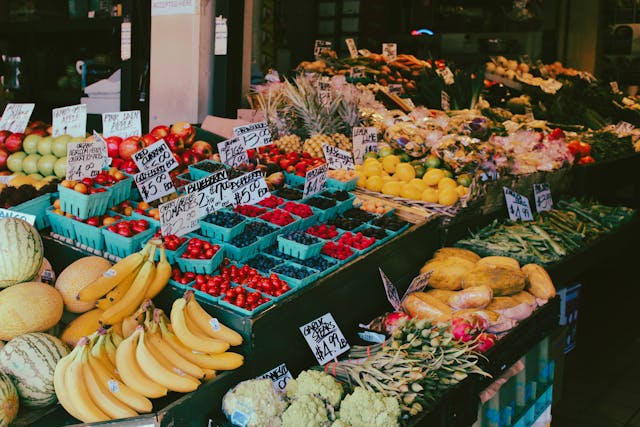
Why is there a market day? There is a market day because it used to be difficult to get food and goods to a market, so it made sense to have one day when suppliers and buyers would all come together.
Thanks to supermarkets, refrigeration, and globalized distribution networks, it is easy to forget how difficult it used to be to buy and sell things. Today, it is possible to walk into a local supermarket 24 hours a day and buy fruit and vegetables from every corner of the world, 365 days a year. That is only something that has existed for the past sixty years or so. Before that, the only things that could really be shipped internationally were goods that did not spoil, such as sugar and dried tobacco. The only way to be able to get things from other countries that spoiled, such as potatoes and tomatoes, was to take their seeds and cultivate them closer to home. If somebody had walked into a shop in the early 19th century, they would mostly only have been able to buy things that were produced locally. However, if we go back a few thousand years, it was even more difficult than that.
Agriculture began in the Fertile Crescent, in the region of the modern Middle East, roughly 12,000 years ago. Before then, humans had generally been hunter-gatherers. They moved around in small groups, hunting animals or finding whatever they needed to eat. They moved with the food and were generally nomadic. Some humans experimented with growing crops they relied on and tending some of the animals they ate, but that was rare. Around 12,000 years ago, after the last ice age ended, the climate started to change. Some areas became much more fertile and some became less so. It became harder to live in certain places, and populations increased in the more fertile areas. As populations grew, there were not enough resources for everybody to hunt and gather. Humans hunted some animals, such as woolly mammoths, to extinction, so they gradually transitioned to farming their own food. This took thousands of years, but it meant they had to stay in one place, and it meant the size of settlements could slowly grow.
One of the advantages of a settlement is that people can specialize. If somebody is living on their own, they have to grow or produce everything for themselves. If they live in a settlement, one person can be in charge of milk and another in charge of grain. Then they can swap with each other. There was usually a place in each settlement that was set aside as the swapping area. This became the marketplace. It often became a central gathering point as well as just a trading place.
Over time, the number of people in settlements increased and the variety of things produced also increased. Everybody needed to trade their produce, but it was not easy to get the things they had grown to the marketplace. Produce could be brought to town by cart, but until the 10th century there were no horse collars, and carts were usually pulled by oxen, which are very slow. The only other alternative was by river, which is why a lot of marketplaces are still located very close to rivers.
Because it was so hard to get produce into town, it made sense to only have one market day each week. Buyers and sellers both knew what day that would be, and it brought them together at the same time. Without a single market day, farmers would have had to sit around waiting for customers, which they could not afford to do. They needed to spend most of their time in the fields. By bringing all of the buyers and sellers together on the same day, it also helped to keep prices fair because both sides were aware of what other goods cost. It also meant farmers could time things so they brought fresh produce to market.
Market days were so important in the community that they became social events as well as days to buy and sell goods. They were often held on the weekend to give the greatest number of people the chance to come. This tradition continued into the 19th century, but it gradually changed because of technology. It became easier to bring goods to town, and farmers started to sell their produce to shops rather than directly to individuals. Then, in the 20th century, supermarkets disrupted the whole system again, and now we have the modern way of shopping, where it is possible to buy almost whatever is wanted whenever it is wanted.
Recently, there has been a revival of interest in markets, and many towns now have a weekly farmers’ market where farmers come to sell their produce. They are popular because they are local, they are fresh, and they are social events as well as places to shop. And this is what I learned today.
Sources
https://www.agricultureforlife.ca/post/the-food-market
https://en.wikipedia.org/wiki/History_of_agriculture
https://education.nationalgeographic.org/resource/development-agriculture
Photo by Emma Cate: https://www.pexels.com/photo/variety-of-fruits-on-fruit-stand-11831458/