
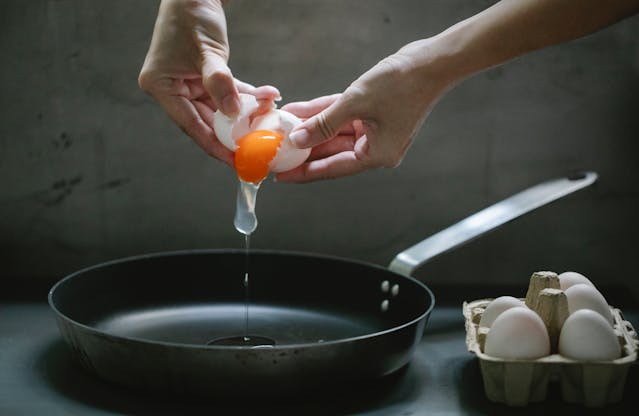
Why does oil splash when cooking? Oil splashes when cooking because water in the food hits the hot oil and instantly vaporizes into steam. If you have ever dropped food into a frying pan and been sprayed with hot oil, you’lI understand this problem. It basically comes down to the heat of the oil, the temperature water vaporizes at, and the way water expands when it turns into steam.
Every liquid has a temperature at which it boils, called the boiling point. This is the point where the molecules in the liquid have absorbed too much energy from the heat source to remain stable as a liquid, and they break away, forming a vapor. The boiling point for every liquid is different because different molecules can absorb different amounts of thermal energy before changing state. For water, at sea level, that temperature is 100°C. If enough thermal energy is supplied to water molecules to get them above 100°C, they will no longer remain liquid and they will become vapor, which we call steam. Oils can get much hotter than this while still remaining liquid, which is why frying works so well.
When frying, the oil is usually put into the pan first and brought up to heat. The oil absorbs a lot of energy and quickly rises above the 100°C needed to boil water. When the food is added, any water inside it very quickly absorbs thermal energy from the oil and reaches its boiling point. The water molecules begin moving more and taking up far more space than they did as liquid. They cannot simply stay where they are, so they form steam bubbles inside the oil.
As more of the water turns to steam, the bubble grows larger and begins to rise toward the top of the oil because it is less dense than the liquid around it. When it reaches the surface, it bursts out into the air and throws some of the oil up with it. That is the splash. If something has a lot of moisture in it, there will be more steam bubbles, which means more splashing. If something is extremely wet, especially in deep-frying, so much steam can be produced so quickly that the oil foams and swells upward. In a bad case, it can boil over the edge of the pot. This can be very dangerous.
The best way to avoid this is to dry the food as much as possible before cooking, although it is impossible to remove all of the water from food. Patting it dry with paper towels can help a lot. This is especially important with foods like fish, potatoes, or anything that has just been washed. Places like fish and chip shops or McDonald’s cook fries in frying baskets. This allows the cook to lower the food into the oil more gradually, which reduces the initial splatter when the moisture first hits the oil. The basket also helps contain the food and makes the whole process safer.
This is also the reason water should never be thrown on an oil fire. Oils have something called a smoke point, which is the temperature at which they begin to break down and give off visible smoke. If the oil keeps getting hotter past that stage, it can eventually reach a temperature where it can ignite and catch fire. That is when there is a serious problem.
When water is thrown on a wood fire, it cools the burning material and helps smother the flames. With an oil fire, it does the opposite. Water is denser than oil, so it sinks below the surface instead of covering it. Once it sinks into the extremely hot oil, it almost instantly turns into steam. As already mentioned, water expands enormously when it becomes steam. That sudden expansion throws the burning oil upward and outward, creating a violent spray of fire. Instead of putting the fire out, it spreads it.
If there is an oil fire, the heat should be turned off if possible and the fire should be smothered. A fire blanket, a metal lid, or the correct fire extinguisher is the safest choice. A carbon dioxide extinguisher can work because it helps cut off the fire’s supply of oxygen. Smothering it with something that safely blocks the air can work too, but throwing water on it is one of the worst things to do. And this is what I learned today.
Sources
https://www.chowhound.com/1631946/why-hot-oil-splatters-stove
https://en.wikipedia.org/wiki/Smoke_point
https://www.dalepinnock.com/blog/cooking-oil-smoke-point-why-does-it-matter
https://en.wikipedia.org/wiki/Template:Smoke_point_of_cooking_oils
Photo by Klaus Nielsen: https://www.pexels.com/photo/woman-cooking-eggs-on-pan-6294432/