
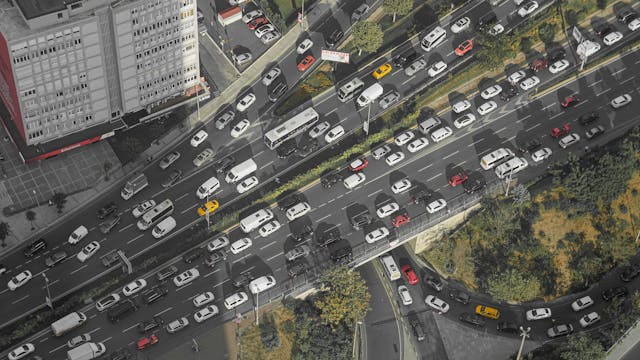
What causes traffic jams? The biggest cause of traffic jams is obviously the volume of traffic, but, in order of importance, they are caused by bottlenecks, traffic incidents, bad weather, road construction, poor signal timing, and other factors.
Obviously, the main cause of traffic congestion, irrespective of the other reasons, is the volume of traffic on the roads. If all other things were to stay constant and you were to massively reduce the number of cars on the road, there would be fewer traffic jams. This stands to reason because roads, despite increasing gradually year by year, are a finite resource and the number of cars is increasing at a much more rapid pace. The first cars were sold in roughly 1900 and they were a rare luxury. After World War 1, production methods improved and they became cheaper. Globally, 1 million vehicles were produced a year in about 1920. World War 2 saw another boost and 10 million vehicles a year were produced in 1950. 30 million in 1970, 40 million in 1980, 60 million in 2000, and in 2025, that number had risen to 97 million. Vehicles get old and are taken off the road, but the new vehicles add to the current ones at a faster rate than they are removed. Roads can never increase at this pace and the majority of the roads in cities cannot be enlarged.
This is an example of the tragedy of the commons, which we have looked at before. Roads, just like common land in a village, are free to use. If a resource is free to use because the cost is shared by all users, individuals always overuse the resource even though it will deplete the resource and make things worse in the long run. With roads, it would make more sense for people to decide not to drive half of the time, but we have no incentive to do that and we fail to see the traffic jam as our fault as well as that of all the other drivers. A solution would be to make more roads, which is difficult, or to charge for the roads, which penalizes the poor. Or driverless cars, which could work as an entire system rather than as individuals.
Now that we understand the sheer volume of cars on the road, we can understand why the biggest cause of traffic jams is bottlenecks. If you have a line of ants passing on a path that passes through a literal glass bottle with a broken bottom, they will have no trouble. If you keep increasing the number of ants, there will be a point where they can’t fit through the bottle neck, and the ants have to wait for their turn. This delay builds up and goes backwards until ants are even lining up to get into the bottle. Bottlenecks can be caused by any number of things that narrow the road and reduce the flow of traffic. Traffic incidents and road construction can also cause bottlenecks, although they are viewed as different causes. Anything that narrows the flow of the traffic is going to cause a bottleneck and make the traffic back up.
Weather can cause traffic jams as well. Fog or heavy rain reduce visibility and changes the way people drive. If people aren’t driving as quickly, the flow is reduced and traffic will back up behind them.
Interestingly, one of the biggest causes of traffic jams has been shown to be the way that people drive. Sudden braking, lane changing, or one slow truck overtaking another slow truck can all have far reaching consequences. Experiments have shown that when cars are driving in line and one car suddenly brakes, the car behind will also brake, and the car behind that, and so on. However, the second car will slow down slightly, but as the wave gets further back, cars will have to slow down even more until they come to a stop. And the cars behind them will stop, and you will have a traffic jam. This has been observed by watching traffic in real time. One person braking suddenly, or changing lanes suddenly, can cause a traffic jam that travels 50 km down the road. A group of Japanese researchers tested this in 2008. They had 22 cars drive around a circular road at about 30 km/h. There was no accident, no traffic light, and no narrowing of the road, but tiny changes in speed still spread backward through the line. Within a short time, the smooth flow broke into stop-and-go traffic. The video of the experiment is fascinating. This human reaction is one of the things that driverless cars would solve because they would work as a single unit and would not react individually. And this is what I learned today.
Sources
https://en.wikipedia.org/wiki/Traffic_congestion
https://en.wikipedia.org/wiki/Tragedy_of_the_commons
https://www.rac.co.uk/drive/advice/driving-advice/traffic-jams-what-causes-them
Photo by Ikbal Alahmad: https://www.pexels.com/photo/photo-of-vehicles-on-road-7358769/