
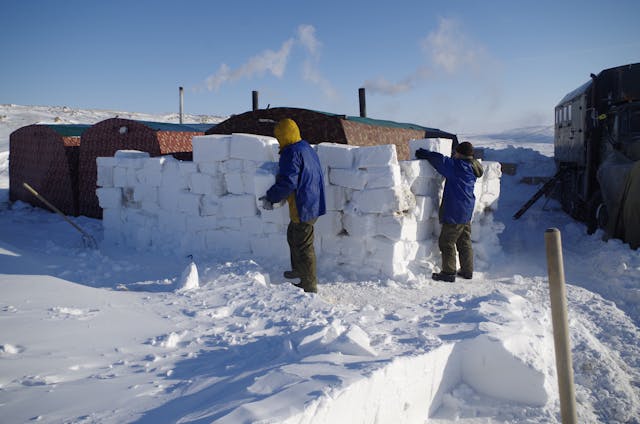
Do people actually live in igloos? People don’t usually live in snow igloos permanently, but some Inuit groups historically used them as winter homes or temporary hunting shelters.
The English word “igloo” comes from the Inuit word “iglu,” which means house or home. It does not necessarily mean a house made of snow. In some Inuit dialects, the more specific word for a snow house is “igluvijaq.” There are a few recorded uses of related words in early European writing about North America, but the word “igloo” seems to have become more widely known after 1824. This was when William Edward Parry, a famous Arctic explorer, published an account of his expedition in search of the Northwest Passage.
Parry and his crew spent a winter frozen in the bay near Igloolik Island. Temperatures dropped close to minus fifty, and there were months of darkness. Some of the crew developed scurvy, and they had to depend on the local Inuit people to survive. They spent a lot of time with them and picked up many of their words. Parry used many of these words in his book, including the word “igloo.” However, as with the Inuit people themselves, he used it to mean a house.
Over the next few decades, English speakers gradually narrowed the word. Instead of meaning any kind of house, “igloo” came to mean a snow house. Then, interestingly, it changed again. If the use of “igloo” is checked in Google’s Ngram graph, the word rises sharply around the 1940s before falling off again. This was not because people suddenly started making lots of snow houses during the war. It was because the US military started using the word “igloo” for earth-covered ammunition stores, which were similar in shape. This pushed the word into manuals, reports, and books, and it probably skewed the graph.
So, did people actually live in igloos? Yes and no. Snow igloos were not usually permanent homes in the way that modern houses are. However, some Inuit groups used them as winter dwellings, and smaller igloos were used as temporary shelters when people were hunting or traveling. Parry saw Inuit people building them near his ship while it was frozen in the ice, but these were temporary shelters rather than permanent settlements. An experienced Inuit builder could make a strong igloo in about one or two hours.
Why build an igloo at all? Hunter-gatherers in warmer climates can often have a base, maybe in a cave or a shelter, and travel out and back in a day. Prey is more plentiful, and sleeping outside is not usually deadly. The Arctic is different. Inuit hunters had to travel much farther to find prey because there were fewer animals, and many of those animals stayed in the sea, under the snow, or away from the worst of the wind. Hunters might be away from their settlement for an extended period, and they needed shelter.
They could take tents, and tents were used in some seasons, but tents have disadvantages. They have to be carried, they can be damaged by strong winds, and they do not always provide enough insulation in extreme cold. A snow igloo solves many of those problems because it uses material that is already there. The Arctic may not have many trees, but it has a lot of wind-packed snow.
An igloo is made by cutting hard-packed snow into blocks and arranging them in a spiral that rises into a dome. The best snow is not soft powder. It is dense snow that has been packed down by wind in very cold conditions. The builder cuts the blocks with a snow knife and places them so that each layer leans slightly inward. The structure is not a perfect half-circle. It is shaped to be strong, especially against wind.
The entrance is usually a low passageway, and inside the igloo there is often a raised sleeping platform. This is clever because cold air sinks. The coldest air collects near the entrance and lower passage, while the sleeping platform stays warmer. The entrance also helps block the wind from blowing directly into the living space. Inside, hides or furs could be used on the sleeping area, and sometimes on the walls, to make the shelter more comfortable.
The igloo works because snow is an exceptionally good insulator. That might sound strange because snow is cold, but snow contains a lot of trapped air. Air does not conduct heat very well, so the snow blocks slow the movement of heat from inside to outside. The igloo blocks the wind, traps body heat, and creates a small protected space. Even if the temperature outside is far below freezing, the inside can be much warmer.
A seal-oil lamp could also be used for light and heat. If the inside of the igloo warmed enough to melt the surface slightly, the water could refreeze into a thin layer of ice. This helped strengthen the structure and seal small gaps. The result was a shelter that was quick to build, strong in the wind, and much warmer than the open Arctic air.
So, people do not generally live in igloos permanently, and the idea that all Inuit people live in igloos is a stereotype. However, snow igloos were real, practical, and extremely clever. They were not primitive shelters. They were carefully designed survival technology, made from one of the few materials available in the Arctic. And this is what I learned today.
Sources
https://en.wikipedia.org/wiki/Igloo
https://en.wikipedia.org/wiki/Edward_Parry_(Royal_Navy_officer,_born_1790)
https://www.etymonline.com/word/igloo
https://language.chinadaily.com.cn/2004-11/15/content_531207.htm
Photo by Игорь Шабалин: https://www.pexels.com/photo/men-stacking-blocks-of-snow-10433610/