
What was the Cadaver Synod? The Cadaver Synod was the trial of the deceased pope, Formosus, in Rome in 897, demonstrating the level of corruption and politics that existed in the Roman Catholic church at the time.
The pope is the head of the Roman Catholic and resides in the Vatican City. Today, he is independent and can technically make decisions that are in the interest of the whole church. However, he still has to be elected in a conclave, where he will need the support of the majority of the other cardinals. That requires a lot of political skill. The pope is said to be chosen by God, but it is a political role, just like any other elected state leader. However, in times gone by, popes were far more controlled by different wealthy families or kings in Europe. This can be seen by the Western Schism, known as the “period of two popes”. Between 1378 and 1417, there was an elected pope in Rome, Urban VI, and a pope in Avignon, France, Pope Clement VII, who was supported by the French monarchy. Wealthy families have often used the popes for their own ends. In a time that was much more religious than today, it was important to have God on your side when embarking on a war, or some other campaign, and that made it useful to have your own pope.
This corruption was the main reason why Martin Luther nailed his list of 95 theses to a church door and started what is now known as Protestantism. He was upset at the Roman Catholic church’s greed. They had slowly turned religion into a money-making machine, culminating in the selling of indulgences. These were certificates you could buy to reduce the amount of time you would spend in purgatory after death. Basically, a license to commit sin. The church had slowly evolved its doctrine to allow all of these schemes. Luther’s proclamations did help and the Council of Trent in 1545 was a chance for reform. There was still a lot of corruption and the Second Vatican Council in 1962 technically modernized the church. Today, it is the same as any other political organization, so there is some corruption, but they try to stamp it out.
The Cadaver Synod was an example of the violence and corruption that surrounded the papacy at this time. Between 896 and 904, when the Cadaver Synod took place, Rome went through a succession of popes and antipopes, with rival noble and political factions fighting for control. This period is often described as the dark age of the papacy. Popes could be made, unmade, exiled, imprisoned, or murdered, and many depended on the support of powerful Roman families. One of the most important of these families was the House of Theophylact, later connected with the Counts of Tusculum. Tusculum was about 24 km southeast of Rome, near modern Frascati, and only ruins remain today. The family’s power became especially important after 904, when Theophylact and his allies helped Sergius III become pope. Members of the family held important offices in Rome and, for much of the 10th century, they dominated the city and heavily influenced the papacy. At that time, popes were not chosen by the College of Cardinals in a conclave. Papal elections were local Roman political events involving clergy, nobles, soldiers, money, and sometimes imperial pressure. If one family controlled the city, the militia, and the money, it could have enormous influence over who became pope.
The Cadaver Synod grew out of a struggle between two factions. The Spoletan faction, led by Lambert of Spoleto, who controlled Rome, and the Carolingian faction, represented by Arnulf of Carinthia. Pope Formosus became pope in 891 and ruled until 896. He didn’t like the control the Spoletan family had over Rome, so he invited Arnulf of Carinthia to invade and free the city, becoming Holy Roman Emperor. Arnulf was successful, but he didn’t stay in Rome and soon returned to Carinthia. The Spoletans slowly regained control of the city. Pope Formosus died in 896 and he was replaced by Pope Boniface VI, who died two weeks later and was replaced by Pope Stephen VI.
Arnulf was no longer in Rome and was unable to protect Formosus’s faction by this point and Pope Stephen was loyal to the Spoletans. Stephen probably convened the Cadaver Synod to satisfy the Spoletan faction, destroy Formosus’s reputation, and weaken the Formosan faction. He had Pope Formosus’s body exhumed and it was put on trial. Formosus was accused of violating canon law, perjury, and illegally transferring from the bishopric of Porto to the bishopric of Rome. Obviously, the corpse could not defend itself and Formosus was found guilty. He was stripped of his papal clothes and the three fingers on his right hand he used for blessings were cut off. The body was then dressed in normal clothes, weighted, and thrown into the River Tiber. It washed up on the banks of the Tiber. This caused an uprising and Pope Stephen was strangled six months later. The pope that succeeded him, Pope Theodore II, had Formosus’s body buried in St. Peter’s Basilica in papal clothes again. And this is what I learned today.
Sources
https://newsinfo.inquirer.net/2039880/saints-and-sinners-triumphs-scandals-and-wars-of-the-papacy-2
https://en.wikipedia.org/wiki/Cadaver_Synod
https://en.wikipedia.org/wiki/Western_Schism
https://en.wikipedia.org/wiki/Saeculum_obscurum
https://en.wikipedia.org/wiki/Pope_Formosus
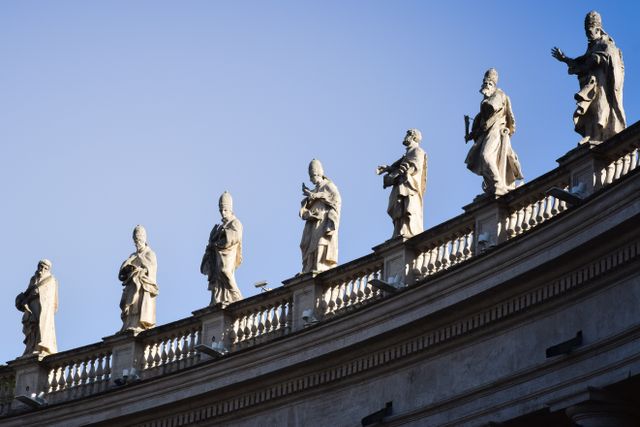
Photo by AXP Photography: https://www.pexels.com/photo/st-peter-s-basilica-statues-under-blue-sky-33008955/