
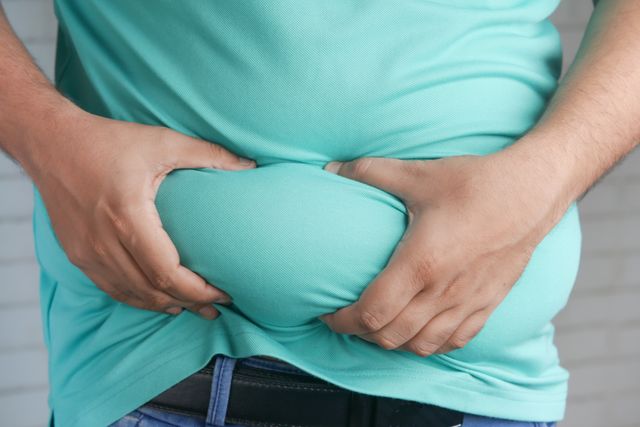
What causes a beer belly? A beer belly isn’t so much caused by beer as it is caused by excess calories, along with hormones and genetics that dictate where your body stores the fat.
Our bodies have evolved to store any excess calories that we consume as fat. We are not the only animals to do this and a lot of animals across the animal kingdom store calories as fat. The reason for this is its energy density. Fat has twice the energy density of carbohydrates or proteins, which means the body can pack two times as much energy into the same space if it is stored as fat. Whales do this to provide themselves with an energy source when they can’t find food, but also to insulate themselves from the cold. Camels store fat in their humps to give themselves an energy source, but also to keep them cooler in the desert. Bears do it before they hibernate. Birds do it before they migrate. Saving the energy as fat means they can carry more energy without getting heavier. And we evolved to do it because our food supply was not consistent. Some days we would be able to find a lot of food and other days we wouldn’t. The trouble is, our food source is no longer inconsistent.
When we eat anything, it contains energy which is measured in calories. Before anything else, the body uses part of those calories as energy and they are immediately burned. This amount depends on your size and your level of activity. About 5 to 10% of the calories pass through you. Our digestive systems are incredibly efficient, but they cannot absorb everything. The rest of the calories are stored as glycogen, used for repair/growth, lost as heat, or stored as fat if there is a long-term surplus.
The food we eat contains fats, carbohydrates, and protein. The fats are broken down into fatty acids, absorbed into the bloodstream and used as a source of energy. Any fat that is not used for energy is stored in the body. Carbohydrates are broken down into glucose and used for energy. When there is more glucose than we need for energy, it is stored in the liver and muscles as glycogen. There is only a certain amount of space for glycogen, and when these stores are full, the excess is stored as fat. The amino acids in the protein are broken apart and used for building and repairing tissue, leaving carbon skeletons behind. If we have more protein than we need, the extra carbon skeletons are converted into glucose and also stored as fat.
The body can store the fat in three places. It can store it as subcutaneous fat, which is beneath the skin. It can store it as visceral fat, which is around the internal organs, and this is what a beer belly is. Or it can store it as intramuscular fat, which is inside the muscles. The location the fat is stored in has a lot to do with genetics, sex, age, hormones, and lifestyle. Generally, the first place fat is stored is as subcutaneous. This is the kind of fat you can pinch, such as in love handles. There are fat cells that the fat is stored in and they expand as more fat is added. Every cell has a limit to how much fat it can take and this is decided by genetics. When the storage space has reached its capacity, the body stores the extra fat around the organs and in other spaces. This is the visceral fat.
A beer belly is visceral fat. The fat surrounds the organs inside the abdomen and pushes out from inside. This gives the easy to recognize shape of the beer belly. Visceral fat is said to be the most harmful because it can increase your risks of diabetes, heart disease, strokes, and cancers.
Despite being called a “beer belly”, it is not exclusively caused by beer. Any type of calorie will cause it if a person overeats but enough. The reason they are called beer bellies is that alcohol, and beer especially, contain a lot of calories. People can drink a lot without realizing how many calories they are consuming. A typical pint of beer (473 ml) contains about 180 calories. A glass of wine has about 150 calories. Somebody can very easily drink four or five pints of beer in an evening, which is almost 1,000 calories. If you do that several nights a week, it is going to start to add up. If someone ate a whole extra meal every day, they would not be surprised to put on fat. That is basically what drinking every evening does. It just surprises people more. Alcohol also has another problem: the body prioritizes breaking it down, so fat burning can slow while the alcohol is being processed. And that is what I learned today.
Sources
https://www.health.harvard.edu/healthy-aging-and-longevity/beer-belly
https://ubiehealth.com/doctors-note/excess-calories-converted-to-fat
Photo by Towfiqu barbhuiya: https://www.pexels.com/photo/a-person-holding-his-belly-fat-9927899/