
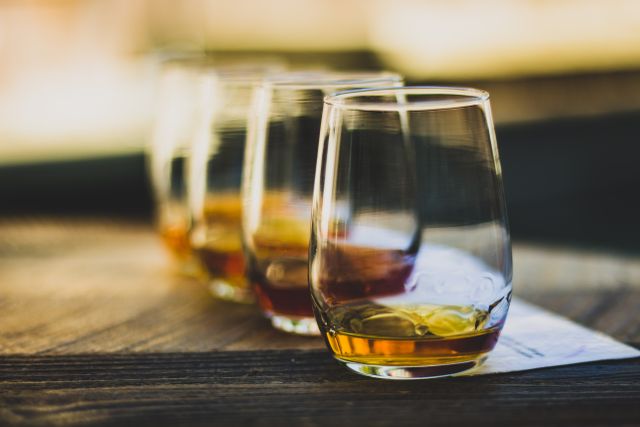
What was the Whiskey Rebellion? It was a rebellion in the young United States over a tax on whiskey. It ended up having a big impact on the government.
In 1791, the Treasury Secretary of the United States, Alexander Hamilton, managed to get his Excise Whiskey Tax passed. The United States had just won the war with Britain, and they were trying to get their new country up and running. The War of Independence had left the US with a staggering amount of debt. They owed France and the Netherlands about $12 million, and they had $65 million of domestic debt. That’s roughly $2.2 billion in today’s money. It is difficult to compare values, though, because the whole US economy was a lot less than it is now, which meant the debt was a significant amount of the US economy. The US had the resources, but the new government didn’t have the authority to tax people. This is why the US government had needed to borrow so much money to pay for the War of Independence. The tax situation changed when the Constitution was ratified, and Alexander Hamilton was responsible for the first tax system. His goal was to pay off the debt. Hamilton’s main source of revenue was import tariffs, but he also introduced an excise tax on whiskey.
He chose to tax whiskey instead of other products for several reasons. Firstly, whiskey was the most commonly made alcoholic drink in the United States. People probably drank more whiskey than any other drink, especially in the expanding western frontier. People on the western frontier also used whiskey as a form of currency because they didn’t have a lot of paper money and whiskey was easy to come by. And thirdly, it was too difficult to tax the grain the whiskey was made from because that was too bulky and difficult to ship across the Appalachian Mountains. Farmers couldn’t trade with the people on the other side of the mountains, so they distilled the grain into whiskey and traded with that instead. That changed with the building of the Erie Canal when it became possible to get grain over the mountains, but until then, it was just easier to tax the whiskey.
It goes without saying that the people who were affected by the whiskey tax didn’t like it. Large whiskey distilleries were able to swallow the tax without much problem, but the smaller family owned distilleries out west couldn’t. And, because whiskey was being used as a form of currency, the tax amounted to an income tax that the westerners thought the easterners were escaping. They didn’t like it, and in 1794 they revolted. 400 rioters harassed tax collectors and even burned down the house of one of them. The number of rioters grew until, by August, 7,000 rebels had come together. They didn’t only want an end to the tax, many of them wanted independence from the newly formed United States.
George Washington was the first president of the United States and he saw that things were not going well. If he didn’t stamp out this rebellion, he might have a revolution on his hands. The government needed the authority to collect taxes or it would never be financially stable. Washington gathered a militia of 12,950 men and led them to Pennsylvania. Of the 7,000 rioters, 150 were captured. 24 were arrested for high treason. Two of them were actually sentenced to death, but Washington pardoned them. He had done what he had set out to do and shown that the United States had the power and the authority to collect taxes and to govern itself. Also, rather coolly, Washington remains the only sitting U.S. president ever to personally lead troops in the field.
The Whiskey Rebellion wasn’t just a rebellion. It had a lasting impact on American politics. Alexander Hamilton was a member of the Federalist Party. Thomas Jefferson was a member of the Democratic-Republican Party and he was strongly opposed to the tax. He said that it was unfair and the way the government had put down the rebellion was unjust. This stance brought him all the votes from the western frontier and he won the election in 1800 becoming the third president of the United States. Once he was in power, he abolished the tax. And this is what I learned today.
Sources
https://www.mountvernon.org/george-washington/the-first-president/whiskey-rebellion
https://www.mountvernon.org/george-washington/the-first-president/whiskey-rebellion-timeline
https://en.wikipedia.org/wiki/Whiskey_Rebellion
https://en.wikipedia.org/wiki/Tariff_of_1791
Photo by Michael M: https://www.pexels.com/photo/close-up-of-drinking-glasses-with-whisky-7599324/