
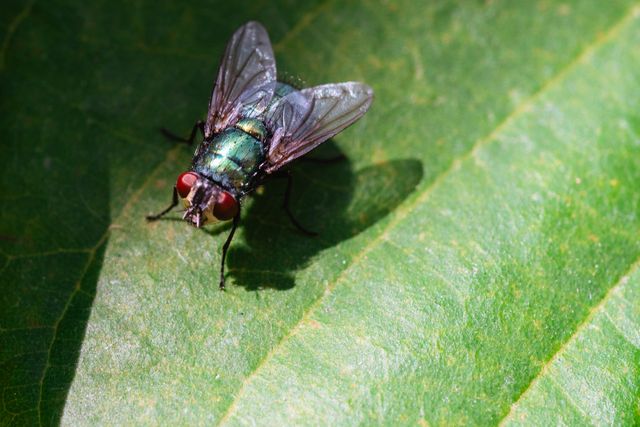
Why do flies seem to fly in squares in the middle of a room? This is possibly two questions. Why do flies appear to be able to make sudden right-angle turns, and why do some flies fly in a square in a room. Flies can turn so quickly because of their rapid saccadic turns. Flies fly in a square in the center of a room as a mating ritual.
If you leave your windows open in the summer and don’t have screen doors, you might find that flies come into your room. Some of them will head straight for your food or fruit, but some of them will just fly in an endless square circuit around the center of the room. Often, they are under a light, or near some piece of furniture, but not always. So, why do they do this?
The flies that we most commonly see flying in squares in a room are almost always male houseflies. They choose a landmark, often a light fitting, and they patrol around it while they wait for females. The loop round and round the same volume of air, chasing away any other males that they see. They are marking and patrolling their territory in the same way any other animal would. The difference is that their territory is often only about a meter across. So, the flies that you see flying in a square in your room are looking for a mate.
Now, why can flies make such sudden turns? That is because of the way their wings work. When birds want to turn in flight, they do so by rolling their body to the side they want to turn. This brings one of their wings up higher and lowers the other, creating more lift on the higher wing. This causes the bird to bank and turn. If you were on a rowing boat and wanted to turn, you would stick one oar in the water and that would turn you, but birds don’t do that because they would lose speed. Birds also have tail feathers that they can fan and turn, in the same way an airplane uses its rudder to steer. Birds have a lot of mass and a lot of speed. They can turn fairly fast, but their turns are still longer and curving. Generally, the smaller and lighter the bird is, the more rapidly it can make turns.
Flies don’t turn in the same way as birds because their flight works very differently. Birds can bank and glide through smooth turns, while flies remain supported by rapidly beating wings throughout the turn. Insects don’t have rigid wings to support them if they were to glide. A bird can hold its wings out sideways and keep moving. If a fly held its wings out sideways, they would buckle. Insects don’t have muscles in their wings. They have a flexible membrane that they flap by distorting their thorax. Insects are also too light to have any momentum if they stopped flapping. A bird has mass, which keeps it moving forward through the air and lets it glide. If an insect tried to glide, it would be stopped by the air and it would fall. Flies turn by changing the speed that they flap one of their wings. This produces torque and twists the fly’s body in the direction of the torque. The fly’s body whips around and then organs called halteres stabilize them. Halteres are tiny modified hind wings that beat in time with the flight wings. They act like biological gyroscopes, detecting the fly’s rotation and helping to stabilize it. Because of this, flies can complete a turn in less than 50 milliseconds, which is too fast for the human eye to detect. To us, it appears that they turn instantaneously. This kind of turn is called a saccade.
Why do they turn like this? It is because of the way they process visual information. When a fly is flying in a straight line, they can judge distances by comparing how quickly close up objects are moving to far away objects. For example, a signpost in the near distance compared to a building in the distance. We can do the same thing. As long as they fly straight, they have that information. When we turn, objects at all distances sweep across our vision together. The signpost and the building. That doesn’t help to judge distances. We are fine with that because our brains can combine the information before and after the turn. Flies have much smaller brains, so they minimize the time spent turning by making the rotation almost instantaneous. Flies are not fine with it. Their solution is to make the turning part, where everything becomes blurry, as quick as possible. So they turn in milliseconds. And this is what I learned today.
Sources
https://www.nwf.org/Magazines/National-Wildlife/1996/The-Mystery-of-Flight-A-Bird-Is-Not-A-Plane
https://www.discoverwildlife.com/animal-facts/insects-invertebrates/how-do-insects-fly
Photo by Leo P: https://www.pexels.com/photo/close-up-of-a-housefly-on-a-green-leaf-30851214/