
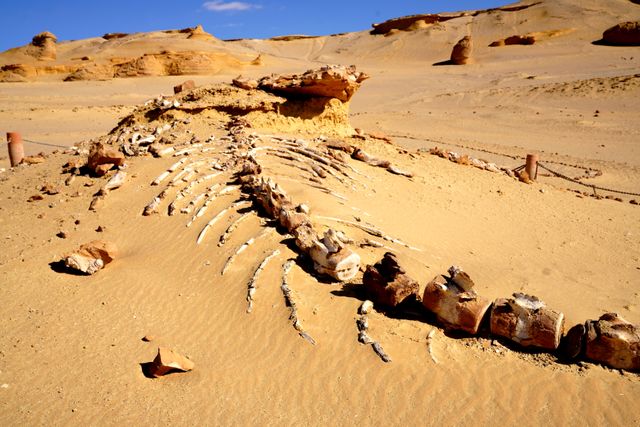
Why do deserts have fossils? Deserts seem to have a lot more fossils because the topsoil is stripped away and because they don’t have dense vegetation. Deserts also formed in places that were good for making fossils.
Many places around the world have fossils, but it seems like most of them are found in deserts. The Gobi Desert is famous for its dinosaur fossils and a lot of marine fossils have been found in the Sahara Desert. It is not necessarily that they have more fossils than a lot of other areas, but the fossils they do have are much easier to find. Fossils in most other places are usually found when the ground is exposed for some reason. Often during things like road construction fossils are found. Or in exposed pieces of rock that have been driven out of the ground by geological forces.
The first reason for this is because of the geology of a desert. Many deserts are covered in sand, gravel, bare rock, or small stones. This is because of the extreme weathering they are subjected to. Deserts don’t have cloud cover, which means they have extremes of temperature from extremely hot in the middle of the day to extremely cold at night. These temperature shifts cause stress on rocks as they expand and contract. Over enough time, the rocks can break into smaller pieces. Deserts are also subject to flash floods. They don’t have a lot of rain, but when it does rain there is no vegetation to trap and direct the water, so it forms a flash flood. This sudden influx of cold water can shatter hot rocks. And lastly, there is no vegetation to block the wind. The winds are very strong over deserts and wind-blown sand acts like sandpaper, slowly wearing away exposed rock. What this means is that the top layer of the ground is cleared away, revealing the fossils. The lack of rain plays another part as well because water is one of the biggest weathering mechanisms there is. Exposed fossils will very quickly be eroded away if they are exposed to prolonged rainfall. The dry conditions in deserts prevents that.
The second reason is the lack of vegetation. Because there are very few trees and plants, it is very easy to see fossils on the ground. It is also fairly easy and quick to search such a large area of desert for fossils. Vegetation also comes with roots, which would hold the soil together and prevent the fossils from coming to the surface. These roots could also break through the fossils and destroy them. Plants need minerals to survive and fossils contain a lot of minerals. Roots can crack fragile fossils, disturb the surrounding sediment, and make them much harder to find. This is why it is much easier to find fossils in deserts than in jungles.
Another reason some deserts have a lot of fossils is because they used to be seabeds. Obviously, not all deserts used to be under the sea. Many deserts have formed simply because they are in areas that are cut off from rainfall by a high mountain range. However, some deserts did used to be under the sea. There are several ways that a sea can disappear. Continental drift can move the land or raise it up so that the sea runs off. Or climate change can shift the weather over the area and the sea can evaporate. The Sahara Desert is an example of this and is why a lot of marine fossils are found there. About 100 million years ago, parts of what is now the Sahara were covered by shallow seas connected to the Tethys Ocean. Later, sea levels changed, the continents moved, and those seabeds were lifted or exposed, leaving marine fossils in what is now desert. The Arabian Desert, Mojave Desert, and Great Victoria Desert were all also covered by shallow seas that gradually dried up.
The fact that they used to be under the sea means they have more fossils because a seabed is an excellent place for fossils to form. It is soft, which means dead animals can be very rapidly and very deeply buried. It is also constantly building up, which puts more and more layers of sediment and silt on top of the dead animals. Some seabeds and lake beds are low in oxygen, which slows decomposition, and they are very high in minerals, which fossils need. And this is what I learned today.
Sources
https://earthscience.stackexchange.com/questions/13331/why-are-many-fossils-found-in-deserts
https://palmdesert.ucr.edu/calnatblog/2023/05/01/hypotheses-how-our-deserts-came-be
https://www.jagranjosh.com/general-knowledge/list-of-deserts-that-were-once-oceans-1820003941-1
https://en.wikipedia.org/wiki/Tethys_Ocean
Photo by George Wang: https://www.pexels.com/photo/ancient-whale-fossil-in-egypt-s-desert-landscape-34328976/