
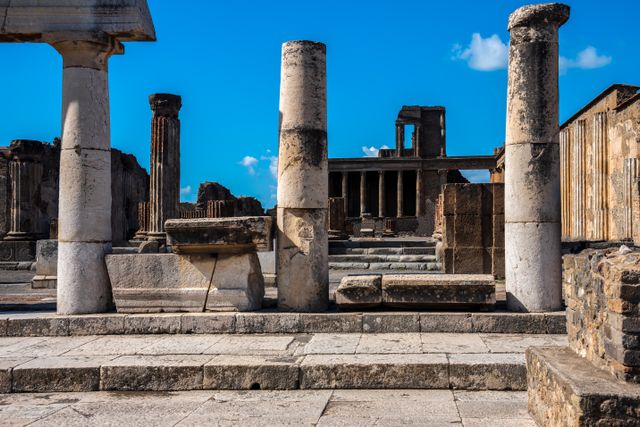
Who discovered Pompeii? Pompeii was accidentally discovered by an Italian architect called Domenico Fontana at the end of the 16th century. The City of Pompeii was buried from 79 AD until it was accidentally discovered in the late 18th century. It was then left untouched until archaeologists started to recover it in the mid-18th century.
The first settlements where Pompeii would grow were built in the 8th century BC. There were five villages in the original settlement, which is where the name for the city comes from. The “pompe” part of Pompeii comes from the Oscan word for the number 5. Oscan was a language spoken in Southern Italy until it was replaced by Latin and died out. Pompeii gradually grew in size from the original five villages and built walled fortifications. It was controlled by the Etruscans from 524 BC until the Romans took over the whole area in 290 BC and Pompeii became a part of the Roman federation. It became a very prosperous area and a stopping off point for traders heading from the sea to Rome.
In AD 62, there was a severe earthquake that damaged many buildings. Rebuilding took a long time. With hindsight, that might have been the first sign that Mount Vesuvius was about to erupt. People in Pompeii were used to earthquakes and they rebuilt and carried on with their lives. Then, in AD 79 , Mount Vesuvius erupted. It ejected super-heated gases, molten rock, pumice, and hot ash to a height of 33 km. The eruption lasted for two whole days.
The cities of Pompeii and Herculaneum were the closest to the volcano. Pompeii was to the southeast and Herculaneum to the northwest. When the volcano erupted, there were earthquakes, but the people were used to this and they stayed in the cities. Fleeing probably wouldn’t have done any good anyway. In the beginning, the rock, pumice, and ash rained down on the towns and the people hid inside their buildings. However, the rock and ash from the sky didn’t stop and the weight of it began to collapse buildings. Some people suffocated, but the majority of people were probably still alive. Then, in the night and then again the following morning there were two pyroclastic flows. A pyroclastic flows is when all of the extremely hot gas and volcanic matter coming out of the volcano stops going up and is pulled by gravity down the sides of the volcano. It is usually several hundreds of degrees hot and moving at the speed of sound. It is impossible to run away from. The pyroclastic flow instantly cooked all of the people left and dumped the ash it was carrying over the whole town. The people were frozen for all time in ash casts and the whole city was buried.
Emperor Titus allocated funds and people for a recovery mission, but nothing was ever done. They probably realized that nobody could be saved and it would be too hard to dig the city out, so they left it. Some of the taller buildings were still sticking out of the ash, so it was clear where the city was. For the next few years, the only people who came to Pompeii were thieves looking for things to steal. They took valuables they could find, building materials, and even marble statues. After the thieves gave up, a settlement was built on the site, but even that had gone by the 5th century. There were several smaller eruptions from Vesuvius and the site was completely buried. And ompeii was forgotten.
Until 1592! Count Muzio Tuttavill commissioned an architect called Domenico Fontana to build an underground aqueduct. While he was building it, his workers came across ancient walls covered with paintings and descriptions. In order for it not to interfere with his work, he kept it secret. Some excavation was carried out in 1693, but only a little, and only for curiosity.
Pompeii was reintroduced to the world in 1738. Workers building a summer palace for the King of Naples, Charles VII, accidentally came across the ruins. King Charles was a collector and he wanted to keep the finds secret, but he commissioned a book called “Antiquities of Herculaneum Exposed,” which kind of gave the game away. The Spanish military (Charles became king of Spain as well) took over the excavations, and then the French military took over when France occupied the area in 1799. Excavation continued over the next century and in 1863, Guiseppe Fiorelli realized that voids in the ash were actually human bodies. He devised the method of pouring plaster into them, which kept their form and is why we can still see the people who died in the city. Excavation is still going on, and there are large parts of the city yet to be found. And this is what I learned today.
Sources
https://en.wikipedia.org/wiki/Pompeii
https://en.wikipedia.org/wiki/Oscan_language
https://en.wikipedia.org/wiki/Eruption_of_Mount_Vesuvius_in_79_AD
https://www.pompeii.org.uk/s.php/tour-the-discovery-of-pompeii-history-of-pompeii-en-239-s.htm
Photo by Russ Stoneback: https://www.pexels.com/photo/columns-in-ruins-of-ancient-bui-5142345/