
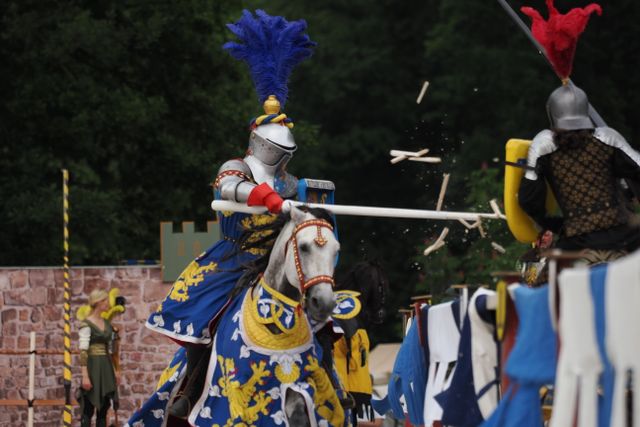
Could anyone become a knight? In theory, it was possible for anyone to become a knight, but the vast majority of knights came from the nobility.
The word “knight” comes from the Old English “cniht”, which meant boy or servant. That came from the Old German “Knecht”, which meant servant, bondsman, or vassal. And that was what a knight was: a servant. They were the servants of their lord, and they were bound in service to him. However, that didn’t mean they were actual servants because many knights were quite wealthy.
The first knights appeared around the 8th and 9th centuries, and they gradually disappeared in the 16th century as guns, gunpowder, and explosives changed the way wars were fought. The role of knights may have disappeared, but a lot of countries in Europe still have a knight class. In the UK, for example, people can be knighted by the king. It doesn’t come with any privileges other than being called “sir” or “dame”, but it is a sign of recognition.
Becoming a knight was not easy, and there was a long and vigorous training program. It was also expensive because the knight would need equipment, horses, and many other things. Because of this cost, the majority of knights came from wealthy noble families. Families that wanted their sons to become knights had to send them away when they were very young to begin the training. The first step was to become a page. This usually happened at 7. The boy was sent away to live in a castle, where he would serve a knight or the lord of the castle. He would have to wait on the table, help the knight to dress, and perform many other household tasks. Along with this, he would also be taught how to care for horses, how to care for the equipment, and how to use mock weapons. He would learn chivalry and manners as well.
After about 7 years of being a page, the boy would graduate to being a squire. A squire is a trainee knight, and the word comes from the French “ecuyer”, which means “shield bearer” because that is basically what a squire does. Their job was to look after the knight. They had to clean and care for his weapons, polish his armor, look after his horses, help him dress for battle, and hold his shield until he needed it. One knight would have several squires. While they were doing this, they would also learn how to fight and ride a horse. They would also learn music, dance, reading and writing in English, Latin, and French, and hunting. The squire was responsible for the knight in battle as well and had to follow him on another horse. If the knight dropped his shield or sword, the squire had to bring him another. If the knight was wounded or killed, it was the squire’s job to bring him back.
After six years or so, if the squire was good enough and had enough money to buy all the things a knight needed, he would be knighted in a very elaborate knighting ceremony. The knight had to spend hours praying in a chapel, then kneel down, recite an oath, and then be dubbed on the shoulder with their lord’s sword. According to one traditional explanation, this touching of a sword on their shoulders was supposed to symbolize the last blow they would ever receive without retaliating. If they were fortunate, the lord would give them some land to help pay for everything. Or they could earn land and treasure as spoils of war. Then, they would receive their own pages and squires, and the cycle would continue.
Most knights came from noble families because only they could usually afford the equipment and training. However, sometimes regular people were knighted. A soldier might be knighted after exceptional bravery on a battlefield. There are several examples of commoners being knighted on the battlefield. They were often given land as well, because without that, there would be no way for them to afford the trappings a knight needed. There were also examples of commoners being knighted for helping the king directly. This is much rarer than being rewarded for service on the battlefield. You can find examples of commoners being elevated to knighthood, but they tend to be in the earlier part of the history of knights. As we head into the 13th century and beyond, it becomes much rarer, and the knighthood becomes the property of the nobles, almost exclusively. And this is what I learned today.
Sources
https://www.abdn.ac.uk/sll/disciplines/english/lion/training.shtml
https://en.wikipedia.org/wiki/Knight
https://www.worldhistory.org/article/1240/how-to-become-a-medieval-knight
https://en.wikipedia.org/wiki/Thomas_de_Rokeby_(died_1356)
Photo by Thomas Nolte: https://www.pexels.com/photo/medieval-jousting-tournament-in-norten-hardenberg-32677287/