
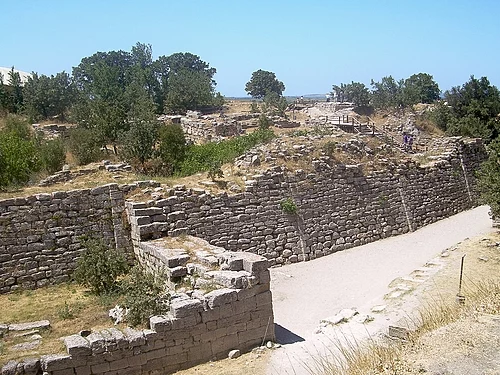
Is Troy a real place? Almost certainly, Troy was a real place. It was located in present day Turkey. However, a Trojan war is only a possibility, and the two poems in which the city is mentioned are probably a mixture of history and legend.
The location of the city of Troy was identified by an English archaeologist called Frank Calvert in 1865, and then excavated by a German businessman called Heinrich Schliemann over the next 30 years. Excavations are still continuing today, and it has been a long process. Calvert spent a long time analyzing the site and was convinced he was in the right place for Troy. However, he didn’t have enough money to continue the excavation, so he turned to Schliemann. Because of that, Calvert’s name has been largely forgotten, but he was instrumental in finding the right location.
The main evidence historians have had for the existence of Troy for two thousand years was Homer’s poems, the Odyssey and the Iliad. The problem with these is that no one even knew if Homer was a real person, let alone if the poems were historical. It was generally assumed that, like most epic poems, they were a mixture of oral history passed from generation to generation and some legend. The difficulty was picking out what was what. A lot of scholars doubted Troy was a real place and assumed it had just been made up for the purposes of the poem. Some scholars believed Troy was real, but thought it was located at Pinarbasi, about 5 km away from where Troy was eventually found. Schliemann believed this too and spent some time excavating here. The place matched parts of the landscape described in Homer’s poems, and it had ancient ruins. Frank Calvert was convinced otherwise. He believed that a mound called Hisarlik was the location of Troy. It matched Homer’s landscape remarkably well. And remains on the surface showed it had been occupied for thousands of years. Calvert began to excavate, but he quickly ran out of money. He approached Schliemann and asked for his help. Schliemann was convinced and began to dig there.
Over the next thirty years, he found nine different cities built one on top of another. Each new city had been built on the ruins of the previous one over a period of almost 3,000 years. They were named Troy I to Troy IX. Schliemann assumed that the deepest of the cities must be Troy, but modern historians believe that Troy was probably Troy VI or VIIa because they date to roughly 1300 to 1200 BC. Unfortunately, in his eagerness to get to the bottom, Schliemann dug through the upper Troys and destroyed some useful evidence. Still, that is said with hindsight. All of the cities had been destroyed at one time and then rebuilt, but Troys VI and VIIa showed evidence of being destroyed either by earthquake or fire, and there was a possibility that they were destroyed in the wars that Homer talked about.
After all that time, it looked like Troy had been found, but there was still no evidence that there was a historical city called Troy. The whole story could have been made up by Homer. More evidence was needed. It was known that the Romans and the Greeks believed in Troy, and Alexander the Great was even said to have visited it at one point, but that was a thousand years after the supposed battle, so there was no way of knowing if he wasn’t just believing the poems as well. Then, evidence appeared, although it was long after Calvert and Schliemann had died.
In the early 20th century, scholars managed to decipher thousands of clay tablets that had been found in Hattusa, the capital of the Hittite Empire. If Troy had existed, it would have been between the Hittite Empire and the Mycenaean Greeks. If the city were real, surely one of those civilizations would have written about it, and it looks like the Hittites did. The translated tablets mentioned a kingdom called Wilusa and a city called Taruisa. Many linguists believe that these names entered Greek and evolved into Ilios, the name of the state, and Troia, the name of the city. Other documents record that the Hittites were sometimes allied with Wilusa and sometimes against it. They also record disputes between Wilusa and a western power called Ahhiyawa, which many historians think was the word for Achaeans, the Mycenaean Greeks. The tablets provide strong evidence that Troy was real, and although they don’t say exactly where it was, they give enough information about neighboring kingdoms, travel routes, treaties, and military campaigns for historians to be convinced that the location found is the correct location of Troy. That being said, there are still some historians who believe Hisarlik is not the correct location. And this is what I learned today.
Sources
https://en.wikipedia.org/wiki/Wilusa
https://en.wikipedia.org/wiki/Troy
https://en.wikipedia.org/wiki/Frank_Calvert
https://www.bbc.com/culture/article/20200106-did-the-trojan-war-actually-happen
https://www.livescience.com/38191-ancient-troy.html
Image By CherryX per Wikimedia Commons, CC BY-SA 3.0, https://commons.wikimedia.org/w/index.php?curid=21675688