
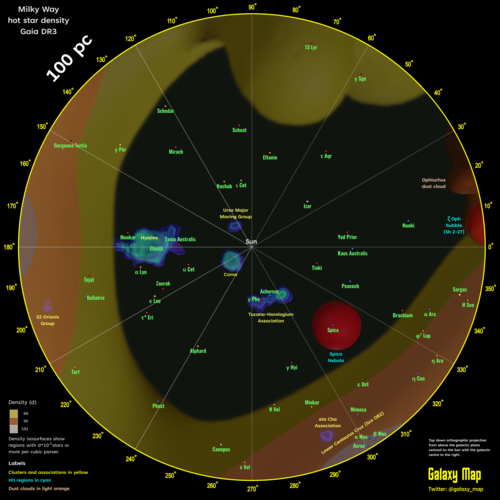
What is the Local Bubble? The Local Bubble is an enormous cavity 1,000 light years across that our solar system is currently traveling through.
We might think that space between the stars and planets is completely empty, but it isn’t. Depending on where it is, most of interstellar space has about 0.3 to 0.5 atoms per cubic centimeter. Those atoms are usually hydrogen, the most common element in the universe. Whatever they are, there are almost always atoms in space. In the local bubble, there are roughly 0.05 atoms per cubic centimeter, which is ten times fewer than usual. Our sun and planets did not form here, but we have drifted into it. We arrived about 5 million years ago, and we will pass through it in roughly another 5 million years. So, what is the local bubble?
The local bubble is a large cavity in space that appears to be expanding. It is roughly 1,000 light years across, but it is not completely round. It is longer than it is wide, which makes sense because it wasn’t created by an equal and symmetrical energy source but by explosions that happened in different places and traveled through regions of space with different densities. It came to the attention of astronomers because of its low density of atoms per cubic centimeter and because no stars appear to have formed here for about 14 million years. All of the stars that are inside the bubble have, like our sun, drifted in. Conversely, a lot of stars were forming on the edge of the bubble. They theorized that all of the matter in the bubble had been pushed out by something. And they thought that the something must have been a supernova. But not just one supernova, 15 of them.
A supernova is caused when a massive star dies and collapses. The star needs to be much more massive than our sun. All stars start by converting hydrogen into helium. This happens because they are huge and their immense gravity pulls matter down towards the center. The process of fusing hydrogen into helium produces massive amounts of energy, which is enough to balance the star’s own gravity. Once all of the hydrogen has gone, smaller stars go through a different process, but larger stars still have a lot of mass, and that pressure converts the helium into heavier and heavier elements. Once the star reaches iron, the process has to stop because the process of converting iron requires more energy than it returns. When the massive star reaches this state, the energy being produced by the star is no longer enough to overcome the star’s gravity, and it collapses. The whole star collapses down to the size of a city in a few seconds, generating an enormous shockwave. This blows apart the outer layers of the star and just leaves a neutron star or a black hole. The explosion is so powerful that it produces more energy in a few seconds than our sun will produce in its entire 10 billion year lifetime. This is called a supernova.
The power of one supernova is incredible, but it is not enough to clear such a large portion of space. Astronomers have looked at the speed with which the local bubble is expanding and its size, and they have theorized that it would have taken 15 supernovae exploding over a period of a few million years to create such a vast cavity in space. How can 15 supernovae have exploded so close together? Stars all go through the same processes, and the amount of time they live for depends on their size. If 15 stars formed out of the same gas cloud at the same time, and they were all pretty much the same size, they would run through their lives in the same amount of time. They would all explode at roughly the same time, creating enough energy to clear a 1,000 light year region of space.
The local bubble is still expanding, and it is pushing a rim of matter with it. This rim has a more concentrated amount of gas and particles than normal space has, so more stars are being created here than elsewhere. There are probably bubbles like this all over the universe. Astronomers think that a process like this could be a factor in where stars are born. And this is what I learned today.
Sources
https://spaceplace.nasa.gov/supernova/en
https://en.wikipedia.org/wiki/Local_Bubble
https://www.livescience.com/earth-trapped-in-local-bubble
Image By Kevin Jardine at galaxymap.org. See the README pdf at File:Map production details, Kevin Jardine (2022) for more details. – Main page: https://gruze.org/posters_dr3/Data sources and blog pages: http://galaxymap.org/drupal/node/265, CC BY 4.0, https://commons.wikimedia.org/w/index.php?curid=139524713