
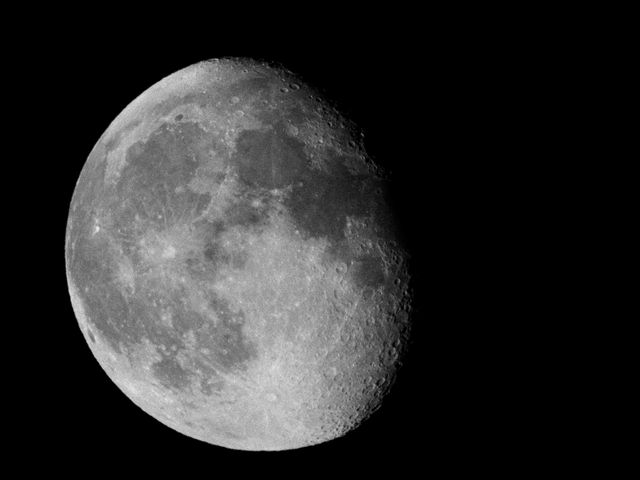
What are the dark patches on the moon? The dark patches on the moon are called lunar mare, and they are large flat plains formed by ancient lava flows. The word mare comes from the Latin word for sea because the mare look like giant seas. A lot of people talk about the man in the moon. Other cultures talk about animals or other characters. They are all seeing the mare, and our brains recognize patterns and turn them into figures.
The mare have been formed by lava. The moon has been struck by many asteroids over the billions of years it has existed. It doesn’t have our atmosphere to deflect or slow them down, and they do an enormous amount of damage. The larger impacts create enormous impact craters. The impacts squash the surface of the moon, making it thinner, and cracks appear in the surface of the moon and lava pools out into the impact craters. The moon still has a partially molten outer core, but most of the interior is solid today. However, it was much more molten in the early days. The lava that spills out is very high in iron, so when it hardens, it has a dark color. The rest of the moon is covered in highly reflective lunar regolith. The lava-filled craters stand out against the bright moon.
16% of the moon is covered in mare, but, interestingly, they are almost all on the side of the moon that faces Earth. If you look at pictures of the far side of the moon, the side we can never see from here, there are almost no dark marks. Nobody knows the actual reason why the mares only form on the side of the moon we can see, but there are several theories. The first, and most widely accepted, theory is that the crust on the near side of the moon is thinner. That would make sense because both sides of the moon are hit by an equal number of asteroids. The crust on this side is between 30 and 40 km, while on the other side it is 50 to 60 km. When huge asteroids hit the moon billions of years ago, they smashed through the crust on the near side, but couldn’t break the crust on the far side. A second theory is that there is a greater concentration of heat-producing radioactive elements, such as uranium, thorium, and potassium, on the near side. How and why this might have happened, scientists don’t know. These heat-producing elements would keep that side of the moon hotter and make more magma that could leak through. The third theory is that the early Earth was still molten and radiated a lot of heat at the moon. The moon was tidally locked to Earth from very early on, so that heat might have kept the one side of the moon more molten. A fourth theory is that there may just simply have been more powerful impacts on the near side of the moon. It might literally just be a coincidence. The real reason could be a combination of all of these theories.
The mare are quite flat, which is why Apollo 11 landed there. The rest of the moon is rugged, but the mare are flat. This is mostly because the lava that came out of the ground and flooded them was a lot thinner and runnier than lava on Earth. Lava on Earth is thick and viscous, but moon lava is made from basalt, which is much thinner. This is because of the amount of silica it contains. Lava on Earth has 70% silica, and the silicon and oxygen atoms link together in long, tangled chains, making it hard for the liquid to flow. Basalt lava has about 45% silica, so they don’t form long chains and the molecules can easily slide past each other. The Moon also has low gravity and no atmosphere, so the lava spread for hundreds of kilometers and settled into a level plane, like water, before it set. Lava on Earth settles in ridges because of how viscous it is.
The mare also tells us something about the Moon’s history. Although the Moon formed about 4.5 billion years ago, most of the maria are much younger. They formed between about 3.1 and 3.8 billion years ago when huge impacts cracked the Moon’s crust, and lava flooded onto the surface. The impacts didn’t create the lava; they simply provided a path for magma that already existed beneath the crust. And this is what I learned today.
Sources
https://en.wikipedia.org/wiki/Lunar_mare
https://www.nhm.ac.uk/discover/how-the-moon-got-its-spots.html
Photo by Brandon Faloona: https://www.pexels.com/photo/close-up-of-moon-in-the-night-sky-19237963/