
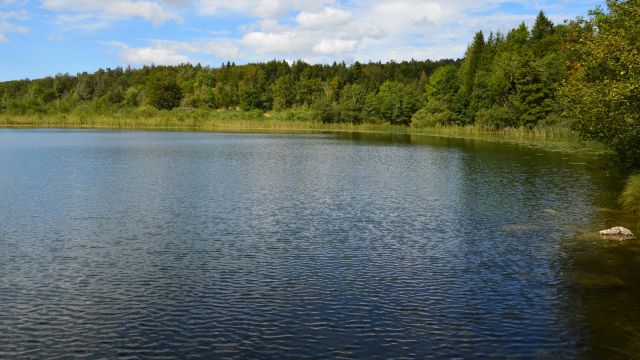
Why do some lakes have no fish? Some lakes have no fish because the environment they are in, or the composition of the water, is too harsh for the fish to survive. A related question is how some completely isolated lakes have fish.
Most lakes contain fish. The few that don’t are usually too inhospitable for fish to survive. Those that do are usually too inhospitable for fish to survive in. Lakes with a very low oxygen content can make it impossible for fish to survive. Just like us, fish need oxygen to survive. They get their oxygen by passing water over their gills. Fish gills have feathery structures called gill filaments that have tiny folds called lamellae. The folds hugely increase the surface area of the lamellae. When water passes over them, there is more dissolved oxygen in the water than there is in the fish’s blood and the oxygen naturally diffuses through the cell walls into the blood vessels. Carbon dioxide moves out of the fish’s blood by the same process. Most fish need at least 5.0 mg/L of oxygen in water to be comfortable. They can survive between 2.0 and 4.0 mg/L, but it can cause severe distress. Under 2 and many fish will die. There are a lot of fish that have adapted to low levels. Northern pike can survive at 0.1 mg/L, but only for a short time. In a lake, oxygen can be depleted by growths of algae. When the algae die, bacteria break them down and consume huge amounts of oxygen. Nitrogen and other runoffs from farms can also deplete oxygen.
Some lakes don’t have fish because of their chemical composition. This can be down to pollution from factories and farms, but it can also be natural. Some water is too salty for fish. The Dead Sea, for example, is so salty that fish would die in minutes. In fact, we can see this happening because some fish are swept from the Jordan River into the Dead Sea and they don’t last long. The extremely salty water causes water to leave the fish’s cells by osmosis, quickly leading to death. There are other chemicals in the Dead Sea as well, magnesium chloride and calcium chloride, that damage fish proteins. Some lakes are too acidic or too alkaline for fish to survive.
Temperature is another factor. Some lakes are heated by geothermal activity, which makes it so hot that it would cook any fish that ended up in there. There are extremophiles that can survive in chemically harsh lakes and boiling lakes, but no fish. Interestingly, though, a lake cannot be too cold for fish. The top of a lake might be covered in ice, but water tends to be densest at 4℃. When a lake freezes, the dense water sinks, staying at 4℃, and the fish can survive in that. They have to have very slow metabolic rates, but they can survive.
Another type of lake without fish are young lakes. Many lakes have never had time to be colonized by fish. That doesn’t mean they won’t be, just that there hasn’t been time for fish to arrive yet.
So, how come there are fish in almost every body of water, including ones that are completely isolated. We might think that fish need a river to get into a lake. There are generally three ways that fish get into isolated bodies of water. The first is that the lake wasn’t always isolated. Many lakes start out being fed by rivers. Fish can get into the lake through the river and thrive. Then, for whatever reason, the rivers dry up and the lake becomes isolated. It may still be fed by rainwater, or the lake itself may dry up over time. The second way fish get into isolated bodies of water is through human intervention. Humans have often released fish into lakes to either eat, to fish, or just for decoration. And the third way fish can get into isolated bodies of water is by being dropped there. A bird may pick up a fish and accidentally drop it in a lake, but that is not the usual method. Fish cannot survive for long out of water, but their eggs can. Fish eggs are surprisingly hardy, and also very sticky. It is very common for fish eggs to become stuck to the legs of a duck, or some other bird that also swims in water. When the duck flies off, it carries the eggs with it. If the duck then settles in another lake, the eggs can drop off and voila, you have an isolated lake that is now populated with fish. Also, a study in 2020 showed that fish eggs can actually survive passing through a duck’s digestive system, which is another way how they can get to a new lake. And this is what I learned today.
Sources
https://www.sciencefocus.com/nature/how-do-fish-end-up-in-isolated-bodies-of-water-like-lakes
https://en.wikipedia.org/wiki/Lake
https://www.moleaer.com/blog/lakes-ponds/future-of-lakes-with-oxygen
Photo by SlimMars 13: https://www.pexels.com/photo/lacs-de-maclu-28248386/