
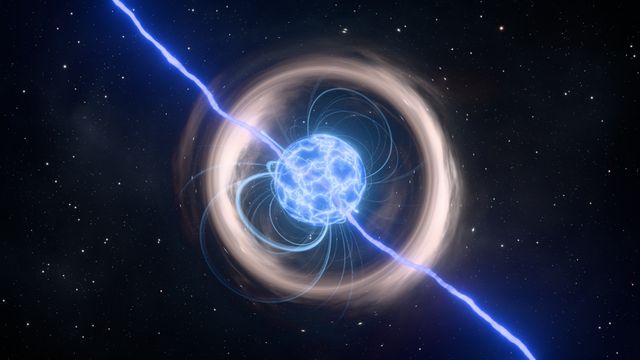
What was the brightest supernova? It depends on what we mean by “brightest”. The brightest supernova that records exist for was SN 1006, which was visible from April 30 to May 1, 1006 (hence its name). The SN stands for supernova. There have been far more massive supernova that we couldn’t see from Earth.
A supernova is an incredibly powerful and bright explosion of a star. Not every star will become a supernova when they die because they need to have enough mass. A star needs to have at least ten times the mass of our sun, but they are usually a lot bigger. There are two main ways that supernova can form. A very large star can collapse in on itself, or a white dwarf star can reignite. The collapse of a large star is the most common way they form.
Stars have an enormous amount of mass and that means the pull of gravity on all of their matter is very great. The only thing that stops a star from collapsing in on itself is the energy that comes from its core, produced by nuclear fusion. Nuclear fusion is possible only because of the gravity. The matter of the star is pulled in so strongly, that the pressure in the center rises until it is high enough to start fusion. If a star is about eight times more massive than our sun, once they convert all of their hydrogen into helium, they convert the helium into heavier elements, and they keep going through a chain of fuels as the core gets hotter and denser. This continues until they reach iron, which is the end of the line. To convert iron into a heavier element would take more energy than it gives off and once that starts to happen, there is no energy to stop the star collapsing. The outer shell reaches speeds of 70,000 km/s as it collapses and this pressure creates a huge increase in both temperature and density. When the core is compressed enough, the star explodes in a supernova. There is so much energy that the outer layers of the star are heated to incandescent temperatures and the heavy elements start to decay glowing brightly. After everything has cooled down, which will take years, a smaller star will become a neutron star, while a larger star will become a black hole.
Another way is when a white dwarf reignites. A white dwarf is a smaller star, about the size of our sun, that has exhausted all of its fuel. The core has become the size of Earth and its outer shell has become a nebula of gas and dust. This is usually the end for a star and it will cool down until all the gas and dust drifts away. Sometimes, another star may be close enough that the white dwarf can pick up gas and debris from it. This increases the mass of the white dwarf, but it doesn’t have enough thermal energy to support the mass, so it collapses, exploding in a supernova.
Whether or not we can see a supernova from Earth depends on how big it is, how much energy the explosion produced, and how far away from us it is. There have been several recorded supernova throughout history. There have been tens of thousands since modern humans arrived, but many of them are not visible without telescopes. There appear to have been seven that were big enough to be recorded. The first of those was seen in 185 AD and recorded by Chinese astronomers. It was said to be visible for eight months. Modern astronomers have found remnants of this supernova and they say it was formed by a collapsing white dwarf 8,000 light years away.
The brightest supernova seen from Earth happened in 1006 AD. The supernova happened 7,200 light years from Earth and the supernova was said to be sixteen times brighter than Venus in the sky. It would have been visible in the daytime as well. The supernova slowly faded, but was visible in daylight for weeks and to the naked eye for 2.5 years. The brightest supernova ever recorded was called SN 2016aps. The supernova happened 3.6 billion light years away from Earth and the star that collapsed was thought to be 100 times more massive than our sun. The light from this supernova would have been 15 times greater than that of SN1006. If it had been at the same distance from Earth, night would have been like day. As it was, being so far away, it was 17.5 billion times less bright, and not visible to the naked eye.
We should be grateful that this supernova was so far away from Earth because supernova release gamma rays that can strip the ozone layer from our planet. In fact, there is a theory that the Late Devonian extinction (372 million years ago) and the Late Ordovician extinction (445 million years ago) were both caused by supernova. The gamma rays striped our ozone layer, and many types of marine life were wiped out by the resultant UV damage. It is interesting but still only a theory. And this is what I learned today.
Sources
https://en.wikipedia.org/wiki/SN_2016aps
https://www.science.org/content/article/brightest-supernova-ever-seen
https://edition.cnn.com/2020/04/13/world/brightest-supernova-sn2016aps-scn/index.html
https://en.wikipedia.org/wiki/SN_1006
https://en.wikipedia.org/wiki/Supernova
https://www.space.com/supernova-caused-earth-mass-extinction-devonian.html
Photo by Nicola Narracci: https://www.pexels.com/photo/dramatic-visualization-of-magnetic-neutron-star-38039464/