
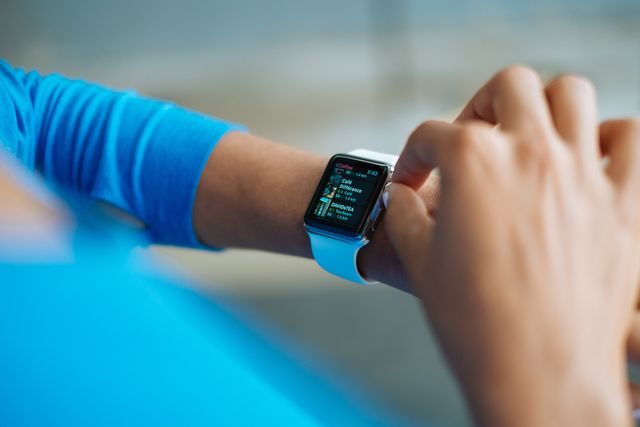
How does a smartwatch measure pulse and blood oxygen levels? A smartwatch measures both pulse and blood oxygen levels by shining different colored lights through your skin and into your blood vessels. These days, smartwatches have more and more functions, and many of those functions are to do with health. Two things they can do are to measure the user’s heart rate and blood oxygen levels. Let’s take a look at how they can do that.
Both heart rate and blood oxygen levels can be detected using light emitted by the watch. Measuring heart rate using light is called photoplethysmography. “Photo” comes from the Greek for light, “plethysmos” is from the Greek for increase, and “graph” is from the Greek for record or write. So, photoplethysmography is Greek for using light to record the increase of something – in this case blood volume. The smartwatch you are wearing cannot detect the expansion and contraction of your heart because it is in the wrong place, but it can detect an increase in the amount of blood in your arteries. Your heart pumps blood out into arteries that head all over the body. Once that blood has been used, it is sent back to the heart along veins. When the heart pumps, it pushes blood along the arteries and there is an increase of the volume of blood and the number of blood cells. Blood cells interestingly absorb green light, so your smartwatch uses a green LED to send green light through the thin skin at your wrist into the artery there and measure how much is reflected back. When there are more blood cells, more green light is absorbed and less reflected back. When there are fewer blood cells, the opposite happens. A detector in the watch measures the amount of reflected light and an algorithm converts it into your heart rate.
Recent smartwatches can also check heart rhythm through electrical activity. They have electrodes on the inside of the watch. When you activate it and place your finger on the crown of the watch, you initiate a simple electrical circuit. The watch can read the electrical signals from the heart through your wrist and your finger. Algorithms can then analyze the patterns to see if there is a problem with your heart.
Oxygen levels are calculated in a similar way. Red blood cells carry hemoglobin, which binds to oxygen and transports it. When hemoglobin is carrying oxygen, it absorbs infrared light and reflects red light. When hemoglobin doesn’t have oxygen, it absorbs red light and reflects infrared light. That is the reason why blood with oxygen is red. The smartwatch emits red light and infrared light, and measures how much comes back. From this, it can work out how much oxygen your blood is carrying.
There are several other ways that smartwatches can measure our health. One of those is through sleep detection. A smartwatch can not only measure how long you were asleep for, but also when and for how long you were in different stages of sleep. It can do this in several ways. One of the ways is simply by tracking movement. The smartwatch has a gyroscope and an accelerometer in it, both of which give information about how much the watch is moving. Just being stationary, or not moving much, for long periods of time doesn’t necessarily mean that the wearer is sleeping. That information is combined with heart rate and blood oxygen levels. When you are asleep, your breathing and heart rate slow down, which means there is less oxygen in the blood. The latest smartwatches can also measure the temperature of your skin using sensors in the back of the watch. These sensors measure skin temperature every few seconds. Your body cools down throughout the night when you are asleep and by different amounts depending on the stage of sleep. These points of data all change during the night, and by monitoring all of this information, the watch can monitor your sleep.
Smartwatches can also combine all of this data to tell if you are sick or stressed. By monitoring your data daily, they will know before you do when something is off and might be able to give you advanced warning. This may be especially important with elderly people. Another thing that they can monitor that might help elderly people is fall detection. The gyroscopes and accelerometers can tell when a watch has moved suddenly in a direction that could indicate a fall. However, there are many normal explanations for such a movement, such as exercise. The watch uses algorithms to analyze the type of movement and any movement that preceded it or came after. From looking at this data it can detect a fall with a high level of certainty. The number of things that our smartwatches are able to detect is constantly growing. And this is what I learned today.
Sources
https://smartwatch-straps.co.uk/blogs/blog/how-does-a-smartwatch-measure-sleep
https://edu.rsc.org/feature/the-science-of-smartwatches/4013008.article
https://my.clevelandclinic.org/health/diagnostics/23429-heart-rate-monitor
https://iopscience.iop.org/article/10.1088/0967-3334/28/3/R01
https://en.wikipedia.org/wiki/Photoplethysmogram
Photo by Pixabay: https://www.pexels.com/photo/person-in-blue-long-sleeve-shirt-using-smart-watch-267391/