
Who invented algebra? Algebra was invented by many people over many years, but Muhammad ibn Musa al-Khwarizmi is known as the “father of algebra” and it is from his seminal work that we get the word “algebra”. The word algorithm also comes from the Latin version of his name “Algorismus”.
Algebra is a branch of mathematics that uses symbols to represent unknown quantities and equations to solve problems when not all of the information is known. We commonly use the letter “x” to replace the unknown quantity, but that was only really begun by Rene Descrtes in 1637. He decided to use letters at the end of the alphabet for unknown quantities and letters at the start of the alphabet for known quantities. He probably didn’t come up with the concept, but he certainly popularized it. Yet, algebra came about a long long time before Descartes.
Algebra developed in many ancient civilizations at different times. Babylonia, Egypt, Greece, and India all used algebra and there is written evidence of algebraic equations in Egypt from before 1650 BC. It makes sense that algebra would have existed for a long time because it is one of the most useful forms of mathematics. Once you have simple addition, subtraction, multiplication, and division, you are going to want to try to work out unknown values. It is the next step. If you know that 2 + 3 = 5, then there are going to be situations where you need to work out what you need to add to 2 to get 5. 2 + ? = 5. That is very basic algebra. Then, as mathematics becomes more complex, algebra is going to become more complex as well.
The mathematical knowledge that the Babylonians and Egyptians developed was taken up by the Greeks and built upon. Pythagorus’s theorem is one of the most famous algebraic equations that we all learn at school. Greek mathematics was adopted by the Roman Empire, but they used it for far more practical purposes, such as building, and there were fewer pure mathematical advances during their time. The next major civilization to further mathematics was India. They came up with the system of numbers we use today, the decimal place, and the concept of zero, among many other things. From there, the next civilization to rise up and take the mathematical baton was the Arabic world. The Golden Age of Arabic mathematics was between the 8th and 14th centuries AD. Scholars were encouraged to study math and they worked to translate Greek, Indian, and Babylonian math. There was a library called the House of Wisdom in Baghdad that scholars were free to use. Many of the things discovered during this time heavily influenced mathematics in Europe and were vital for many inventions that came about, such as telescopes.
In 780 AD Muhammad ibn Musa al-Khwarizmi was born. Not much is known about his life, but he did end up studying at the House of Wisdom. There is a legend that he started off as a translator, translating from Greek and Hindi into Arabic, and ended up as the director of the House of Wisdom. While he was there, he wrote several books. One of them, written in 825, was called “On the Calculation with Hindu Numerals”. This is the book that pushed for the use of the Hindi numbering system and is the reason why we write 1, 2, 3 and so on today. These numbers are Indian, even though we call them Arabic numerals.
His second book, was called, “The Compendious Book on Calculation by Completion and Balancing”. In Arabic that is, “al-Kitāb al-mukhtaṣar fī ḥisāb al-jabr wal-muqābala”. It was translated into Latin as, “Liber algebrae et almucabala.” It was an attempt to organize and explain a lot of the equations that existed at the time in different places. He didn’t use the symbols we would recognize today, but he wrote out all of the problems and equations using words. He explained how to reduce equations to simpler terms, such as 3x+5x becomes 8x. He explained how to restore equations, which is when you restore terms from one side of an equation to the other to balance it out. For example, you add 1 to both sides of x-1=3 to get X=4. In Arabic, “al-jabr” means restoration. The Latin translation of that was “algebrae”, and that is where our word algebra comes from. A lot of the methods that he wrote about in his book are still used today. His contributions to the world of mathematics and everything our modern civilization are based on were enormous. And this is what I learned today.
Sources
https://www.bbc.com/future/article/20201204-lost-islamic-library-maths
https://en.wikipedia.org/wiki/Al-Khwarizmi
https://en.wikipedia.org/wiki/Algebra
https://en.wikipedia.org/wiki/Al-Jabr
https://www.lowellmilkencenter.org/programs/projects/view/muhammad-ibn-musa-al-khwarizmi/hero
https://www.mathtutordvd.com/public/Who-Invented-Algebra.cfm
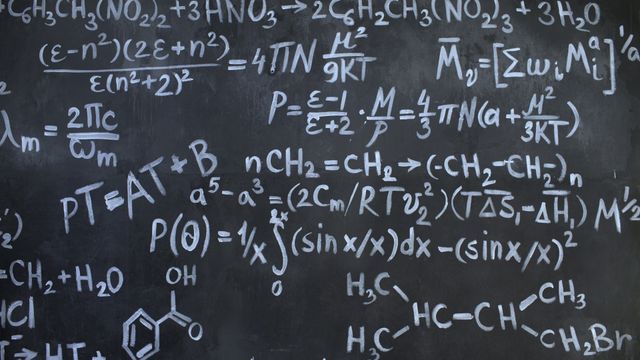
Photo by Vitaly Gariev: https://www.pexels.com/photo/close-up-of-complicated-equations-written-on-a-blackboard-22690750/