
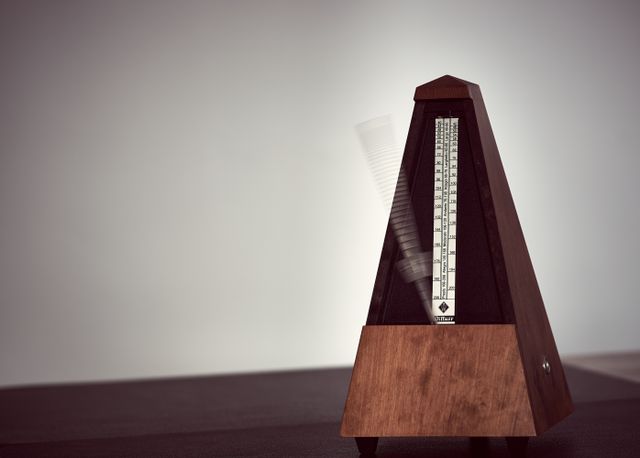
Why don’t metronomes slow down? Mechanical metronomes do slow down eventually, but not in the same way that a normal swinging pendulum does. A simple pendulum loses energy with every swing because of friction and air resistance. A metronome has a wound spring inside it that keeps adding a little energy back into the movement, so the beat stays almost steady until the spring runs down.
The word metronome comes from the Greek metron, which means measure, and nomos, which means law. The first metronome that we would recognize today was invented in 1814 by Dietrich Nikolaus Winkel. Johann Maelzel then (allegedly) stole Winkel’s idea, added a numerical scale to it, came up with the name, and patented it in 1815. That is why Maelzel’s name became attached to the device, even though Winkel seems to have been the real inventor. The invention of the metronome changed music because composers could write down the speed at which they wanted a piece to be played. Before the metronome, composers could write words such as allegro, andante, or adagio, but those words were not exact. Different musicians and different orchestras might play the same piece at very different speeds.
Maelzel rather originally called his device Maelzel’s Metronome and engraved M.M. on many of them. The tempo a piece of music is meant to be played at is often written as M.M. followed by a number, such as M.M. 120. The M.M. stands for Maelzel’s Metronome, and the number tells the musician how many beats there should be in one minute.
Beethoven knew Maelzel and was very interested in the metronome. He was one of the first major composers to put metronome markings on his music because he wanted people to play it at the speed he imagined. There is also a little canon called “Ta ta ta, lieber Maelzel” that was long attributed to Beethoven, but modern scholars are not completely sure that he actually wrote it. On the other hand, some composers, such as Brahams, were against metronomes, or at least against relying on them too much. They thought that having music played at one fixed speed could make it too mechanical or cold. They wanted the feeling and emotion that came from the musician. They felt that music was alive, constantly evolving, and should be able to breathe.
These days, you can get digital metronomes that work on devices like a smartwatch or a phone. Smartwatch metronomes can vibrate silently while you play. You can also get electronic metronomes that use quartz timing, and you can still buy mechanical metronomes. Digital and electronic metronomes don’t slow down because they work from very accurate electronic timing systems that are powered by electricity. The only reason they would lose time is if their power source ran out, or if they were broken. Mechanical metronomes are a little different.
A mechanical metronome has several parts. The first is the wooden or plastic case that holds all of the mechanism. Then it has an inverted pendulum. This is the part of the metronome that ticks from side to side. The bar on the pendulum has a sliding block on it that can be adjusted upward or downward. The measurements in beats per minute are usually stamped on this bar. A pendulum’s speed depends on the position of its weight. When the block is higher, the pendulum swings more slowly. When the block is lower, the pendulum swings more quickly. That is why the numbers are arranged with slower tempos at the top and faster tempos at the bottom.
So, how does the metronome move from side to side, and why doesn’t it slow down? The answer is the escapement. This is the same general idea used in mechanical clocks and watches. Inside the metronome is a spring, a small train of gears, and an escapement mechanism. The metronome has a winding key, and when you turn the key, you tighten the spring. This transfers energy from your hand into the spring. Without the escapement system, the spring would release all of that stored energy very quickly. The gears would spin, the spring would unwind, and the metronome would be useless.
The escapement prevents that from happening. It holds the spring back and lets it release its energy in tiny controlled bursts. Each time the pendulum swings, the escapement gives it a small push. That push replaces the energy the pendulum loses to friction and air resistance. The pendulum then controls when the next push happens. In other words, the spring powers the metronome, but the pendulum regulates it. This is why the metronome does not gradually slow down with every swing in the way a free pendulum would. It keeps being topped up by the spring.
The clicking sound comes from this controlled release of energy. As the pendulum swings from one side to the other, the escapement catches and releases part of the mechanism, making the familiar tick-tock sound. Sliding the block up and down the pendulum changes how quickly this catch-and-release cycle happens. A higher block gives slower beats per minute. A lower block gives faster beats per minute. The metronome will keep time for as long as the spring has energy, just like a mechanical watch will keep time until it needs winding. And this is what I learned today.
Sources
https://en.blog.newzik.com/blog/tout-savoir-sur-le-metronome
https://electronics.howstuffworks.com/gadgets/audio-music/metronome.htm
https://en.wikipedia.org/wiki/Metronome
https://en.wikipedia.org/wiki/Johann_Nepomuk_Maelzel
https://en.wikipedia.org/wiki/Escapement
Photo by Florian G: https://www.pexels.com/photo/close-up-of-a-moving-metronome-7220729/