
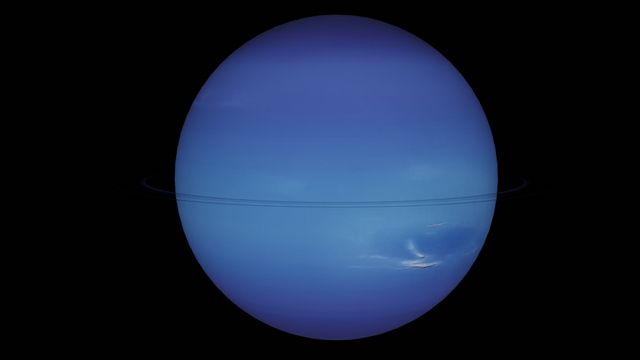
How did we discover Neptune? Neptune is the only planet in the Solar System whose existence was predicted by mathematics before it was observed.
Neptune is the furthest planet in our solar system. It has about 17 times the mass of the Earth and is a gas giant. There is a lot of methane in its atmosphere, which is what makes it blue. It is 4.5 billion kilometers from the sun and it takes 164.8 years to make one complete orbit.
Neptune was the last of all the planets to be discovered. That is, if we don’t count Pluto, which was discovered in 1930 and lost its planetary status in 2006. Mercury, Venus, Mars, Saturn, and Jupiter were discovered thousands of years ago because they are all visible with the naked eye. Venus is the brightest of all the planets and the brightest object in the sky after the sun and moon. Jupiter is the next brightest because its enormous size and composition reflects a lot of sunlight. Ancient people maybe didn’t know that these were planets, but they knew they were different from the other stars because they slowly moved against the background stars over weeks and months.
Uranus was discovered in 1781 by William Herschel. He was doing a survey of the night sky, and he noticed that one point of light was moving more than a star should. He realized that it was actually orbiting the sun and he initially thought it was a comet. Other astronomers heard about his discovery and thought that it was most likely an as yet undiscovered planet and in 1783 Herschel redesignated it as a planet. Uranus had been known about for a couple of thousand years, but people thought it was a star. It is so far away from the sun that it is extremely dim. It is technically visible with the naked eye, but you need pitch black skies, zero light pollution, and no clouds. Even then, it is difficult to see.
Nobody knew whether Uranus was the outermost planet in our solar system, but an eighth planet couldn’t be found. Many astronomers spent a lot of time studying the newly found seventh planet. It takes Uranus roughly 84 years to complete an orbit of the sun and several astronomers noticed some irregularities with the orbit. Using Newton’s laws of motion and gravity, astronomers could calculate what orbit Uranus would take, but when they observed it, they noticed irregularities. There were two thoughts. Either Newton’s laws were incomplete, or Uranus was being pulled by another, unseen planet.
Two astronomers- a French astronomer, Urbain Jean-Joseph Le Verrier, and a British astronomer, John Couch Adams believed that the reason for Uranus’ irregular orbit was the presence of an eighth planet. Independently, they decided to try to calculate where that planet might be. The calculations were complex because they didn’t have any information for the mass of Neptune or its distance from Uranus. The only information they had was about the orbit of Uranus. To complete the calculations, they estimated the new planet’s mass, distance, and orbit, then repeatedly adjusted those values until the calculated motion of Uranus matched its observed motion. If it didn’t fit the actual orbit, they moved the point of the hypothetical planet and calculated again. A modern computer could probably do this in minutes. They only had paper and pen, so it took a very long time. It took several years.
In September of 1846, Le Verrier had worked out where the planet could be found. He tried to get French astronomers interested, but no one was. In frustration, he sent his findings to a German astronomer, Johann Galle, at the Berlin Observatory. Galle received the letter on the 23rd of September, and he started searching that night. After an hour of searching, and just after midnight, he found Neptune. It was only 1 degree away from the position that Le Verrier had calculated. The 8th planet had been discovered.
Le Verrier wanted to name the planet after himself. Naming it was his right as its discoverer, but all of the other planets were named after Roman gods. They had other names in other languages, but the Romans associated the planets with their own gods, and those are the names that carried on. Having 6 planets named after gods and the last one called Leverrier seemed odd, so it was unanimously decided to call it Neptune. Le Verrier didn’t like that.
The discovery of Neptune was one of the greatest triumphs of Newton’s theory of gravity. A planet had been found not by looking through a telescope, but by solving equations on paper. And this is what I learned today.
Sources
https://en.wikipedia.org/wiki/Discovery_of_Neptune
https://en.wikipedia.org/wiki/Timeline_of_discovery_of_Solar_System_planets_and_their_moons
https://airandspace.si.edu/stories/editorial/planets-our-solar-system-timeline
Photo by Zelch Csaba: https://www.pexels.com/photo/neptune-on-a-black-background-20376388/