
How does a car differential work? A car differential works by turning the rotation of the driveshaft through 90 degrees to rotate the wheels. It has to solve several problems.
The car differential was invented to solve three problems that cars have. The first is the direction of power. The second is that the wheels rotate at different speeds. The third is that the driveshaft spins too quickly.
Let’s look at the first problem. Cars followed on from horses and carts, which don’t have the problem of needing to change the direction of power. A horse pulls the cart forwards and the four wheels on the axle rotate in the same direction as the power. A car is different. When you start the engine, air and gasoline are burned in the cylinders to force the pistons up and down. This up and down motion is used to rotate the crankshaft. The crankshaft connects to a flywheel, which stores rotational energy and makes the motion of the pistons in the engine smoother. This keeps the engine running when it is idling. After the flywheel is the clutch, which is between the flywheel and the transmission. It disconnects the engine when you change gears, so you don’t have to constantly stop the engine when you want to go up a gear. After the transmission is the driveshaft, which carries the rotational energy down the car. The problem is that the driveshaft is rotating across the car and the wheels need to rotate in the direction of the car.
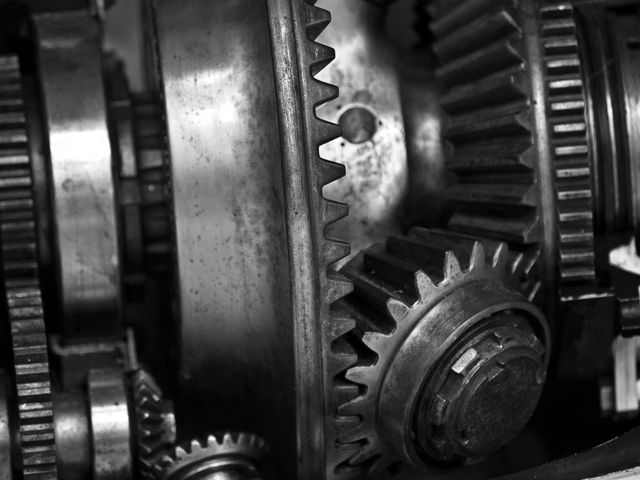
The driveshaft connects to the differential, which is a series of cogs. A cog at the end of the driveshaft connects to big cogs at right angles to it. These larger cogs are connected to the axle on each side that the wheels are on. The horizontal motion of the driveshaft is transferred through the cogs to become the vertical rotation needed for the wheels.
Let’s look at the second problem. You have a car with four wheels, but when you turn a corner, the four wheels have to rotate at different speeds. The wheel on the outside of the corner has to travel further than the wheel on the inside and must therefore rotate faster. If you didn’t have a differential, the wheels would be locked together and when you turned a corner the outside wheel would skid and scrape along the road because the side of the car would be moving faster than the wheel. This was a very clever part of the invention.
The cogs connected to the axles are next to smaller cogs called spider cogs. These spider cogs are connected to the differential casing. When the car is going straight, they are carried around by the casing but don’t rotate on their own axes because both wheels are turning at the same speed. When the car turns, the road forces the inside and outside wheels to rotate at different speeds. This causes the spider cogs to rotate on their own axes as well. Their rotation allows one side gear to slow down by the same amount that the other speeds up. This lets both wheels travel at the speed they need while still receiving power from the engine.
The third problem is the speed at which the driveshaft rotates. It is rotating far too quickly for the power to be transferred directly to the wheels. The large ring gear turns more slowly than the smaller pinion gear driving it. This reduces the rotational speed reaching the wheels but increases the torque. This is called the final-drive ratio.
The differential was invented to solve all these problems, but it does bring a problem of its own. Because of all the extra cogs, gears, bearings, and thick lubricating oil, a lot of energy gets lost as heat and that reduces efficiency. This reduction can be anything from 10% to 20% depending on the type of car. Still, combustion engine cars couldn’t run without them. Another problem is that this ability to let the wheels turn independently also creates a disadvantage. If one wheel is on ice, an ordinary open differential can allow that wheel to spin while the other wheel receives too little torque to move the car. Limited-slip and locking differentials were developed to overcome this problem.
Differentials weren’t invented for the car and they weren’t invented by one person. Nobody really knows when the first differential was invented. In modern times, they were improved through the age of steam engines by several people. The first person to put a differential in a motorized vehicle was Karl Benz in 1885. He used it in his Patent-Motorwagen. And this is what I learned today.
Sources
https://auto.howstuffworks.com/differential1.htm
https://en.wikipedia.org/wiki/Differential_(mechanical_device)
https://autofusionrepairs.co.uk/learn/how-does-an-engine-actually-move-a-car-wheels-in-an-engine
https://autofusionrepairs.co.uk/learn/how-does-an-engine-actually-move-a-car-wheels-in-an-engine