
How did we discover DNA? DNA was first discovered in 1869, but it wasn’t identified as the substance carrying hereditary information until 1944, and its structure wasn’t discovered until 1953.
DNA stands for deoxyribonucleic acid. Broken down, “deoxyribo” refers to the sugar part of the DNA, “nucleic” means it is found within the nucleus of the cells, and “acid” means it is a weak acid. DNA is often called the instruction manual for life because it contains the genetic code that is necessary for everything that we do. DNA is hereditary, which means it is passed down from the parents, and we all carry part of our mother’s DNA and part of our father’s DNA, which makes our own unique DNA. If we have children, they will carry half of our DNA.
DNA is found in the nucleus of almost every cell in our body, and when the cells replicate, they read the information in the DNA. It is made up of two intertwined strands that are linked together by pairs of compounds made from nitrogen. These are called bases, and they are divided into adenine (A), cytosine (C), guanine (G), and thymine (T). Each strand has bases attached to it that point inwards towards the other strand. The bases on opposite strands pair together, but they can only make certain pairs. As always pair with Ts, and Cs always pair with Gs. The order of the bases contains genetic information, including instructions for making proteins.
The first person to discover DNA was a Swiss physician and biologist called Johannes Friedrich Miescher, but he didn’t know what he had found. Miescher was interested in white blood cells, and he wanted to isolate and describe the protein components of the white blood cells. To do this, he needed a supply of white blood cells, so he approached his local hospital. They supplied him with bandages that had pus on them. Pus contains enormous numbers of white blood cells, so it was perfect for Miescher. He planned to wash the bandages to get out the white blood cells, and then he could extract the proteins. What he ended up extracting completely surprised him. He found a substance that had a much higher phosphorus content than regular proteins, and it was very resistant to being digested. He didn’t know what it was, but he knew that it was a new substance. He called it nuclein because it came from the nucleus. This was in 1869.
Over the next fifty or so years, more work was done on the nuclein. Scientists established that nuclein was an acidic substance, leading eventually to the name nucleic acid. Phoebus Levene worked out that it was made of phosphate, sugar, and a nitrogenous base. But still nobody knew what it was for. Then a scientist called Frederick Griffith made a great discovery. He had two types of bacteria, one lethal to the mice and the other harmless. When he killed the dangerous bacteria and injected them into mice, nothing happened. However, when he injected the dead dangerous bacteria with live harmless bacteria into the mice, the mice died, and he was left with live dangerous bacteria. Something from the dead bacteria had entered and transformed the living bacteria.
A group of scientists called Avery, MacLeod, and McCarty worked out what was doing the transforming in 1944. They repeated Griffith’s experiment, but they kept removing different bits of the cells until the dangerous bacteria stopped transforming the harmless bacteria. They removed everything, and it still worked, until they removed the DNA (nuclein), and then it stopped working. They had discovered that DNA carries hereditary information.
In 1950, Erwin Chargaff made another important discovery. He measured the amounts of the four bases in DNA and found that the amount of adenine was always roughly equal to the amount of thymine, while the amount of cytosine was roughly equal to the amount of guanine. He didn’t know why, but this would become an important clue to the structure of DNA. Other scientists worked out that the DNA carried genetic instructions to create new cells.
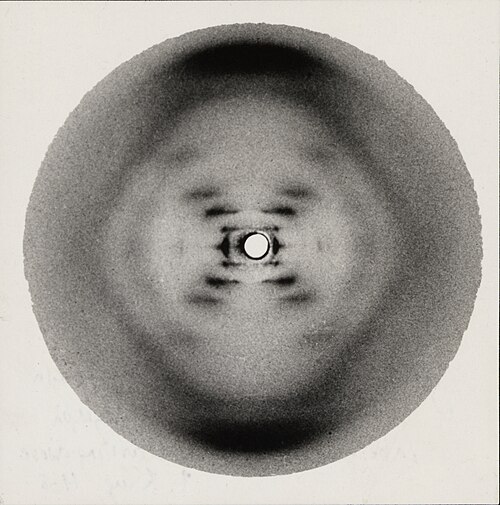
At King’s College London, Rosalind Franklin and Raymond Gosling used X-ray diffraction to study DNA. In 1952, they produced the famous Photo 51. It wasn’t a photograph of the DNA molecule itself, but the pattern produced by X-rays passing through DNA fibres provided crucial information about its shape and dimensions and strongly indicated that it had a helical structure.
Finally, in 1953, James Watson and Francis Crick put together the information that had been discovered by all of these scientists and built a model of DNA. They realized that it consisted of two strands twisted into a double helix, with the bases pointing inwards. Adenine paired with thymine and cytosine paired with guanine, explaining Chargaff’s mysterious ratios. Even more importantly, the structure suggested how DNA could copy itself. If the two strands separated, each one could act as a template for building its partner. They had finally discovered the structure of DNA. And this is what I learned today.
Sources
https://www.jax.org/news-and-insights/minute-to-understanding/what-is-dna
https://www.nature.com/scitable/topicpage/discovery-of-dna-structure-and-function-watson-397
https://www.yourgenome.org/theme/the-discovery-of-dna-the-first-building-blocks
https://www.bbc.co.uk/bitesize/articles/z4pd382
https://en.wikipedia.org/wiki/DNA
https://en.wikipedia.org/wiki/Friedrich_Miescher
Image By Raymond Gosling – King’s College London Archives: KDBP1/1/867. Taken from “The double helix: “Photo 51” revisited” by Thoru Pederson (https://doi.org/10.1096/fj.202000119), Public Domain, https://en.wikipedia.org/w/index.php?curid=38068629