
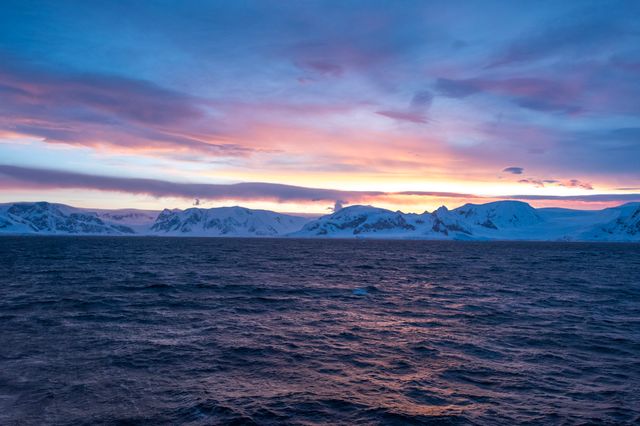
How did people discover Antarctica? Antarctica was first discovered by a Russian naval officer called Fabian von Bellingshausen in 1820. However, it is possible that Polynesian sailors reached Antarctica over 1,000 years before.
It took a long time to discover the Antarctic because it is extremely difficult to get to. The Arctic was discovered thousands of years earlier. “Discovered” is probably the wrong word to use with the Arctic because nobody really discovered it. It is connected to the tops of North America, Greenland, and Siberia. Indigenous people slowly moved north and settled it over two thousand years ago.
The Antarctic is a lot more difficult to get to. It is separated from the closest land by a lot of sea. The Southern Ocean separates it from Cape Horn, the southernmost tip of South America. The crossing is about 900 km. You can get there from the southernmost tip of Tasmania and New Zealand as well, but it is a lot further. 900 km is a long distance to sail if you don’t know there will be any land for you to step onto. The weather conditions in the Southern Ocean are also terrible. The winds are incredibly strong and the waves high. It was very easy to become shipwrecked. There is also thick pack ice and enormous icebergs floating in the Southern Ocean. They can easily destroy a ship. And there is often a thick fog so the icebergs are difficult to spot. Couple that with the fact that there is no where to stop and replenish supplies, and you have a very difficult to reach place.
People suspected that there was more land in the southern hemisphere. Only having all of the land in the northern hemisphere was possible, but it seemed unlikely. They theorized that there were whole undiscovered contents down there that would balance the planet. They called it Terra Australis Incognita. Terra means land, Australis means south, and Incognita means unknown. There were different theories as to where it could be and what it could look like. Some theories had it in the expanse of ocean below Africa, and some theories had it attached to the bottom of South America. Nobody had reached the end of that continent.
Magellan was the first person to sail round the end of South America in 1520, and he sailed through the strait that is now named after him. He showed that there was more land below where he reached. That is what we know today as Tierra del Fuego. Magellan thought it could be the start of the undiscovered continent. Then Willem Schouten and Jacob Le Maire rounded Cape Horn in 1616 and proved that Tierra del Fuego was an island and there was no land attached to the bottom of South America. Then a sailor called Anthony de la Roche was blown off course while rounded Cape Horn in 1675 and he ended up on the island of South Georgia, proving that there was more land. This encouraged people to try and sailors started trying to find the southern continent. They found new islands, but no one found the lost continent.
Then, when Australia was discovered by Captain James Cook the late 18th century. Things seemed settled, but people always thought that there might be more. Captain Cook reached the 71st parallel, which is well within the Antarctic circle, but he had to turn back because of pack ice. He discovered the South Sandwich Islands and he showed that if there was land, it was much further and smaller than people thought.
In 1819, William Smith was blown off course around Cape Horn and headed south. He landed on lands that he called the South Shetland Islands. He didn’t know it, but he was only about 120 km from Antarctica. The islands were rich with seals, and he came back with a hunting party. Within four years they had wiped out the seal population of that area. Finally, in 1820, a Russian naval officer called Fabian von Bellingshausen reached an enormous ice-covered land. He thought it was sea ice, but he had sighted the continent of Antarctica. However, he wrote a report saying that the unknown southern continent probably didn’t exist. Just two days later, on January 30, 1820, British naval officer Edward Bransfield saw mountains on the Antarctic Peninsula and charted part of the Antarctic mainland. An American sealer called Nathaniel Palmer also saw Antarctica later that year. Because the three discoveries happened independently within such a short period, exactly who should be called the discoverer of Antarctica is still debated.
There is also a legend that a Polynesian navigator called Hui Te Rangiora reached Antarctica. This idea came about because an ethnologist translated their oral stories and interpreted part of them as referring to snow and ice. From this, the idea that they reached Antarctica arose. However, it is likely that his translation was wrong and he may even have simply misunderstood the story. It is unlikely that they reached Antarctica. Their boats and clothing were not designed for the brutal conditions of the Southern Ocean, and there is no archaeological evidence that they travelled that far south. That being said, there is evidence that Polynesian sailors did settle on Enderby Island in the Auckland Islands. This is 465 km south of New Zealand. They were certainly masters of sailing and navigation, but Antarctica is a long way south from there, through semi frozen seas, and incredibly strong winds. And this is what I learned today.
Sources
https://www.rmg.co.uk/stories/maritime-history/history-antarctic-explorers