
Alfred Wegener realized that all of the continents had once been joined together, but he could not explain how they could move. It took the mapping of the ocean floor during and after World War 2, followed by the discovery of strange magnetic patterns in the seabed, for scientists to finally work out what was happening.
Today, we learn at school how plate tectonics work. The surface of the Earth is divided into different-sized plates that slowly move over the softer mantle beneath them. The plates move extremely slowly, usually only a few centimeters a year, but over millions of years that movement completely changes the surface of the Earth. Where plates collide, mountains can be pushed up or one plate can be forced beneath another. Elsewhere, plates move apart and new crust is created between them. This movement is slowly pushing the continents apart or towards each other. In another few hundred million years, the continents will probably squash together again to form another supercontinent, before eventually being ripped apart and remaking the globe all over again.
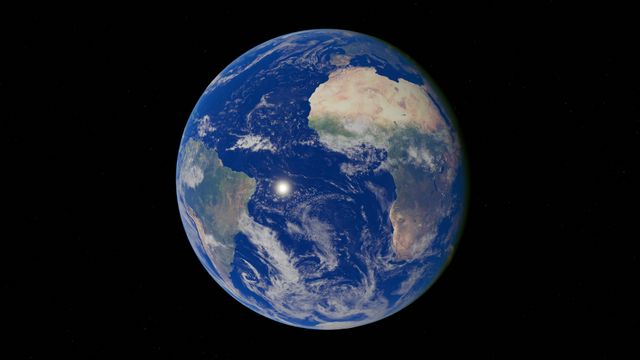
If you look at any image of the globe now, it is easy to see how some of the continents could fit together. They look like jigsaw pieces that are slowly being moved apart. We have only really had photographs of the whole Earth since the second half of the twentieth century, but accurate maps of the world existed long before that. A German meteorologist and geophysicist called Alfred Wegener looked at maps in the early twentieth century and was struck by how well the continents seemed to fit together. South America closely matched Africa and it was possible to imagine Europe and North America fitting together as well. This led him to believe that the continents were moving, and he presented his theory of continental drift in 1912.
Wegener went further than just looking at maps. He compared rocks and fossils found on opposite sides of the Atlantic and found similarities that were too great to be coincidence. The same types of fossils could be found on continents separated by thousands of kilometers of ocean. Mountain ranges and rock formations on one continent also seemed to continue on another. Wegener concluded that the continents had once been joined together in a giant supercontinent that he called Pangaea.
The problem was that Wegener knew the continents were moving, but he didn’t know how. He suggested several possible forces, including the centrifugal force caused by the Earth’s rotation, but none of them was powerful enough to move continents. He also imagined the continents somehow plowing through the ocean floor. Most geologists rejected his theory, largely because he couldn’t explain what force could possibly move entire continents through solid rock. Wegener died in 1930 with his theory still largely rejected.
However, another scientist had an idea. A British geologist called Arthur Holmes suggested that slow convection inside the Earth’s mantle might be capable of moving the continents. Hot material could rise from deeper inside the Earth, cool, and eventually sink again, creating enormous, incredibly slow currents. Holmes couldn’t prove that this was happening, though, and Wegener’s continental drift remained unpopular.
Things started to change during and after World War 2. Sonar and other technologies used to navigate and hunt submarines helped scientists map the ocean floor in far greater detail than ever before. What they found was surprising. The bottom of the ocean wasn’t a huge flat plain. There were enormous mountain ridges running through the world’s oceans and vast trenches disappearing deep into the Earth.
In the late 1950s and early 1960s, an American geologist called Harry Hess used this new information to come up with an explanation. He proposed that magma was rising from the mantle at the enormous mid-ocean ridges. It cooled and became new ocean floor, which then slowly moved away from the ridge in both directions. Eventually, old ocean floor reached deep ocean trenches and sank back into the mantle. The continents weren’t plowing through the ocean floor as Wegener had imagined. The ocean floor itself was moving.
It was a wonderful idea, but scientists still needed evidence that the seafloor really was spreading. That evidence came from something very strange that had been discovered on the ocean floor.
The newly formed oceanic crust is mostly basalt. Basalt contains magnetic minerals such as magnetite. When molten rock cools, these minerals become magnetized in the direction of the Earth’s magnetic field, and that direction becomes locked into the rock. However, the Earth’s magnetic field has reversed many times during its history. Magnetic north has sometimes been magnetic south, and then it has switched back again.
When scientists measured the magnetic properties of the ocean floor, they discovered long stripes where the magnetic polarity alternated. But the really important discovery was that the same pattern of stripes appeared on both sides of the mid-ocean ridges, like a mirror image. This was exactly what you would expect if new rock was forming at the ridge and then moving outwards in both directions. Each time the Earth’s magnetic field reversed, the new rock recorded the new direction and another stripe was created. In 1963, British scientists Frederick Vine and Drummond Matthews explained the pattern as evidence for seafloor spreading. Canadian scientist Lawrence Morley had independently reached the same conclusion.
Suddenly, Wegener’s strange idea from half a century earlier made sense. The continents really were moving, but they weren’t moving by themselves. They were parts of much larger plates that included both continental and oceanic crust. New oceanic crust was being created at some plate boundaries while old crust was disappearing back into the mantle at others. By the late 1960s, these discoveries had come together into the modern theory of plate tectonics. It explained not only why the continents move, but also why earthquakes, volcanoes, mountain ranges, ocean ridges, and deep trenches appear where they do. Wegener had been right that the continents were moving. He just never lived long enough to discover how. And this is what I learned today.
Sources
https://www.bbc.com/news/science-environment-41472281
https://en.wikipedia.org/wiki/Plate_tectonics
Photo by Zelch Csaba: https://www.pexels.com/photo/earth-from-space-stunning-view-of-our-planet-30596215/